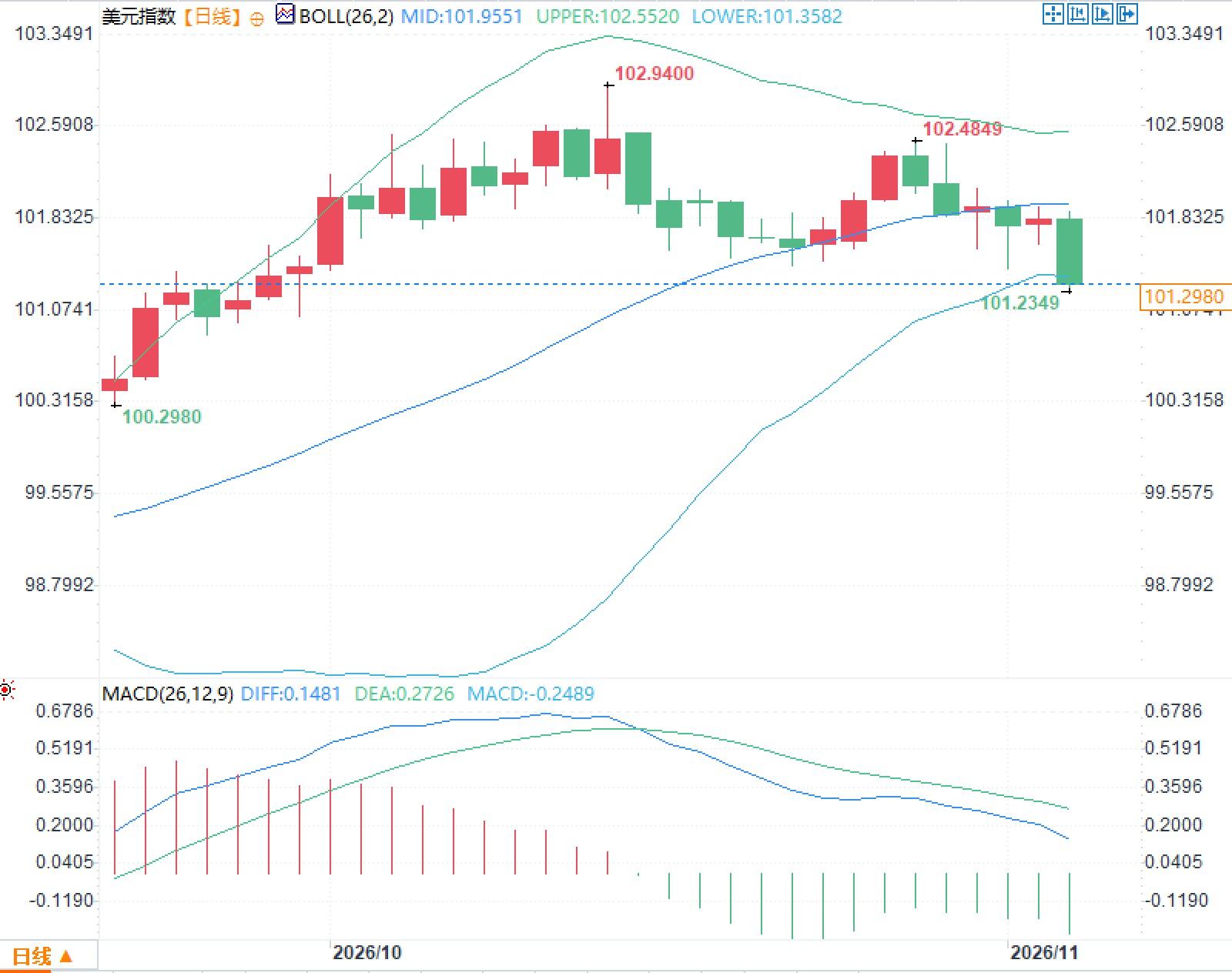
The US dollar index is fluctuating around 101.3. How are the weights of political factors and policy paths changing?
2026-11-04 20:56:27
On Wednesday, November 4th, the US midterm election results confirmed that the Democrats had gained control of both the House of Representatives and the Senate, causing the dollar index to fall to a low of around 101.25. The Federal Reserve maintained the target range for the federal funds rate at 3.75% to 4% on October 28th, and the committee's statement on the pace of economic expansion remained neutral, indicating that inflationary pressures remained at a high level. 
The impact of the US midterm election results on the US dollar
The news of the Democrats gaining full control of both houses of Congress triggered initial concerns about policy continuity, putting pressure on the dollar index and short-term interest rates. ING analyst Chris Turner pointed out that the election results' impact on the dollar is more of a short-term sentiment-driven phenomenon, with investors subsequently turning their attention back to economic growth data and the Federal Reserve's policy stance. Since the new Congress won't officially take office until January, the current policy framework remains largely unchanged, and this time lag has prompted some position adjustments. Turner also noted that the US president's acceptance of the election results removed some downside risk expectations, and overnight price action may provide a reference for the market in 2027. From a relative value perspective, the dollar's pricing against the euro, yen, and Swiss franc is driven more by interest rate differential expectations than by a single political narrative.Changes in AI capital expenditure expectations and market sentiment fluctuations
Given AI's role in driving economic growth, the market was initially concerned that the new US Congress might influence related capital expenditure plans. Some Asian markets with a strong chip export focus saw a 3% to 4% drop overnight, but subsequently recovered all losses. This volatility reflects investors' sensitivity to changes in the regulatory environment, but actual policy adjustments still require confirmation through a complete legislative process. Current trading logic is more focused on corporate capital expenditure data and earnings reports than on purely political expectations. Analysts believe that the sustainability of AI-related investments depends more on corporate cash flow and the pace of technological iteration; the transmission of political factors has a significant time lag.Federal Reserve Policy Stance and Short-Term Interest Rate Watch
The Federal Reserve voted 10-2 at its October meeting to keep interest rates unchanged, with two members voting against a rate hike. The committee described economic activity as maintaining a strong pace of expansion, while noting that inflation remained high and emphasizing the need to gather more information to confirm the next policy stance. Market pricing of the dollar is primarily driven by macroeconomic and monetary policy factors, with elections having limited weight. Turner stressed that it is not advisable to simply chase short-term dollar fluctuations at present, as the path of macroeconomic and monetary policy remains the dominant variable. The federal funds rate remained in the 3.75% to 4% range, providing a relatively stable anchor for interest rate differentials.US Treasury Supply Arrangements and Bond Market Focus
The market focused on the release of the US Treasury's quarterly refinancing plan. Analysts anticipated the Treasury might continue to attempt to reduce long-term supply, with the ability of the short-term to effectively absorb the new issuance becoming a key observation point. Turner warned that volatility in the bond market could have a transmission effect on currency pairs such as USD/CHF, similar to the market reaction in August. Current supply arrangements and cash flow conditions determine the actual issuance size and bond type distribution; investors are focusing on the specific maturity structure rather than the total amount itself. Changes in short-term interest rate tolerance and the shape of the yield curve will directly affect the relative value pricing of the US dollar. From a financial perspective, supply adjustments affect exchange rates through term premiums and interest rate spreads, rather than being a simple directional driver.Frequently Asked Questions
Question 1: Why did the US midterm election results fail to trigger a sustained decline in the US dollar index? Answer: With the new Congress taking office in January, the continuity of current policies has not changed substantially. Investors quickly shifted their focus back to economic growth data and the Fed's interest rate path, and the initial emotional disturbance subsided. Question 2: How do concerns about AI capital expenditure affect market pricing? Answer: Market concerns briefly arose that the new Congress might affect related investment plans, causing volatility in some chip-related markets. However, this recovered, indicating that actual trading is still driven by fundamental data. Question 3: What does the US Treasury refinancing plan mean for short-term interest rates? Answer: If the US Treasury continues to adjust long-term supply and increase short-term issuance, the ability to absorb short-term interest rates will become a key observation point, potentially affecting the overall yield curve shape and the relative pricing of the US dollar.- Risk Warning and Disclaimer
- The market involves risk, and trading may not be suitable for all investors. This article is for reference only and does not constitute personal investment advice, nor does it take into account certain users’ specific investment objectives, financial situation, or other needs. Any investment decisions made based on this information are at your own risk.