A chart shows that the Baltic Dry Index has rebounded from a more than two-week low, driven by stronger freight rates for larger vessels.
2026-11-05 00:14:25
Latest data shows that the Baltic Dry Index (BDI) reached 2694 points on November 4, 2026, a three-day high, up 4.02% month-on-month (compared to the previous value), marking the largest increase since September 3, 2026. Looking at the short-term charts, the BDI has seen positive growth 6 times, negative growth 5 times, and zero growth 0 times in the last 11 BDI data points. Specifically, the Panamax Freight Index (BPI) was 1894 points, up 1.50% from the previous value; the Capesize Freight Index (BCI) was 4097 points, up 7.22%; and the Supramax Freight Index (BSI) was 1835 points, down 0.60%. For detailed charts of the latest 720-day and 10-year trends of the Baltic Dry Index and its three main sub-indices, please refer to the charts specially created by FX678. 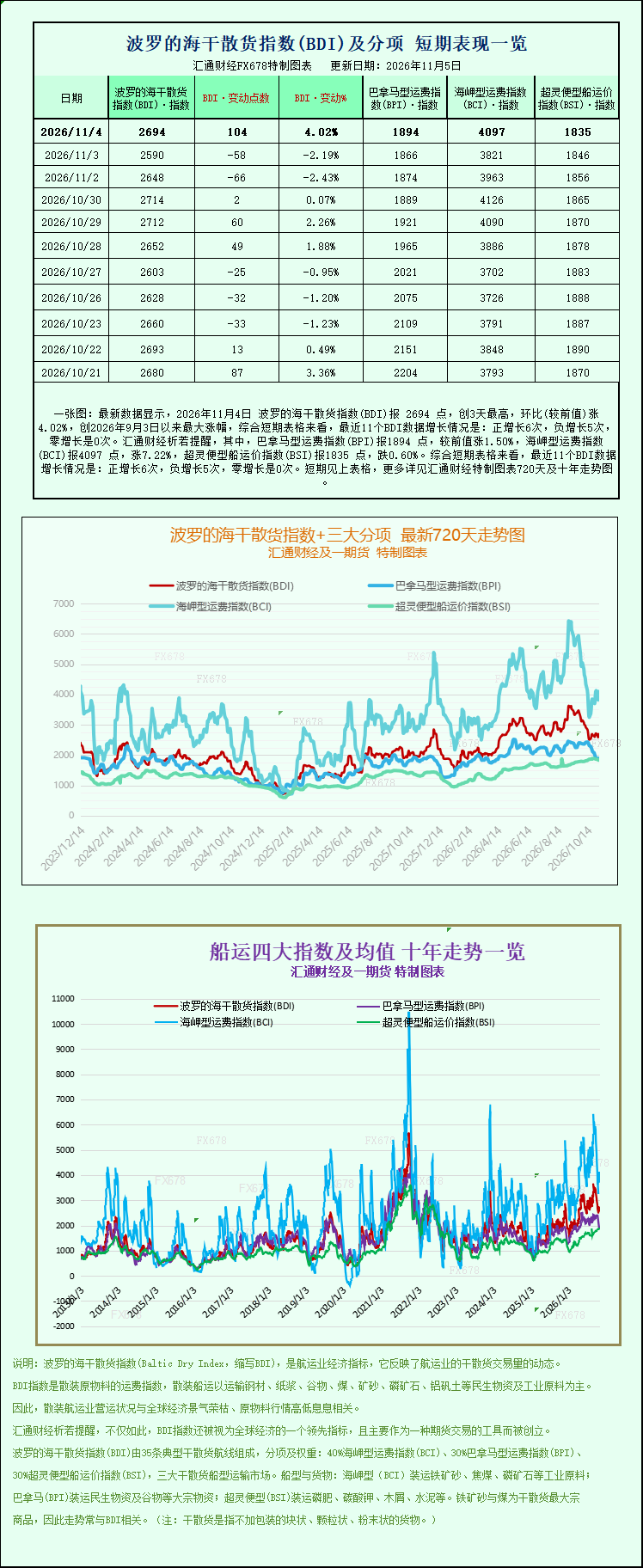 On Wednesday, November 4th, the Baltic Dry Index (BDI), the main dry bulk shipping index on the Baltic Dry Exchange, rebounded from a more than two-week low hit in the previous trading day, primarily driven by stronger freight rates for Capesize and Panamax vessels. The Baltic Dry Index (BDI) is a core indicator tracking the overall trend of freight rates for the three major vessel types: Capesize, Panamax, and Supramax. The index rose 104 points, or 4.02%, to close at 2,694 points on Wednesday, a significant recovery from the previous trading day's low. The Capesize index led the gains . Among them, the Capesize freight rate index performed the best, surging 276 points, or 7.22%, to close at 4,097 points, becoming the main force driving the overall index upward. Capesize vessels typically carry 150,000 tons of cargo, mainly transporting bulk commodities such as iron ore and coal. Correspondingly, the average daily charter rate for this vessel type also climbed, increasing by $2,511 per day to $33,659. Industry analysts pointed out that the strengthening of Capesize freight rates is closely related to the stabilization and rebound of iron ore prices. On Wednesday, iron ore prices rebounded, mainly supported by short covering, while the market anticipated that steel mills in China, the world's largest consumer, would begin replenishing their inventories before the Spring Festival holiday. As one of the most important cargo types for Capesize vessels, improved demand expectations for iron ore can often be quickly transmitted to freight rates, thus affecting the overall trend of the dry bulk shipping market. Panamax Ends Decline Besides Capesize, the Panamax freight rate index also recorded a significant improvement. After falling for 15 consecutive trading days, the index rebounded, rising 28 points, or 1.50%, to close at 1,894 points on Wednesday, the highest level in nearly a week. Panamax vessels, typically carrying 60,000 to 70,000 tons of cargo such as coal or grain, saw their average daily charter rate rise by $258 to $17,049. The end of a previous decline in Panamax freight rates reflects a recovery in overall sentiment in the dry bulk market, driven by stronger Capesize rates. Marginal improvements in demand for grain and coal shipments, along with some shipowners' willingness to maintain prices, jointly supported the stabilization and rebound of freight rates for this vessel type. Supramax bucked the trend and weakened . In contrast to the strength of the two main vessel types, the Supramax freight rate index fell 11 points, or 0.60%, to close at 1,835 points on Wednesday, the lowest level since October 13th. Supramax vessels are mainly used for transporting small to medium-volume cargoes, and their continued weakness indicates that the rebound in the dry bulk market is not widespread, and significant differentiation remains between different vessel types. Market Analysis and Outlook Overall, the rebound in the Baltic Dry Index (BDI) on Wednesday was primarily driven by a significant increase in Capesize freight rates, coupled with the stabilization of Panamax rates, which together reversed the previous day's decline. However, the continued decline in Supramax freight rates serves as a reminder that the recovery in dry bulk shipping remains mainly concentrated on large vessels, with freight rates for smaller vessels not yet fully catching up. From a fundamental perspective, the anticipated restocking by Chinese steel mills before the Spring Festival and the short-term rebound in iron ore prices have provided temporary support for large vessel freight rates. However, market analysts generally caution that the sustainability of the iron ore price recovery and whether downstream demand has truly rebounded remain uncertain. Dry bulk freight rates are influenced by multiple variables, including seasonal factors, commodity price fluctuations, and global trade demand; their future trends require further observation. Overall, the Baltic Dry Index (BDI) has shown signs of stabilization and rebound in the short term after hovering at low levels for more than two weeks. However, the market is clearly differentiated, and the sustainability of the rebound remains to be seen. Going forward, key factors to watch include the pace of restocking by Chinese steel mills, iron ore price trends, and marginal changes in global dry bulk trade demand.
- Risk Warning and Disclaimer
- The market involves risk, and trading may not be suitable for all investors. This article is for reference only and does not constitute personal investment advice, nor does it take into account certain users’ specific investment objectives, financial situation, or other needs. Any investment decisions made based on this information are at your own risk.