US Yield Curve Control: Conditions for Implementation Are Gradually Taking Shape
2026-11-05 00:38:27
US fiscal policy is out of control, and yesterday's midterm elections will not reverse this situation; on the contrary, they will only exacerbate it. The root of the problem lies in the extreme division within American politics, with the White House and Congress constantly shifting control. In this situation, neither of the two major parties will pursue responsible fiscal policies, because doing so would mean losing the already close election. In my view, the only way to prevent the US from sliding step by step towards fiscal collapse is to form a third party, allowing political centrists with fiscally conservative views to have a voice. Unfortunately, however, this goal remains a long way off.  Therefore, the situation will only worsen first, and then possibly improve. In August of this year, I published two articles discussing the various measures highly indebted countries that have exhausted their fiscal space. I pointed out at the time that such countries would engage in three types of behavior: first, blaming the market for irrationality when yields rise; second, pressuring central banks to lower policy rates and initiate quantitative easing; and third, shortening the duration of newly issued debt. This is a self-destructive trade-off—it exposes the country to extremely high debt rollover risks. If these practices seem familiar, it's because the United States is now deeply entrenched in these three maneuvers. This article will update the discussion of the "methods" the United States is currently employing regarding debt issuance and yields.
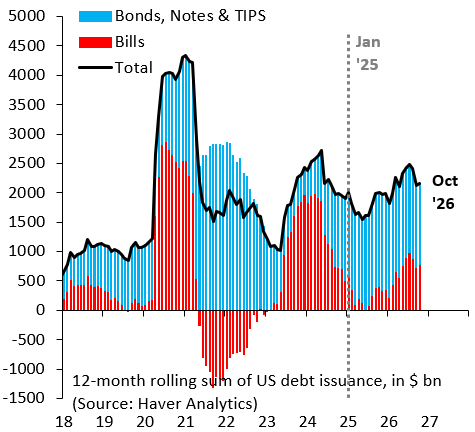 (Figure 1 Explanation: The black line in the figure represents the 12-month rolling total of US monthly debt issuance; the red bars represent short-term bond issuance, and the blue bars represent issuance of bonds with other maturities.) In the year ending October 2026, total US debt issuance reached $2.2 trillion, equivalent to 6.5% of GDP, roughly double the pre-COVID-19 level. The chart also shows that due to significantly higher long-term yields, the US is increasingly reliant on short-term debt issuance to keep financing costs within a manageable range. As mentioned above, this is a short-sighted approach that carries enormous debt rollover risks. Historically, there have been periods of significant increases in short-term debt issuance, but the current situation is different, as will be explained below.
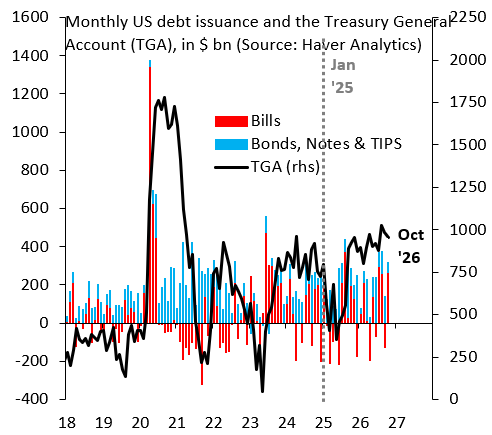 (Figure 2 Explanation: The red and blue bars have the same meaning as in the first chart, but now represent monthly bond issuance data instead of the 12-month rolling total; the black line represents the Treasury General Account (TGA), the Federal Reserve account where the U.S. Treasury holds cash for future expenditures.) Historically, there have been two instances of a surge in short-term bond issuance. The first occurred at the beginning of the COVID-19 pandemic, when the Treasury, taking advantage of emergency quantitative easing, issued a large number of short-term bonds at low yields to prepare funds for pandemic-related fiscal stimulus. The second occurred in 2023 during the debt ceiling impasse, when the Treasury General Account was depleted to extremely low levels, requiring rapid replenishment through short-term bond issuance. However, there are no such specific incentives now: neither the pandemic nor the debt ceiling standoff exists. The U.S.'s increased issuance of short-term bonds is purely out of necessity. The backdrop to all this is an unusual announcement released by the Treasury in August, prior to which the U.S. yield curve experienced a sharp bear steepening. At that time, Treasury Secretary Bessant attributed the bond market turmoil to insufficient market liquidity and market pricing discrepancies. The sell-off in US Treasuries also explains the Federal Reserve's fluctuating policy stance: whenever yields seem on the verge of spiraling out of control, the Fed adjusts its policy direction. When a country's fiscal space is exhausted, these kinds of maneuvers are repeated, and the ultimate outcome of this process is to initiate a new Treasury-Fed agreement. Unfortunately, the midterm elections are powerless and will not change this outcome.
Therefore, the situation will only worsen first, and then possibly improve. In August of this year, I published two articles discussing the various measures highly indebted countries that have exhausted their fiscal space. I pointed out at the time that such countries would engage in three types of behavior: first, blaming the market for irrationality when yields rise; second, pressuring central banks to lower policy rates and initiate quantitative easing; and third, shortening the duration of newly issued debt. This is a self-destructive trade-off—it exposes the country to extremely high debt rollover risks. If these practices seem familiar, it's because the United States is now deeply entrenched in these three maneuvers. This article will update the discussion of the "methods" the United States is currently employing regarding debt issuance and yields. (Figure 1 Explanation: The black line in the figure represents the 12-month rolling total of US monthly debt issuance; the red bars represent short-term bond issuance, and the blue bars represent issuance of bonds with other maturities.) In the year ending October 2026, total US debt issuance reached $2.2 trillion, equivalent to 6.5% of GDP, roughly double the pre-COVID-19 level. The chart also shows that due to significantly higher long-term yields, the US is increasingly reliant on short-term debt issuance to keep financing costs within a manageable range. As mentioned above, this is a short-sighted approach that carries enormous debt rollover risks. Historically, there have been periods of significant increases in short-term debt issuance, but the current situation is different, as will be explained below. (Figure 2 Explanation: The red and blue bars have the same meaning as in the first chart, but now represent monthly bond issuance data instead of the 12-month rolling total; the black line represents the Treasury General Account (TGA), the Federal Reserve account where the U.S. Treasury holds cash for future expenditures.) Historically, there have been two instances of a surge in short-term bond issuance. The first occurred at the beginning of the COVID-19 pandemic, when the Treasury, taking advantage of emergency quantitative easing, issued a large number of short-term bonds at low yields to prepare funds for pandemic-related fiscal stimulus. The second occurred in 2023 during the debt ceiling impasse, when the Treasury General Account was depleted to extremely low levels, requiring rapid replenishment through short-term bond issuance. However, there are no such specific incentives now: neither the pandemic nor the debt ceiling standoff exists. The U.S.'s increased issuance of short-term bonds is purely out of necessity. The backdrop to all this is an unusual announcement released by the Treasury in August, prior to which the U.S. yield curve experienced a sharp bear steepening. At that time, Treasury Secretary Bessant attributed the bond market turmoil to insufficient market liquidity and market pricing discrepancies. The sell-off in US Treasuries also explains the Federal Reserve's fluctuating policy stance: whenever yields seem on the verge of spiraling out of control, the Fed adjusts its policy direction. When a country's fiscal space is exhausted, these kinds of maneuvers are repeated, and the ultimate outcome of this process is to initiate a new Treasury-Fed agreement. Unfortunately, the midterm elections are powerless and will not change this outcome.
- Risk Warning and Disclaimer
- The market involves risk, and trading may not be suitable for all investors. This article is for reference only and does not constitute personal investment advice, nor does it take into account certain users’ specific investment objectives, financial situation, or other needs. Any investment decisions made based on this information are at your own risk.