Gold Trading Alert: Democratic sweep of Congress triggers a sharp drop in the dollar, causing gold prices to surge over 3% in a single day, marking the biggest gain in March!
2026-11-05 07:52:27
On Wednesday (November 4), the global gold market witnessed a long-awaited strong rebound. Spot gold surged 3.3% to close at $4,060.01 per ounce, having briefly touched the $4,070 mark during the session; US gold futures for December delivery also rose 3.4%, closing at $4,073. This was the largest single-day gain since mid-August, allowing gold prices to quickly recover after briefly dipping below $4,000. Just last Friday (October 30), spot gold had fallen to $3,869.85, its lowest level since October 2025. In just a few trading days, market sentiment shifted rapidly from pessimistic to positive, and the core catalyst for this was the political and economic signals released by the US midterm election results. On Thursday (November 5) in early Asian trading, spot gold fluctuated narrowly, currently trading at $4,065 per ounce. 
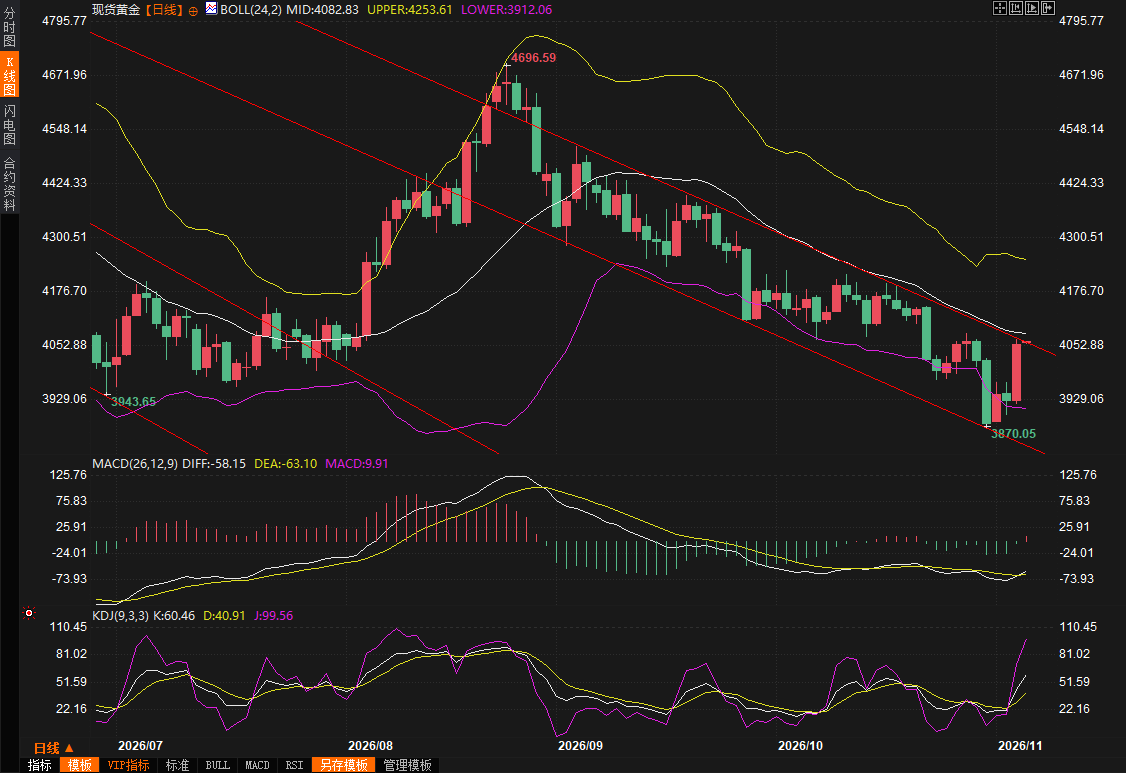 (Spot gold daily chart, source: FX678) At 07:48 Beijing time, spot gold is currently trading at $4065.82 per ounce.
The sharp decline in the US dollar became the most direct boost to gold prices.
The Democrats secured a landslide victory in Tuesday's midterm elections, winning not only the House of Representatives but also the Senate, achieving historic breakthroughs in some traditionally Republican strongholds. Following the election results, the dollar fell to its lowest level in over a month. The dollar index fell 0.32% on Wednesday to 101.52, having earlier touched a five-week low of 101.21. The euro rose to its highest level in nearly a month. Gold's dollar-denominated nature means that a weaker dollar directly increases its attractiveness to overseas buyers. When the dollar depreciates, the cost of buying gold decreases for holders of other currencies, naturally increasing demand. Jim Wyckoff, a market analyst at the U.S. Gold Exchange, noted that gold prices received clear support from the weaker dollar. The market generally believes that with the Democrats controlling Congress, the U.S. legislative process is likely to stall. This stalemate itself could drag down economic growth, increasing the likelihood of the Federal Reserve adopting a more accommodative monetary policy in the future. Even though traders currently still expect an 83% probability of a Fed rate hike in December, expectations for the medium- to long-term policy path have begun to soften. The election results alleviated market concerns about a potential contested outcome, leading to a significant short-term increase in risk appetite. The S&P 500 climbed about 2% on Wednesday, while oil prices experienced sharp fluctuations. Erik Bregar, head of foreign exchange and precious metals risk management at Silver Gold Bull, described this as a typical "sell the rumor, buy the fact" reaction—the market breathed a sigh of relief, at least avoiding a quagmire surrounding election manipulation. This atmosphere of heightened risk appetite is typically unfavorable for the US dollar but indirectly beneficial for gold.The plunge in oil prices and geopolitical expectations are reshaping the logic of inflation and safe-haven demand.
In stark contrast to the surge in gold prices, the oil market experienced a sharp correction. Brent crude futures closed at $94.62 a barrel on Wednesday, down $8.98, or 8.7%; U.S. crude futures also fell 8.3% to close at $88.12. Both benchmark contracts hit their lowest closing prices since August 31. The market quickly bet that a power struggle within Washington, following Democratic control of Congress, could accelerate the end of the U.S.-Israel war against Iran. Trump himself told the Financial Times that the U.S. currently has no plans to strike Iran and acknowledged that the Iran issue played a role in the Republican Party's midterm election defeat. Vice President Vance even publicly questioned the value of the war, attributing the election defeat entirely to it. Sources close to the Gulf government indicated that a relatively weakened Trump, facing a Democratic Congress that could limit his military options, was more motivated to seek an agreement. The possibility of a full-scale offensive appeared to have decreased, and the potential increase in Middle Eastern oil exports and expectations of a de-escalation of the war jointly depressed oil prices. The sharp drop in oil prices helps alleviate inflationary pressures, which in turn reduces pressure on the Federal Reserve to raise interest rates, providing support for the dollar. However, the reality is more complex. Despite the plunge in oil prices, inflation concerns have not completely subsided. Previously high oil prices, Trump's tariff policies, and resource price increases driven by the expansion of the artificial intelligence industry continue to support inflation expectations. The break-even yield on 10-year Treasury Inflation-Protected Securities (TIPS) still indicates that the market expects an average annual inflation rate of approximately 2.3% over the next decade, significantly higher than the Fed's 2% target. A Democratic-led Congress may demand more aggressive inflation control measures under its oversight responsibilities and become more skeptical of the claim that "the widespread adoption of artificial intelligence will bring a downward effect on inflation." Meanwhile, the debt ceiling and federal spending will become important bargaining chips for Democrats to check the Trump administration. Historically, fiscal policy adjustments after midterm elections have often been quietly completed amidst stalemates and negotiations. Ed Al-Hussainy, global interest rate strategist at Threadneedle Investments in Colombia, points out that midterm elections are often a hidden moment for fiscal policy shifts. This potential policy friction may actually increase economic uncertainty, providing medium-term support for gold.Employment data and the Federal Reserve's policy path remain key short-term variables.
The ADP National Employment Report released Wednesday showed that U.S. private sector jobs increased by 86,000 in October, higher than the market expectation of 69,000. While the services purchasing managers' index declined slightly, it remained in expansion territory. Investors are closely watching Friday's non-farm payroll report for further clues about the interest rate outlook. The Federal Reserve kept interest rates unchanged at its October meeting, and the market is still highly pricing in the possibility of a December rate hike. Rising interest rates increase the opportunity cost of holding non-yielding gold, a significant short-term downward pressure on gold. However, the post-election political landscape has begun to alter market assessments of the policy environment. Bill Merz, head of research at Bank of America Capital Markets, believes that inflationary pressures may ease as AI-related growth may slow, oil prices fall, and Congressional support for the Iran conflict weakens. The legislative deadlock between Congress and the White House may also limit government spending in the short term. Trump previously promised a $5,000 subsidy to adult citizens if Republicans retain control of Congress, a massive expenditure. This prospect has now cooled significantly. Meanwhile, the U.S. trade deficit narrowed slightly to $105 billion in September, but imports remained at a record high, with significant increases in imports of computers, peripherals, and semiconductors reflecting strong demand for artificial intelligence infrastructure. James Knightley, chief international economist at ING, pointed out that less than two years ago, the U.S. imported about $20 billion worth of such products per month, but in September it reached $87 billion. Following Democratic victories in some gubernatorial elections, skepticism about data center expansion may intensify, potentially affecting the pace of future investment and indirectly impacting economic growth and inflation paths.Market Sentiment and Outlook
In summary, the core driver of this round of gold price rebound is the rapid weakening of the US dollar after the Democratic Party's landslide victory, and market expectations that the legislative deadlock may lead to a more accommodative monetary policy environment. The plunge in oil prices has eased inflation concerns and reduced pressure on the Federal Reserve to continue raising interest rates. In the short term, Friday's non-farm payroll data will be a key test. If the employment data continues to be strong, it may strengthen expectations of a Fed rate hike in December, putting pressure on gold; if the data is weak, it may further solidify the foundation for the gold price rebound. From a medium-term perspective, gold still faces a game of multiple variables. With the Democrats controlling Congress, fiscal policy negotiations, debt ceiling talks, tightening regulations on artificial intelligence, and the ultimate outcome of the Middle East situation will all continue to affect the US dollar, inflation expectations, and risk appetite. As an asset with monetary, safe-haven, and inflation-hedging attributes, gold still has strong allocation value in this highly uncertain policy environment. The current price has regained the $4,000 mark; whether it can further challenge higher levels depends on the dollar's performance, changes in real interest rates, and the pace of geopolitical risk evolution. The market is repricing the outlook for the US economy and policies under a divided government, and gold has already reacted to this. Today's trading session will also focus on the US initial jobless claims for the week ending October 31 and speeches by Federal Reserve officials, as well as the Bank of England's interest rate decision. Furthermore, attention should be paid to further developments in the Middle East and the escalating impact of the US midterm elections. (Spot gold daily chart, source: FX678) At 07:48 Beijing time, spot gold is currently trading at $4065.82 per ounce.
- Risk Warning and Disclaimer
- The market involves risk, and trading may not be suitable for all investors. This article is for reference only and does not constitute personal investment advice, nor does it take into account certain users’ specific investment objectives, financial situation, or other needs. Any investment decisions made based on this information are at your own risk.