Crude oil trading alert: International oil prices continue their rebound, but a significant drop of approximately 10% is still expected on the weekly chart.
2026-11-06 11:22:26
Oil prices are expected to fall sharply this week, influenced by market expectations of a de-escalation in the Iranian situation following US President Trump's midterm election defeat, but supply concerns in the Middle East stemming from the conflict continue to provide support. On Friday (November 6) during Asian trading hours, international oil prices continued their rebound, with Brent crude futures for January delivery rising about 1.5% to around $99.75 per barrel, and WTI crude futures for December delivery rising about 0.9% to around $91.30 per barrel. Both contracts rose for the second consecutive trading day. However, Brent and WTI crude futures are still expected to fall by about 10% this week. Earlier this week, oil prices plunged, influenced by market expectations surrounding Tuesday's US midterm elections. The election results showed that the Democrats regained control of both houses of Congress, which the market believes could lead to a de-escalation of the conflict between the US and Israel over Iran. After the Democrats swept the midterm elections, oil prices fell 8% on Wednesday alone, settling at a two-month low. 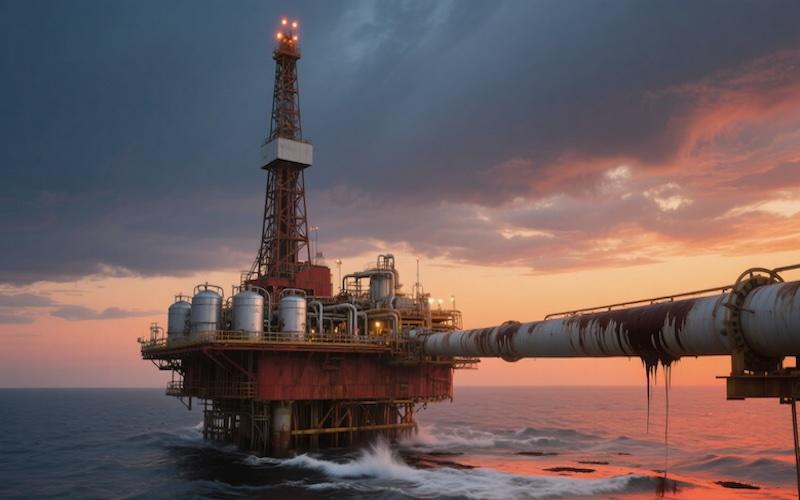
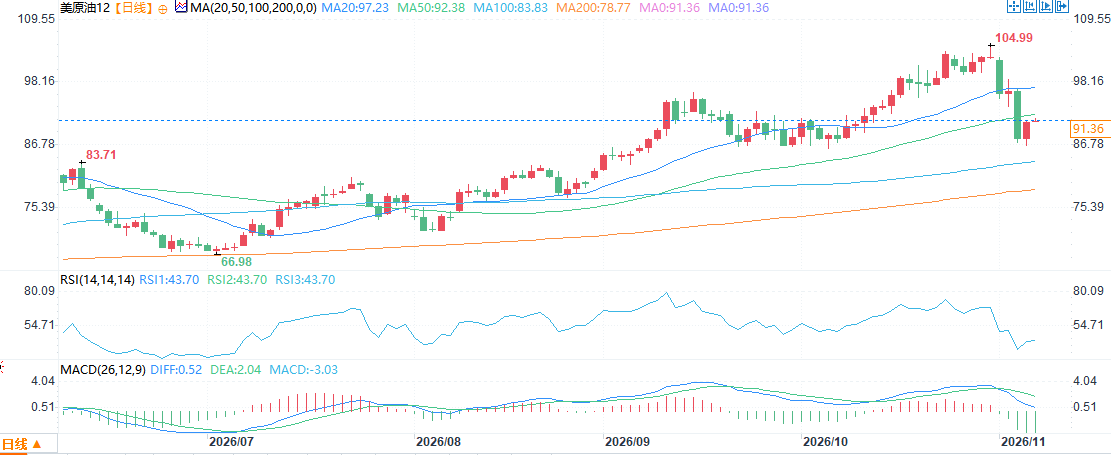 (Daily chart of US crude oil futures December contract, source: FX678) At 11:19 Beijing time, the US crude oil futures December contract was trading at $91.31 per barrel.
Tanker attacks are occurring at near-record frequency, reigniting supply risks in the Hormuz region.
On Wednesday and Thursday, a series of attacks on oil tankers in the Persian Gulf and the Strait of Hormuz sparked concerns about oil supplies in the region, causing oil prices to rebound. A senior commodities strategist at an institution stated in a report, "Traders believe Wednesday's sell-off was excessive, leading to the price rebound." He noted that oil prices had been under downward pressure since the Democratic victory, but during Thursday's trading, "the market began to recognize reality." "Iran still controls the Strait of Hormuz and is unlikely to relinquish control," he said, adding that currently, less than 60% of the total oil transport volume through the strait is used. Iran reported on Thursday that three more oil tankers were damaged in the Strait of Hormuz. Data from the UK's Office for Maritime Trade Operations showed that at least five ships have reported incidents since Sunday, a frequency roughly equivalent to October; the agency reported 35 attacks on ships in October, the highest monthly total since the conflict began. The Iranian Revolutionary Guard typically denies firing on merchant ships but claims the shipping route is unsafe without Tehran's consent; the Revolutionary Guard stated that two oil tankers struck mines on Thursday, and another caught fire. Iran's Supreme Leader Mojtaba Khamenei said on Wednesday that Iran should not "show even the slightest tendency to yield" to the United States, adding that the US will continue to be hostile to Iran regardless of which party is in power.Diplomacy and military action proceed in parallel: Iran submits nuclear proposal but insists on seven conditions; internal divisions exist within the US regarding the resumption of hostilities.
A senior Iranian official said on Thursday that Iran submitted a nuclear proposal to the United States through Qatar, but discussions would only begin after Washington met seven demands from Tehran. The official said the US was reviewing the proposal. Iran's security chief, Rezaei, stated, "On diplomatic issues, we have announced seven conditions to the United States. We will neither open the Strait of Hormuz nor begin negotiations until the United States fulfills these seven conditions." Iran's demands include lifting US sanctions, unfreezing frozen Iranian assets, and paying war reparations; the US, however, has stated that the nuclear issue must be part of any initial negotiations. Meanwhile, there are internal divisions within the US regarding the resumption of hostilities. Vice President Vance published a lengthy post on social media on Wednesday, claiming the conflict was the reason for the Republican Party's election defeat. Iranian Parliament Speaker Ghalibaf responded sarcastically on Thursday, accusing Vance of allowing Trump to double down like a "gambler who's lost everything," and saying that if Vance thought the conflict was a mistake, he should persuade Trump to stop it. When asked about Vance's comments on Wednesday, Trump defended his decision to launch the conflict, saying preventing Iran from acquiring nuclear weapons was crucial. A White House advisor said some officials within the White House believe Vance's post signifies a divergence between him and the president on foreign policy; however, two sources said they believe Trump could still order a resumption of hostilities, with one saying, "He's planning to bomb Iran. Don't listen to what he says. He didn't act before because of the midterm elections."Russian refineries attacked again, adding uncertainty to diesel exports to the US.
Ukraine's renewed attacks on Russian oil refineries have exacerbated Moscow's difficulties in addressing its domestic fuel shortage, while Russia continues to supply diesel to the international market under an export agreement reached with Trump. Video analysis suggests that the Ryazan refinery, one of Russia's largest, appears to have been attacked in a large-scale drone strike targeting the city's industrial area overnight. If true, this would be the second refinery attacked this week, following the attack on the Yaroslavl refinery late Monday night, marking the breakdown of the previous strike moratorium. Shipping data shows that at least six Russian diesel cargo ships have announced plans for transatlantic voyages, while two previous shipments destined for the US Atlantic coast appear to have changed course. No Russian diesel cargo has arrived in the US since the agreement was reached. Analysts say the first monitored Russian cargo bound for the US is expected to arrive in New York this weekend, but its unloading is uncertain due to concerns about regulation, legislation, and sanctions. Kremlin spokesman Dmitry Peskov stated, "These are commercial shipments, and details naturally cannot be disclosed. All diesel fuel will find buyers." Kremlin envoy Dmitriev said that the Russian diesel tankers bound for the United States are still on their original routes. Peskov added that the change of course by the diesel tankers is unrelated to the results of the US midterm elections.Houthi attacks continue; Saudi Arabia warns of risks to Yanbu export hub.
Saudi Arabia issued an alert on Thursday warning of potential danger to its oil export hub, Yanbu, as pro-Iranian Houthi rebels in Yemen continued their attacks. The Saudi-led coalition fighting the Houthis in Yemen said it had destroyed a missile aimed at the Islamic holy city of Medina; the Saudi Civil Defense also issued an emergency alert for the southeastern Sharula region bordering Yemen. As of Thursday, the Houthis had not claimed any new attacks against Saudi Arabia. On Wednesday, the Houthis claimed responsibility for an attack on Riyadh International Airport during the Syrian president's visit to Saudi Arabia, an attack that Saudi authorities have not confirmed. As the world's largest oil exporter and a key ally of the United States, Saudi Arabia has been seeking assistance from the United States, Europe, and several Middle Eastern countries, hoping to gain defensive and offensive support in its escalating conflict with the Houthis.in conclusion
Oil prices are expected to fall by about 10% this week, primarily driven by market expectations of a de-escalation in the Iranian situation following the midterm elections—after the Democrats swept both houses of Congress, oil prices fell 8% on Wednesday, settling at a two-month low. However, supply-side risks have not disappeared: attacks on oil tankers in the Persian Gulf and the Strait of Hormuz are nearing record frequency; Iran claims three more tankers have been damaged, bringing the total number of ships attacked in October to 35, the highest monthly figure since the conflict began, with traffic in the straits at less than 60% of capacity; although Iran submitted its nuclear proposal through Qatar, it insists that the US must first meet seven conditions, making a diplomatic breakthrough still a long way off; there are internal divisions in the US regarding the resumption of hostilities, and sources say Trump may still order a resumption of strikes. Furthermore, Ukraine's resumption of attacks on Russian refineries adds uncertainty to Russian diesel exports to the US, while Houthi attacks continue and Saudi Arabia warns of risks to the Yanbu export hub. The oil market is therefore caught in a constant balancing act between "expectations of political easing" and "real supply threats," resulting in increased short-term volatility. The coexistence of a sharp weekly decline and a daily rebound directly reflects this tug-of-war. (Daily chart of US crude oil futures December contract, source: FX678) At 11:19 Beijing time, the US crude oil futures December contract was trading at $91.31 per barrel.
- Risk Warning and Disclaimer
- The market involves risk, and trading may not be suitable for all investors. This article is for reference only and does not constitute personal investment advice, nor does it take into account certain users’ specific investment objectives, financial situation, or other needs. Any investment decisions made based on this information are at your own risk.