World Bank Commodity Report: Gold and silver prices will gradually decline, but are unlikely to return to historical lows.
2026-11-06 10:47:27
The World Bank's latest October Commodity Markets Outlook report predicts that gold and silver prices will gradually correct in 2027-2028, but will still remain at historically high levels, making it unlikely that the surge and volatility of 2026 will be replicated. The fundamentals for gold and silver are clearly diverging; gold is supported by central bank gold purchases, while silver is dragged down by changes in industrial demand.
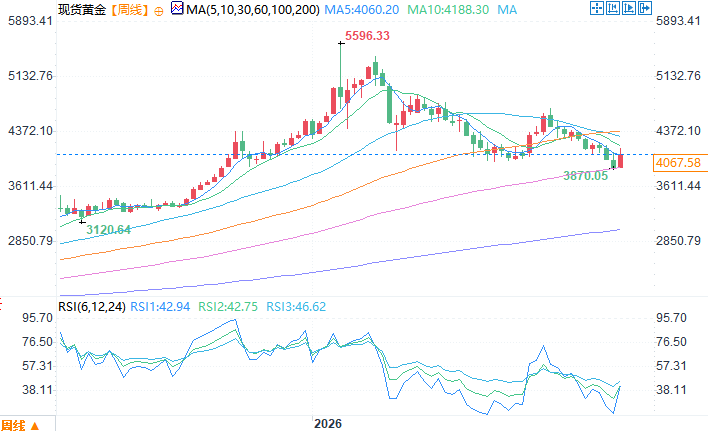 Spot gold weekly chart source: FX678. At 10:43 AM Beijing time on November 6th, spot gold was trading at $4064.58 per ounce.
Price forecasts have been revised downwards, bringing the gold and silver price surge to a temporary halt.
This report's forecast is slightly bearish compared to the April version. It projects an average gold price of $4,600 per ounce in 2026, a 33.6% increase from 2025; however, it predicts a 7.6% decline to $4,250 in 2027, followed by a further 5.9% drop to $4,000 in 2028. Silver is expected to outperform gold this year, with an estimated average price of $70, a nearly 76% increase, followed by a larger correction, falling to $62 in 2027 and $58 in 2028. The overall precious metals index is projected to rise nearly 40% this year, followed by two consecutive years of decline; even with this correction, prices will remain significantly higher than the 2015-2019 average. Gold prices fell 5% in the third quarter, with rising US Treasury yields, tightening expectations, and a stronger dollar suppressing the precious metals market.Gold fundamentals are solid, while silver faces pressure from industrial demand.
The supporting logic for gold lies in investment demand and central bank gold purchases. In the first half of 2026, investment demand and central bank gold purchases combined accounted for half of global gold demand. Although demand growth is expected to slow in the next two years, a solid bottom has been formed. Central bank gold purchases, after cooling at the beginning of the year, have rebounded, providing additional support for gold prices. However, high prices have suppressed gold jewelry consumption, with jewelry demand weakening continuously since 2023. On the supply side, limited increases in gold mine production will lead to increased recycling of gold. The silver market is more complex, with industrial demand being a key variable. The photovoltaic industry is attempting to replace silver with copper and improve process efficiency, which will suppress silver consumption; demand for silver jewelry is also dragged down by high prices. Silver demand in the electronics, computing centers, automotive, and power infrastructure sectors continues to grow, providing only limited support. Silver mine production is increasing slightly, and recycling is rising simultaneously, gradually easing the tight supply and demand situation.The balance between bullish and bearish risks means that external disturbances will influence market trends.
The World Bank stated that the upside and downside risks to gold and silver price forecasts are broadly balanced. Escalating geopolitical tensions, increased market volatility, and larger-than-expected central bank gold purchases could all push prices higher than the baseline forecast. The biggest downside risk comes from continued monetary tightening by major central banks such as the Federal Reserve; high interest rates and a strong dollar will continue to weaken the attractiveness of these non-interest-bearing assets. Furthermore, a weakening global economy will impact industrial demand for silver, and profit-taking and deleveraging will amplify selling pressure.Overall outlook for commodities: Risks of inflationary pressures remain.
Looking at the entire commodity market, driven by energy supply disruptions and geopolitical uncertainties, overall commodity prices are expected to rise by 23% this year and fall by 7% in 2027. The Middle East conflict and El Niño's impact on agricultural production are two core disruptive factors. Various risks may also overlap, pushing up energy and food prices and posing challenges to global inflation and monetary policy.Conclusion
The surge in gold and silver prices in 2026 is likely coming to an end, with a moderate correction expected over the next two years. Gold is more resilient due to central bank gold purchases, while silver faces greater downward pressure due to factors such as photovoltaic substitution. Geopolitical tensions and Federal Reserve policies remain the core variables determining whether precious metals can strengthen again. Spot gold weekly chart source: FX678. At 10:43 AM Beijing time on November 6th, spot gold was trading at $4064.58 per ounce.
- Risk Warning and Disclaimer
- The market involves risk, and trading may not be suitable for all investors. This article is for reference only and does not constitute personal investment advice, nor does it take into account certain users’ specific investment objectives, financial situation, or other needs. Any investment decisions made based on this information are at your own risk.