The US dollar index continued its decline, hitting a monthly low, awaiting the release of non-farm payroll data.
2026-11-05 14:46:26
The dollar index, which measures the dollar's performance against a basket of six major currencies, continued its decline in Asian trading on Thursday, marking its second consecutive day of losses and hitting a monthly low of 101.20 during the session. The Democratic Party's victory in the midterm elections, securing control of both the House and Senate, fueled market concerns about a policy deadlock in Washington and hindered progress on a major fiscal stimulus bill, prompting investors to sell off the dollar. Meanwhile, market expectations of a swift resolution to the Middle East conflict led to a sharp decline in international oil prices, and cooling inflation expectations further pressured the dollar.  However, the US dollar has not completely lost support. The latest US economic data demonstrates economic resilience, supporting expectations of a December rate hike by the Federal Reserve. The ADP private sector employment report showed 86,000 new jobs added in October, higher than the market expectation of 69,000; September's employment data was revised down from 90,000 to 86,000. The ISM Services PMI fell slightly to 54.5, slightly below the expected 54.8, but the reading remained above the 50-point threshold, indicating continued expansion in the service sector. The CME FedWatch Tool shows that the market is currently pricing in a near 82% probability of another rate hike in December. The resilient employment data is providing support for the dollar, inhibiting further short selling. The market will now focus on the initial jobless claims data released on Thursday, while Friday's non-farm payroll report is the most important risk event of the week. The strength or weakness of the employment report will directly revise expectations for a Fed rate hike. If the employment data continues to be stronger than expected, the dollar may have a chance to rebound; conversely, if employment weakens significantly, the dollar may continue its current decline. On the daily chart, the US dollar index is currently at 101.20, trading below the 9-period and 50-period exponential moving averages, maintaining a short-term bearish bias. Previous rebounds have failed to break through these two dynamic resistance levels. The 14-day RSI has fallen to 43, below the 50 neutral line, indicating waning bullish momentum, but it has not yet entered severely oversold territory, so the possibility of fluctuating consolidation cannot be ruled out. The first resistance level is at the 50-period EMA of 101.27, with further resistance at the 9-period EMA of 101.72. Only if the daily closing price holds above 101.72 will the short-term downward pressure be alleviated; otherwise, the price is likely to encounter selling pressure during rebounds towards the moving averages, and the US dollar index still faces the risk of further declines. Key support levels to watch are 100.75 and then 100.24; a break below these levels would open up more downside potential. On the 4-hour chart, the moving averages are in a bearish alignment, the price center of gravity continues to shift downwards, and indicators are in a neutral to weak range, with no clear oversold signal yet. The market is currently in a trend correction, so it's not advisable to blindly short. Instead, wait for a breakout at key levels and pay close attention to the drivers of the evening's trading and Friday's employment data.
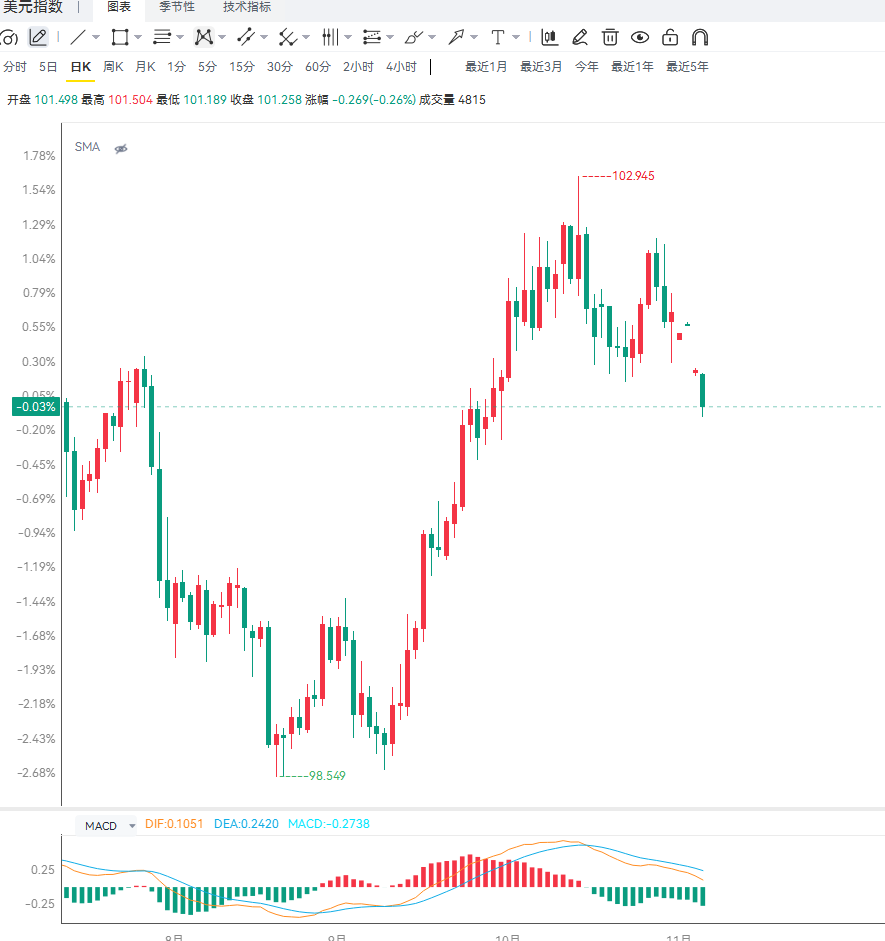 Editor's Summary: The US dollar index weakened further, hitting a monthly low, pressured by both the midterm election results and expectations of easing tensions in the Middle East. However, resilient US employment data supported a high probability of a Fed rate hike, limiting further downside potential. Short-term risks lie in a significant increase in non-farm payrolls, potentially driving a dollar rebound; a potential opportunity is weaker-than-expected employment data, which could open up further downside for the dollar. Key levels to watch are the resistance zone of 101.27-101.72 and whether the support level of 100.75 holds.
However, the US dollar has not completely lost support. The latest US economic data demonstrates economic resilience, supporting expectations of a December rate hike by the Federal Reserve. The ADP private sector employment report showed 86,000 new jobs added in October, higher than the market expectation of 69,000; September's employment data was revised down from 90,000 to 86,000. The ISM Services PMI fell slightly to 54.5, slightly below the expected 54.8, but the reading remained above the 50-point threshold, indicating continued expansion in the service sector. The CME FedWatch Tool shows that the market is currently pricing in a near 82% probability of another rate hike in December. The resilient employment data is providing support for the dollar, inhibiting further short selling. The market will now focus on the initial jobless claims data released on Thursday, while Friday's non-farm payroll report is the most important risk event of the week. The strength or weakness of the employment report will directly revise expectations for a Fed rate hike. If the employment data continues to be stronger than expected, the dollar may have a chance to rebound; conversely, if employment weakens significantly, the dollar may continue its current decline. On the daily chart, the US dollar index is currently at 101.20, trading below the 9-period and 50-period exponential moving averages, maintaining a short-term bearish bias. Previous rebounds have failed to break through these two dynamic resistance levels. The 14-day RSI has fallen to 43, below the 50 neutral line, indicating waning bullish momentum, but it has not yet entered severely oversold territory, so the possibility of fluctuating consolidation cannot be ruled out. The first resistance level is at the 50-period EMA of 101.27, with further resistance at the 9-period EMA of 101.72. Only if the daily closing price holds above 101.72 will the short-term downward pressure be alleviated; otherwise, the price is likely to encounter selling pressure during rebounds towards the moving averages, and the US dollar index still faces the risk of further declines. Key support levels to watch are 100.75 and then 100.24; a break below these levels would open up more downside potential. On the 4-hour chart, the moving averages are in a bearish alignment, the price center of gravity continues to shift downwards, and indicators are in a neutral to weak range, with no clear oversold signal yet. The market is currently in a trend correction, so it's not advisable to blindly short. Instead, wait for a breakout at key levels and pay close attention to the drivers of the evening's trading and Friday's employment data. Editor's Summary: The US dollar index weakened further, hitting a monthly low, pressured by both the midterm election results and expectations of easing tensions in the Middle East. However, resilient US employment data supported a high probability of a Fed rate hike, limiting further downside potential. Short-term risks lie in a significant increase in non-farm payrolls, potentially driving a dollar rebound; a potential opportunity is weaker-than-expected employment data, which could open up further downside for the dollar. Key levels to watch are the resistance zone of 101.27-101.72 and whether the support level of 100.75 holds.
- Risk Warning and Disclaimer
- The market involves risk, and trading may not be suitable for all investors. This article is for reference only and does not constitute personal investment advice, nor does it take into account certain users’ specific investment objectives, financial situation, or other needs. Any investment decisions made based on this information are at your own risk.