Spot gold is trending higher despite an over 80% probability of a December rate hike. Why isn't it breaking down?
2026-11-05 14:54:26
Spot gold rose in Asian trading on Thursday (November 5), marking its second consecutive day of gains, and is currently trading around $4,125 per ounce. Earlier in the session, it touched $4,146.79 per ounce, a near two-week high. The dollar continued its decline following the US election results, falling to its lowest level since the end of September, helping gold to continue its upward trend after a surge of more than 3.5% the previous day—its largest single-day gain since mid-August. 
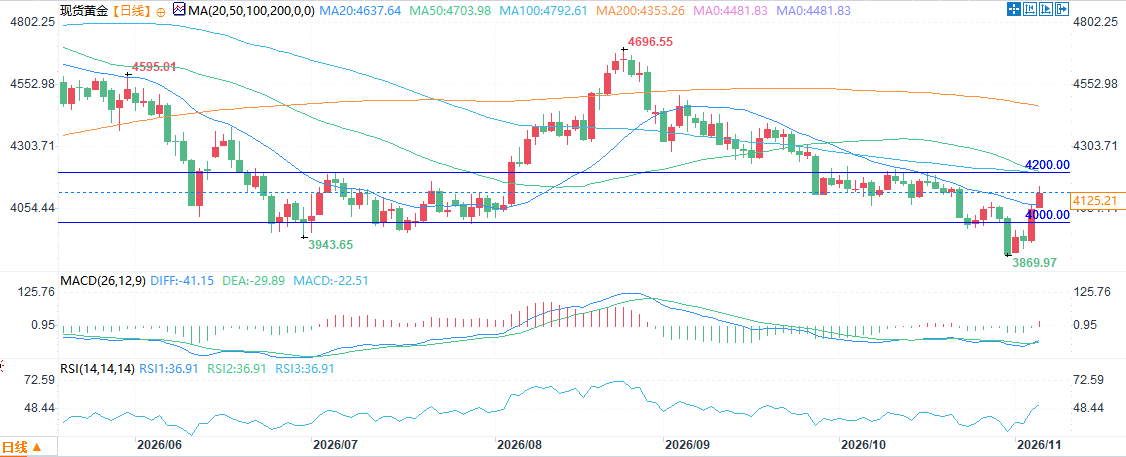 (Spot gold daily chart, source: FX678) At 14:52 Beijing time, spot gold was trading at $4126.78 per ounce.
Election and Oil Prices: Democratic victory lowers escalation expectations, oil prices fall to two-month low
The Democratic Party's landslide victory in the US midterm elections eliminated a major source of uncertainty and reduced expectations that President Trump would resume military strikes against Iran. Indeed, Senate Majority Leader Schumer pledged on Wednesday to push for an end to the Iran conflict, stating that his party could use its control over government funding to pressure that goal. This optimism dragged crude oil prices to a two-month low and eased inflation concerns. Furthermore, expectations that the fiscal impasse in Washington could limit government spending further depressed US Treasury yields, keeping the dollar weak and providing a tailwind for gold.Institutional View: Market reaction was less than expected given the size of the election; subsequent policy responses will determine the direction of the US dollar.
Some analysts have observed that "the scale of the Democratic victory—exceeding any previously reported predictions—has not matched the magnitude of volatility in financial markets," with the dollar and US Treasury yields only showing modest weakness so far. They believe that the shift in the political landscape could still be decisive for the dollar: "If subsequent developments in repricing policies or geopolitical risks occur, that would certainly reverse the current downward trend we are seeing in the dollar and US Treasury yields." Conversely, the institution suggests that "if Trump does not attack Iran and uses voter disapproval of his policies as a reason to seek a deal, the dollar's weakness is much more likely to continue," highlighting that post-election policy responses could determine whether the current dollar pullback deepens or reverses.Interest rate hike constraints: Over 80% probability of rate hikes in December limits gold price gains as expectations of rate hikes by multiple central banks limit their upward movement.
Despite the shifting political landscape, expectations for further tightening by the Federal Reserve remain largely unchanged. CME FedWatch shows traders are still pricing in an over 80% probability of a December rate hike, further supported by a stronger-than-expected ADP report – private sector employment increased by 86,000 in October, unchanged from the revised previous month; the ISM services PMI fell to 54.5 from 54.9, but remained above the 50 expansion threshold. Furthermore, bets on rate hikes by other major central banks may limit gains in non-yielding gold: the Bank of England is expected to raise rates by 25 basis points later today, the Bank of Japan's September minutes showed policymakers discussed the need for continued or even accelerated rate hikes, and the market is also pricing in a higher probability of December rate hikes by the European Central Bank and the Swiss National Bank. This necessitates caution before betting on further gains in precious metals.Data Focus: Non-farm payrolls and FOMC speech; Middle East situation may add volatility.
Traders may choose to await Friday's release of the U.S. monthly non-farm payrolls report. This key data, along with speeches from influential FOMC members, will be used to glean further clues about the Fed's future policy path and drive near-term dollar demand. Furthermore, further developments in the Middle East could inject volatility and provide some momentum for gold prices.Institutional Views
Goldman Sachs lowered its year-end 2026 gold price forecast to $4,650/oz from $4,900/oz, but maintained its year-end 2027 target price of $5,400/oz. Analysts believe that the Fed's tightening monetary policy may slow the short-term rise in gold prices, with rising real interest rates and a stronger dollar exerting downward pressure. However, the continued central bank gold purchases and the trend of diversifying foreign exchange reserves remain unchanged, and these are still the core structural factors supporting gold's medium- to long-term performance. Standard Chartered's investment strategist, Anthony Naab, stated that the bank maintains its overweight rating on gold but lowered its three- to twelve-month target prices: the three-month target was adjusted to $4,350/oz, and the twelve-month target to $4,700/oz. Despite short-term pressure from interest rates and the dollar, Standard Chartered believes gold still has the potential to recover, and structural demand (central bank gold purchases and investment demand) will limit downside. The bank pointed out that current price levels have partially reflected expectations of interest rate hikes, and if energy prices or inflationary pressures ease and real interest rates peak, gold prices are expected to recover.in conclusion
Gold rose for the second consecutive day, primarily driven by the dollar's continued decline after the election, hitting a new low since the end of September. The Democratic victory reduced expectations of Trump resuming military action against Iran, oil prices fell to a two-month low easing inflation concerns, and expectations of a fiscal impasse depressed US Treasury yields, all supporting gold prices. However, institutions pointed out that the market reaction was less significant than the election itself, and subsequent policy responses will determine whether the dollar's pullback deepens or reverses; the probability of a December rate hike remains over 80%, with upward pressure constrained by rate hike expectations from the Bank of England, the Bank of Japan, the European Central Bank, and the Swiss National Bank. Short-term direction depends on Friday's non-farm payrolls and FOMC speeches' repricing of rate hike expectations, as well as the development of the Middle East situation and Trump's response to the election results. (Spot gold daily chart, source: FX678) At 14:52 Beijing time, spot gold was trading at $4126.78 per ounce.
- Risk Warning and Disclaimer
- The market involves risk, and trading may not be suitable for all investors. This article is for reference only and does not constitute personal investment advice, nor does it take into account certain users’ specific investment objectives, financial situation, or other needs. Any investment decisions made based on this information are at your own risk.