The US dollar fell against the Indian rupee for the fifth consecutive day. Which is driving the decline in oil prices or the weakening dollar?
2026-11-05 16:06:29
The dollar extended its losses against the Indian rupee on Thursday (November 5), marking its fifth consecutive day of decline. The dollar fell to a two-month low of 94.30 against the rupee, pressured by significant selling pressure on the dollar and a sharp drop in oil prices following the Republican Party's setback in the US midterm elections. 
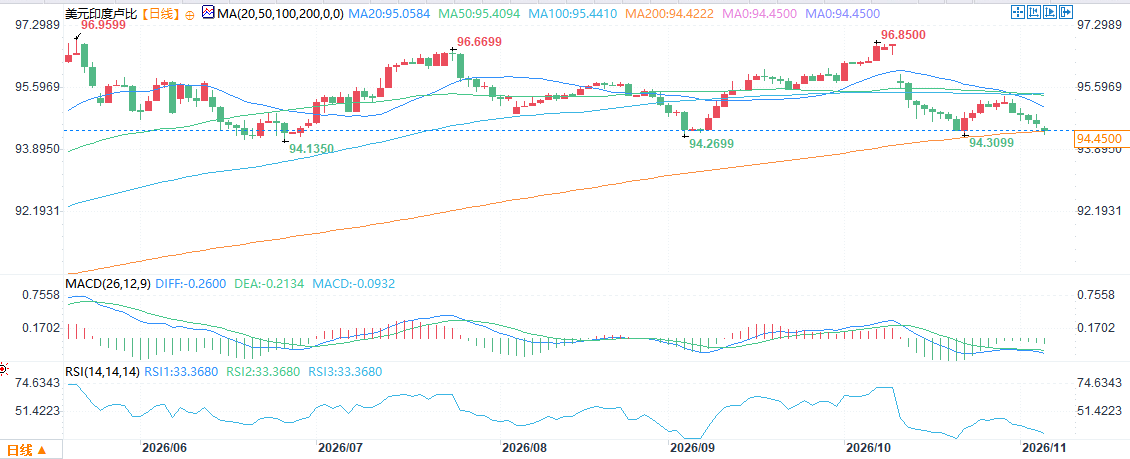 (USD/INR daily chart, source: FX678) At 16:05 Beijing time, the USD/INR exchange rate was 94.45/46.
Dollar Under Pressure: Political Stalemate and AI Regulatory Risks
The US dollar is facing strong selling pressure as markets anticipate that Democratic control of the Senate and House of Representatives could "lead to a debt ceiling impasse and a prolonged government shutdown next year," one institution stated. The institution further warned that "concerns about stricter regulation could suppress artificial intelligence stocks (we've recently seen how this has impacted the dollar)." This assessment implies that political gridlock and regulatory risks are working together, with the former affecting the continuity of fiscal policy and the latter impacting AI, a core narrative supporting dollar capital inflows.Medium-term outlook: The US dollar may weaken further in 2027, and the risk of government shutdowns will increase.
Analysts at the firm believe that the US political landscape could be an additional headwind for the dollar in the medium term. They argue that "if a more assertive Democrat raises greater objections to Republican policies, including deregulation and AI development, the dollar could weaken further into 2027." The firm adds that "the possibility of a prolonged government shutdown by mid-2027 adds justification for a weaker dollar next summer," reinforcing their view that rising political tensions could increasingly diminish the dollar's appeal.Oil Prices and Geopolitics: Risk of escalating conflict with Iran eases, supply to the Strait of Hormuz resumes
The Democratic Party's victory in the midterm elections eased concerns about a further escalation of the US-Iran conflict, leading to a sharp drop in oil prices. Meanwhile, analysts and media reports indicate that oil shipments through the Strait of Hormuz—a crucial chokepoint carrying nearly 20% of the world's energy supply—have recovered to near pre-war levels, albeit at higher costs. One organization stated, "The recovery of Gulf supplies has put the global oil market back in surplus after months of disruption due to conflict." For the rupee, the drop in oil prices and the recovery in supply constitute a substantial improvement in terms of trade, the core fundamental support for this round of price increases.in conclusion
The dollar fell to a two-month low of 94.30 against the rupee, driven by a combination of a weaker dollar and lower oil prices. On the dollar front, Democratic control of both houses of Congress raised concerns about a debt ceiling impasse and a government shutdown. Analysts warned that stricter regulations could suppress AI stocks and drag down the dollar, predicting further dollar weakness in 2027 due to political friction. On the oil front, the Democratic victory eased concerns about an escalation of the US-Iran conflict, with shipping in the Strait of Hormuz returning to near pre-war levels. The global oil market has returned to a surplus, with MCX crude oil falling nearly 17.5% from its recent high, directly improving India's terms of trade. Short-term trends depend on whether the dollar's weakness priced in by the political impasse continues, the sustainability of the recovery in oil supply, and the repricing of US economic data on interest rate hike expectations. (USD/INR daily chart, source: FX678) At 16:05 Beijing time, the USD/INR exchange rate was 94.45/46.
- Risk Warning and Disclaimer
- The market involves risk, and trading may not be suitable for all investors. This article is for reference only and does not constitute personal investment advice, nor does it take into account certain users’ specific investment objectives, financial situation, or other needs. Any investment decisions made based on this information are at your own risk.