Oil prices plunged more than 15% in a week! Two waves of shocks from the midterm election reversed the trend.
2026-11-05 15:58:26
On Thursday (November 5th) during the Asian and European sessions, international oil prices consolidated at low levels, with the WTI crude oil futures contract currently trading at $87.94. Wednesday's article explained the immediate reaction of oil prices and warned of an impending decline. At that time, oil prices were near flat, but by evening they had plummeted by 9%, falling more than 15% within a week. The midterm elections delivered two powerful shocks to oil prices. The expectation that the Democrats would at least win the House of Representatives and thus hinder the US-Iran war was the first shock. The unexpected landslide victory of the Republican Party in both the House and Senate brought the expectation of impeaching the US Secretary of Defense and the President, significantly limiting future US military operations, which was the second shock. 
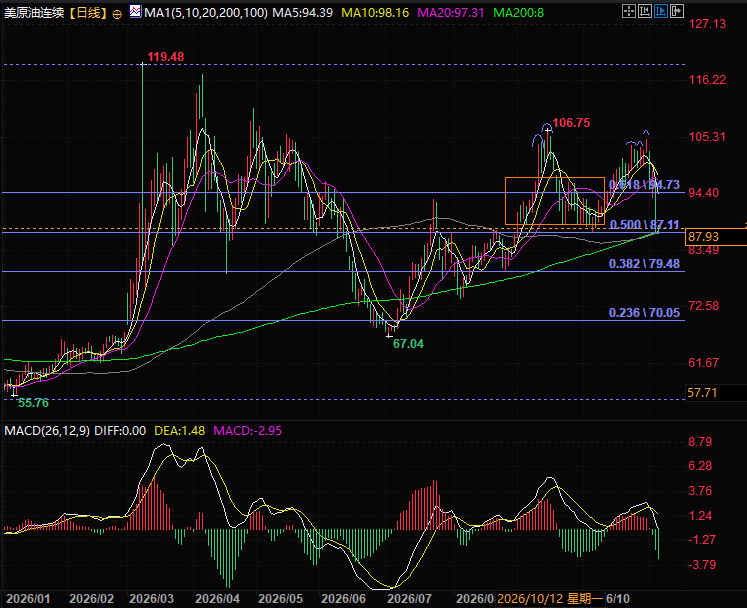 (WTI crude oil futures daily chart, source: EasyTrade) At 15:56 Beijing time, WTI crude oil futures are currently trading at $88.06 per barrel.
Election results trigger oil price repricing: risk premium falls rapidly.
With the US midterm elections concluded and the Democrats securing a majority in both the House and Senate, a sharp valuation adjustment in the oil market was triggered. Brent crude oil prices plunged as much as 10% intraday, and the energy sector weakened in tandem, with the S&P Energy Index falling 4.77%. The market's main theme shifted rapidly: from trading the safe-haven premium of "the Middle East conflict escalating at any time" to expectations that the Republican election defeat would force the Trump administration to shift towards diplomatic détente. This is the core driver of the recent deep oil price correction. Major market institutions generally agree that Vice President Vance's public attribution of the defeat to the Iran war, coupled with Democratic leader Schumer's statements pushing for an end to the conflict, significantly increased market expectations for a de-escalation of US-Iran tensions. However, traders generally agree that mere verbal statements are insufficient to support a sustained decline in oil prices; a stable and effective US-Iran de-escalation agreement is essential to digest the geopolitical premium.The Republican Party is divided, and the White House is facing a dilemma regarding its Iran policy.
Following the election defeat, internal conflicts within the Republican Party erupted, with the focus entirely on the Iran conflict. Several Republican lawmakers blamed Defense Secretary Hergsays for the loss, accusing him of lobbying Trump to launch a strike against Iran without a corresponding exit strategy or an assessment of the political costs. House Republicans plan to initiate impeachment proceedings soon, with Representative Thomas Massey preparing to submit impeachment bills after Congress reconvenes; party sources predict a high probability of success. Most senior Republicans deliberately avoided directly criticizing Trump, choosing instead to focus their criticism on Hergsays, reflecting the intense internal power struggles within the White House. Trump currently faces three options: restarting military action, reaching an agreement with Iran, or maintaining a maritime blockade coupled with economic pressure. The divisions are clear: Vice President Vance favors diplomatic negotiations and ending the conflict; the CIA director, Treasury Secretary, and other staff insist on continued economic and maritime pressure. The US military has completed large-scale operational plans, and Qatari mediators are advancing a draft agreement; Israel has repeatedly called for a US strike, but has yet to issue a presidential order for an attack. Diplomatic efforts are progressing, military preparations are being implemented simultaneously, and there is a coexistence of easing expectations and escalating risks.Iran's tough stance indicates that the physical risks in the Strait of Hormuz have not been eliminated.
Iran remains on high alert, anticipating that Trump might choose military escalation to compensate for his election defeat. The Iranian Revolutionary Guard recently reported incidents in the Strait of Hormuz: two oil tankers and a rescue tugboat caught fire in the strait's illegal shipping lanes, and one large oil tanker struck a mine and became stranded. Iranian electronic warfare units also intercepted two intruding Lucas drones, claiming firm control over the Strait of Hormuz. Physical constraints are far more rigid than futures market fluctuations: current daily ship traffic in the strait is far below pre-war levels, and war risk premiums and shipping costs remain high. A decline in crude oil futures does not equate to a return to normal shipping and supply chains; the hard risks associated with the strait, a global energy lifeline, persist.The Houthis have demanded exorbitant ceasefire terms, making the stalemate in the Bab el-Mandeb Strait difficult to resolve.
Saudi Arabia's attempt to reach a ceasefire with the Houthis has encountered extremely high hurdles. The Houthis have demanded $51 billion in compensation to cover losses from past airstrikes and blockades, while also requiring Saudi Arabia to formally recognize them as the legitimate rulers of Yemen. This massive compensation claim, coupled with these sovereignty-related demands, has put Saudi Arabia in a difficult position regarding ceasefire negotiations. Furthermore, the Houthis' recent actions highlight the lack of US control in the Middle East. The Houthis' continued attacks on Red Sea oil tankers and their control of the Bab el-Mandeb Strait, a crucial waterway, have not abated their disruptive risks. Coupled with widespread flight cancellations and delays on routes to and from Saudi Arabia by multiple UAE airlines, regional aviation and shipping continue to face pressure, and the potential for disruption to the entire Middle East energy transport chain remains.The opening of the Russia-Ukraine negotiation window has created a second clue to cross-regional disturbances.
Beyond the Middle East, the Russia-Ukraine conflict has reached a new negotiation juncture, becoming another important variable in the crude oil market. Russia has confirmed that trilateral talks between the US, Russia, and Ukraine will be held in Abu Dhabi, UAE, on November 10-11, with the Russian delegation led by Medinsky. Zelensky has already spoken with US special envoys Witkov and Kushner, submitting a negotiation proposal to the US, hoping to accelerate the ceasefire process, while continuing to request additional air defense interception munitions from the US. The direction of the Russia-Ukraine negotiations will directly impact Black Sea crude oil exports, European refined product supply expectations, and create a cross-regional resonance with the Middle East situation, requiring continuous monitoring to see if the talks achieve substantial progress.Be wary of divergence: Crude oil price decline does not necessarily mean diesel pressure will ease simultaneously.
This round of price declines was concentrated in the main crude oil contract, but the market easily overlooked the independent fundamentals of distillate fuels. Diesel supply is highly dependent on crude oil processing in the Middle East and Black Sea, as well as the operation of regional refineries. Observing diesel and crude oil together is crucial to understanding the degree of easing of the energy shock in the market, which affects the valuation levels and trends of global assets. Even if the geopolitical premium for crude oil declines, as long as shipping insurance and navigation restrictions in the Strait of Hormuz and the Bab el-Mandeb Strait remain in place, diesel freight rates and war risk premiums will remain high. Going forward, it is essential to closely monitor European diesel inventories and the resilience of North American distillate fuel demand. Diesel crack spreads may diverge from crude oil trends, and a unilateral bearish view following crude oil should be avoided.Summary and Technical Analysis:
Markets tend to react to expectations first, then track and verify signals. Currently, tanker traffic hasn't improved, nor has the black swan risk of the Middle East geopolitical crisis been eliminated, yet oil prices have still plummeted by 15%. The US midterm elections and the potential ceasefire between Russia and Ukraine have essentially capped, or even ended, oil price movements. The main driver in the later stages should be repeated geopolitical events stimulating oil price rebounds, but the core theme will be a return to supply and demand, with oil prices gradually declining in the long term. However, the negotiation conditions between the US and Iran, and between Saudi Arabia and the Houthis, are currently very demanding. White House hawks, Israeli pressure, and Iran's hardline stance could all potentially disrupt the de-escalation process at any time, leading to a rebound in oil prices. Going forward, we will focus on monitoring three types of verification signals: the implementation of the draft US-Iran agreement brokered by Qatar, actual navigation and insurance conditions in the Strait of Hormuz, and the impact of the Hegseth impeachment on Trump's Middle East policy. Simultaneously, we will monitor the outcome of the Abu Dhabi trilateral talks with Russia and Ukraine, as well as changes in diesel crack spreads. We will use diesel prices to observe global energy inflation and economic data, as energy costs and economic growth are the core drivers of oil prices' impact on the global economy. From a technical perspective, international oil prices have broken below the 0.618 Fibonacci retracement level of 94.73, and have now corrected to around 87.11, which is also the 0.500 level. This marks a reversal from an upward to a downward trend. Readers have witnessed the entire process of oil prices forming a triple top and then gradually breaking through key support levels. (WTI crude oil futures daily chart, source: EasyTrade) At 15:56 Beijing time, WTI crude oil futures are currently trading at $88.06 per barrel.
- Risk Warning and Disclaimer
- The market involves risk, and trading may not be suitable for all investors. This article is for reference only and does not constitute personal investment advice, nor does it take into account certain users’ specific investment objectives, financial situation, or other needs. Any investment decisions made based on this information are at your own risk.