One chart: The Baltic Dry Index achieved its third consecutive weekly increase, with Capesize and Panamax freight rates rising.
2026-11-06 23:46:26
Latest data shows that the Baltic Dry Index (BDI) reached 2805 points on November 6, 2026, a new high since October 12, 2026, up 2.37% month-on-month, the largest increase since November 4, 2026, and the third consecutive day of increase (including zero growth). Looking at the short-term charts, the recent 11 BDI data points show: 6 positive increases, 5 negative increases, and 0 zero increases. Specifically, the Panamax Freight Index (BPI) was 2003 points, up 2.40% from the previous value; the Capesize Freight Index (BCI) was 4344 points, up 3.65%; and the Supramax Freight Index (BSI) was 1815 points, down 0.49%. For detailed 720-day and 10-year trend charts of the Baltic Dry Index and its three sub-indices, please refer to the charts specially created by FX678. 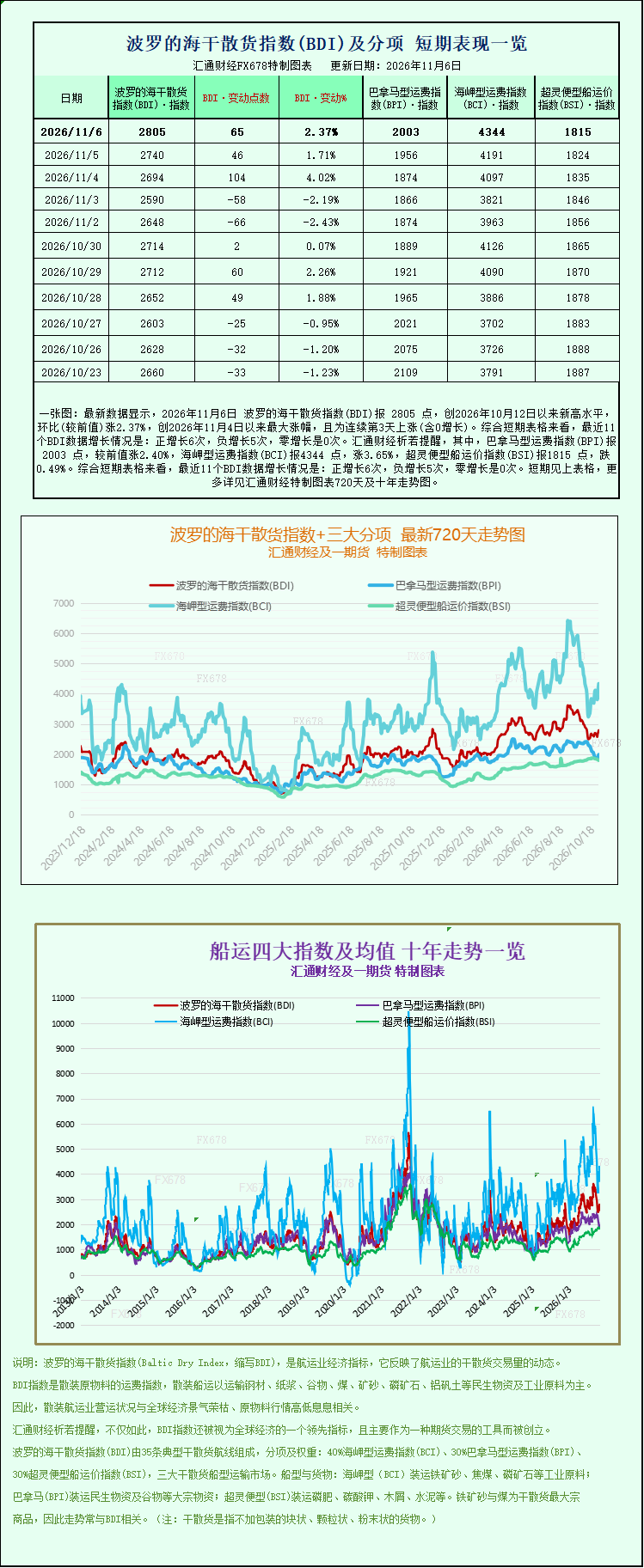 Driven by stronger freight rates for Capesize and Panamax vessels, the Baltic Dry Index (BDI) continued its upward trend on Friday, marking its third consecutive weekly gain. This reflects a further widening of the divergence in market conditions among different vessel types in the international dry bulk shipping market. While freight rates for large vessels rebounded, those for smaller vessels faced downward pressure, resulting in a generally positive market sentiment. The Baltic Dry Index (BDI) tracks freight rates for Capesize, Panamax, and Supramax vessels and is a key indicator of global dry bulk shipping trade. The index rose 65 points, or 2.37%, to close at 2805 points on Friday, reaching a new high since October 12th, with a cumulative weekly gain of 3.4%. This continued rise in the index was primarily driven by increased demand for large cargo ships fueled by commodity trade. Increased transoceanic transport of bulk raw materials such as iron ore and coal boosted charter rates for major vessel types. Looking at the data by vessel type, the Capesize Index (BCI) performed the best, rising 153 points, or 3.65%, to close at 4344 points, reaching its highest point in nearly a month. It also completed its third consecutive weekly gain, with a weekly increase of 5.3%. Capesize vessels mainly carry bulk cargoes of 150,000 tons or more, primarily iron ore and thermal coal. Changes in the earnings of this type of vessel directly reflect the demand for upstream raw material shipping in the steel industry chain. Data shows that the average daily earnings of Capesize vessels increased by $1382, reaching $35892. Iron ore futures remained stable on Friday, also recording its second consecutive weekly gain. The market generally expects further declines in coking coal prices. Lower coking coal prices can alleviate the production cost pressure on steel mills, potentially stimulating them to maintain or even expand their raw material restocking pace, thereby continuously boosting trade orders for ocean-going iron ore and providing fundamental support to the Capesize shipping market. However, it's important to recognize that the iron ore market is largely driven by expectations, and changes in the actual operating rates of downstream steel mills remain a key variable determining whether shipping demand can continue to be released. The Panamax Index (BPI) also saw a significant rebound, rising 47 points, or 2.40%, to close at 2003 points, a new high since October 27th, with a cumulative increase of 6% this week. Panamax vessels, mostly with a deadweight tonnage of 60,000-70,000 tons, primarily handle cross-border shipping of commodities such as coal and grain. With rising freight rates, the average daily earnings of Panamax vessels increased by $427 to $18,030. Orders from grain-exporting countries and demand for coal transportation in the Asia-Pacific region jointly pushed up Panamax charter rates. Seasonal global grain shipments, coupled with energy trade flows, improved market activity for medium-sized dry bulk carriers, becoming another important pillar of this index's upward trend. In stark contrast to the strong performance of the two main vessel types, the Supramax Index (BSI) bucked the trend, falling 9 points, or 0.49%, to 1815 points, its lowest level since October 9th, marking a weekly decline of 2.7% and the second consecutive week of decline. Supramax vessels are primarily focused on short-haul, small-volume bulk cargo transportation. Weak regional trade demand and relatively abundant vessel supply have suppressed freight rates for this type of vessel. This divergence in market performance between large and small vessel types reflects the current structural characteristics of the dry bulk market: long-haul bulk raw material shipping demand is recovering, but regional short-haul bulk cargo circulation has not yet recovered in tandem, resulting in an uneven market recovery. From an overall market perspective, the three consecutive rises in the BDI are due to two factors: firstly, a corrective rebound after previous price corrections; and secondly, rising trade expectations for iron ore and coal, driving demand for chartering large ocean-going cargo ships. However, the continued weakness in Supramax vessels reminds the market that the overall dry bulk industry has not yet entered a phase of full prosperity, with the rise concentrated primarily in larger vessel types. Going forward, it's necessary to continuously monitor the actual purchasing power of steel mills, the pace of global grain exports, and the deployment of shipping capacity. If downstream demand falls short of optimistic market expectations, the current upward trend in freight rates may be unsustainable. Conversely, if raw material restocking continues, freight rates for large bulk carriers are expected to remain high.
- Risk Warning and Disclaimer
- The market involves risk, and trading may not be suitable for all investors. This article is for reference only and does not constitute personal investment advice, nor does it take into account certain users’ specific investment objectives, financial situation, or other needs. Any investment decisions made based on this information are at your own risk.