Gold Trading Alert: Trump downplays Iran situation, oil price plunge and weakening dollar combine to push gold prices to a two-week high; US CPI data is coming soon!
2026-11-10 07:58:28
Global gold markets rebounded significantly on Monday (November 9), with spot gold surging over 1.5% to a two-week high of $4148.65 per ounce, closing at $4141.17 per ounce. This was primarily driven by a weaker dollar and a significant drop in oil prices easing inflation concerns. Trump's downplaying of further military action against Iran boosted risk appetite and accelerated the decline in oil prices. The People's Bank of China's substantial increase in gold holdings in October also provided support. While gold prices benefited from multiple positive factors in the short term, high interest rate expectations remain a constraint, and future price movements will depend on close monitoring of inflation and geopolitical developments. After a brief adjustment following last week's non-farm payroll data release, the market is now focusing on the upcoming US inflation data, seeking further clues about the Federal Reserve's interest rate path. On Tuesday (November 10) in early Asian trading, spot gold hovered around $4140. 
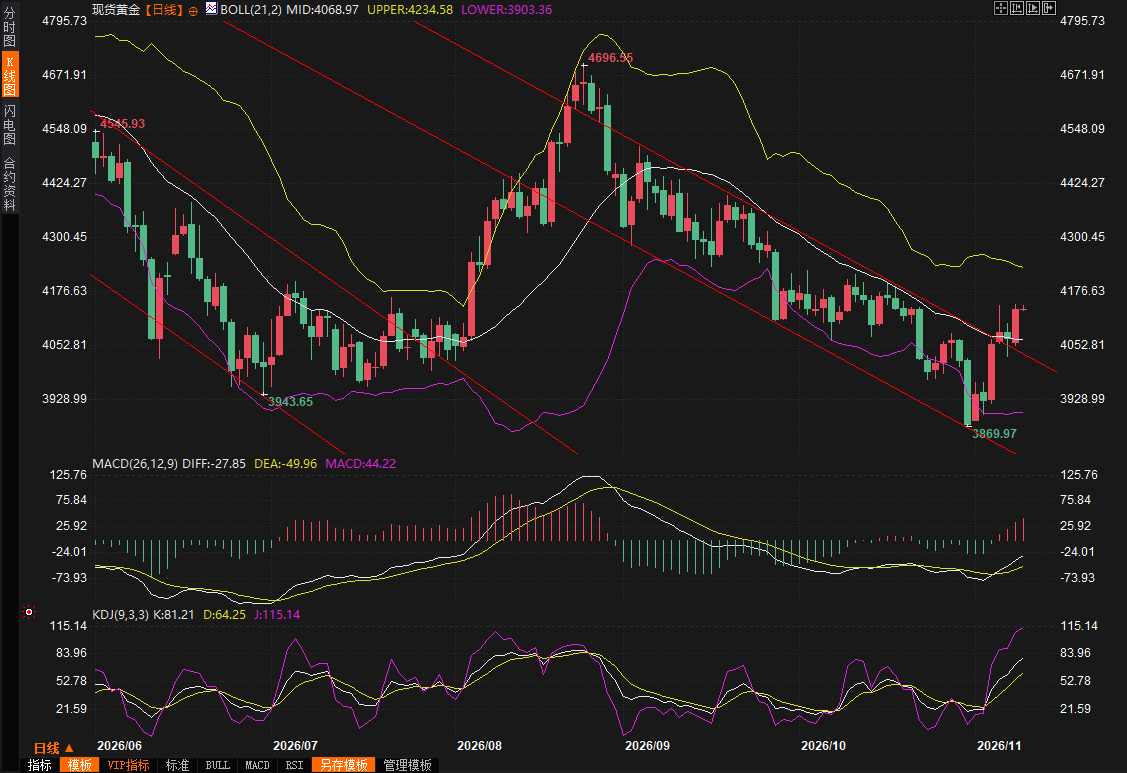 (Spot gold daily chart, source: EasyTrade) At 07:52 Beijing time, spot gold is currently trading at $4139.06 per ounce.
A weaker dollar and lower oil prices were the direct drivers of the decline.
One of the key drivers behind the rise in gold prices was the significant decline in the US dollar index. The dollar index fell 0.6% on Monday, closing at 101.66, erasing most of Friday's gains. A weaker dollar directly reduces the cost of dollar-denominated gold for overseas buyers, thus increasing its relative attractiveness. Meanwhile, international oil prices fell sharply, with Brent crude futures settling down by more than $7, hitting a low of $90.62 per barrel, the lowest level since late August. This change significantly eased market concerns about persistently high inflation. Jim Wyckoff, a market analyst at the Gold Exchange, pointed out that the lower dollar index on the first trading day of the week, coupled with falling oil prices, indicates that inflation concerns are fading. This is beneficial for the gold and silver markets, as easing inflationary pressures may prompt central banks to adopt a more accommodative monetary policy stance. Since the escalation of the conflict related to Iran in late February, persistently high energy prices have been a significant factor driving up inflation expectations and forcing central banks to maintain higher interest rates. A high-interest-rate environment weakens gold's competitiveness relative to yield-generating assets, and the current rapid decline in oil prices provides a temporary respite for this logic.Geopolitical signals and market sentiment recovery
The immediate trigger for the oil price plunge came from US President Trump's latest remarks on the situation with Iran. Trump clearly stated that he was highly unlikely to order a new round of military strikes against Iran, provided that negotiations aimed at ending the conflict made progress. This statement quickly boosted market risk appetite and caused a significant pullback in the energy risk premium that had been high due to expectations of escalating war. Although there were still reports of attacks on ships near the Strait of Hormuz and actual fighting had not completely subsided, the improved prospects for peace were enough to give sellers the upper hand. It is worth noting that the Democratic Party's victory in the midterm elections, which won control of both the Senate and the House of Representatives, had previously fueled market hopes that the war with Iran could end soon, pushing gold prices up by about 5% last week. However, stronger-than-expected US non-farm payroll data on Friday reinforced expectations that the Federal Reserve might maintain higher interest rates for a longer period, causing gold prices to fall back. On Monday, Trump's further downplaying of the necessity of military action injected another boost into market sentiment. He even stated that Iran is "virtually finished" militarily, the blockade of the Strait of Hormuz against Iran continues, and the United States is ready to act at any time, but there seems to be no need to take immediate military action.Central bank gold purchases: the long-term ballast of gold
Beyond short-term fluctuations, the gold market has also received a significant long-term boost. Data from the World Gold Council shows that the People's Bank of China increased its gold reserves by approximately 25.8 tons in October, the largest monthly increase in three years. This data is significant. Against the backdrop of policy uncertainty surrounding the US dollar's credit system following the midterm elections and the US strategic petroleum reserves falling to their lowest level since October 1982 at 279.5 million barrels, the continued increase in gold reserves by major central banks worldwide reflects a long-term recognition of gold's value as a reserve asset. This official gold purchase provides medium- to long-term demand support for gold prices and also reflects the strategic intention of some central banks to continue allocating gold reserves amid global uncertainty.Inflation data and the Federal Reserve's path become key short-term variables.
While geopolitical and oil price factors provided short-term support for gold, the market's real focus remains on the upcoming US inflation data this week. Tuesday's Consumer Price Index (CPI) and Friday's Producer Price Index (PPI) will be key indicators of the Federal Reserve's stance at its December policy meeting. The CME Group's FedWatch tool shows traders currently expect an 82% chance of a Fed rate hike in December, a expectation further solidified by Friday's strong non-farm payroll data. In the bond market, US Treasury yields rose slightly on Monday, reflecting a weakening demand for safe-haven assets amid a rebound in risk assets. The 2-year and 10-year Treasury yield curve flattened, indicating that the market's pricing in a continued high interest rate by the Fed in the short term remains firm. Richmond Fed President Barkin stated on Monday that the Fed should "act cautiously" in dealing with inflation, which remains the biggest risk, further reinforcing market expectations of a relatively hawkish policy stance. From a broader perspective, the US dollar index gave back most of Friday's gains on Monday, and a rebound in risk appetite also put pressure on safe-haven currencies. Some analysts believe that the main problem currently facing dollar trading is overcrowded market positions, with active participants already holding a large number of long dollar positions, limiting further upside potential for the dollar. At the same time, the political landscape changes brought about by the midterm elections may also have a marginal impact on investment in high-growth sectors of the US economy, such as artificial intelligence, thus potentially putting pressure on the dollar in the medium term.The short- and medium-term logic of gold under the interplay of multiple factors
In summary, Monday's strong rebound in gold prices was essentially a result of the combined effects of a temporary easing of geopolitical tensions, a rapid decline in oil prices alleviating inflation concerns, and a weakening dollar. These factors have temporarily reduced the downward pressure on gold from the high-interest-rate environment, allowing its safe-haven and inflation-hedging attributes to regain market attention. The People's Bank of China's significant increase in gold holdings provided additional demand support for gold prices. However, the market still needs to be wary of potential volatility from this week's inflation data. If the CPI data remains strong, expectations of a December rate hike by the Federal Reserve may be further strengthened, potentially limiting the upside potential for gold. Conversely, if inflation shows clear signs of cooling, it could accelerate market pricing in a shift towards looser monetary policy, opening up greater upside potential for gold prices. Meanwhile, the actual developments in the Iranian situation, the navigation status of the Strait of Hormuz, and subsequent statements from Trump will remain key variables influencing oil prices and risk sentiment. Gold is currently in a highly sensitive window of opportunity. In the short term, the movements of the US dollar and oil prices will continue to dominate price trends. In the medium term, the Federal Reserve's policy path, global central bank gold purchases, and geopolitical developments will jointly determine whether gold prices can break through the previous trading range and begin a new trend. While paying attention to technical support and resistance levels, investors also need to closely monitor this week's inflation data and speeches by relevant officials to grasp the rhythm of gold in a complex and volatile macroeconomic environment. (Spot gold daily chart, source: EasyTrade) At 07:52 Beijing time, spot gold is currently trading at $4139.06 per ounce.
- Risk Warning and Disclaimer
- The market involves risk, and trading may not be suitable for all investors. This article is for reference only and does not constitute personal investment advice, nor does it take into account certain users’ specific investment objectives, financial situation, or other needs. Any investment decisions made based on this information are at your own risk.