Hawkish Bank of Japan vs. Hawkish Federal Reserve: Whose direction should the yen take?
2026-11-10 15:34:32
The dollar rose slightly against the yen to around 158 in European trading on Tuesday (November 10). The Bank of Japan's hawkish stance may limit the pair's upside. Traders remain highly wary of potential intervention by Japanese authorities in the currency market. US consumer price index data will be in focus later on Tuesday. According to the summary of opinions from the October policy meeting released on Tuesday, Bank of Japan board members believed a near-term rate hike was necessary, suggesting a high probability of action in December. One of the nine board members stated, "The central bank should decide on the next policy rate hike when possible, without being overly cautious." 
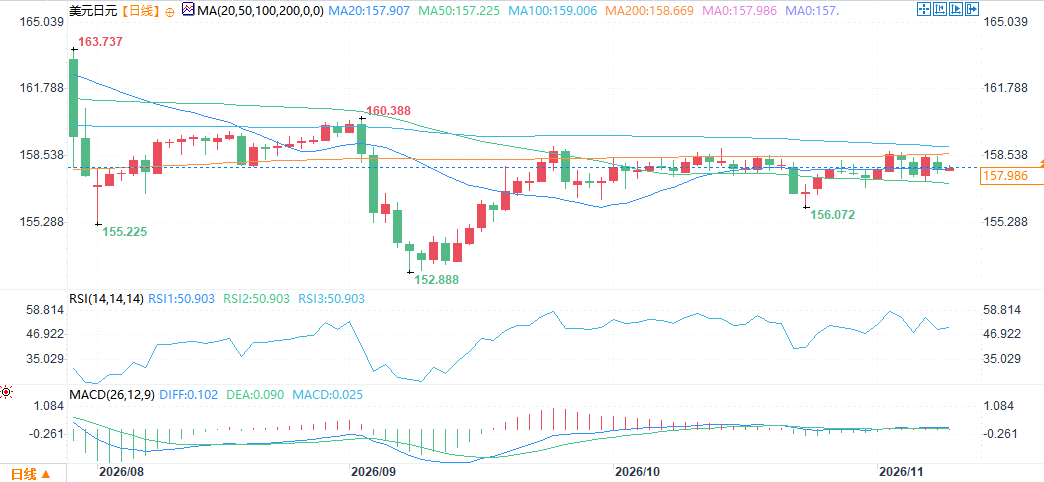 (USD/JPY daily chart, source: FX678) At 15:29 Beijing time, USD/JPY was trading at 157.97/98.
Intervention Risk: Market intervention over three trading days, with a record 7.98 trillion yen intervention on July 30th.
Japanese officials' intervention in the currency market could boost the yen against the dollar in the short term. Quarterly data released by the Ministry of Finance on Monday showed that Japan intervened in the foreign exchange market over three trading days between July 30 and August 3. The largest intervention occurred on July 30, totaling 7.98 trillion yen (approximately $50.36 billion), surpassing the previous record of 6.28 trillion yen set on April 30, 2025. This data implies that Tokyo has demonstrated its willingness to spend heavily to defend the yen, and the risk of intervention is real when the exchange rate approaches 158, limiting the upside potential of the dollar against the yen.Institutional Views
Analysts have emphasized that the yen is the best-performing currency this year, "the second-best performing currency among the G10 in the six months to date." They acknowledge that "this strong ranking was achieved with the help of three days of large-scale foreign exchange intervention during the summer (including joint support with the US Treasury)," but point out that the currency has also recently risen on its own merits. Specifically, "the yen has outperformed the dollar on a one-month perspective, and the market is clearly reluctant to push USD/JPY above the 158.70 area, which coincides with the 200-day moving average." On the policy front, the bank notes that "although the sell-off in the Nikkei 225 late last week lowered market expectations for a December rate hike by the Bank of Japan, strong September wage data supports the possibility of further tightening next month and next year." Against this backdrop, they believe that "USD/JPY may fall back to the 155.00 area on a three-month perspective." They add that "another component of any turnaround for the yen could be a more robust tone in the Japanese government bond market," which "could provide a more favorable backdrop for the yen in the coming months." From a funding and fiscal perspective, the bank emphasized that "Japan's primary deficit is better than the G7 average, and there is speculation that Japan's large asset management institutions may be inclined to repatriate funds to take advantage of higher Japanese government bond yields, which will have a positive impact on the yen." Looking ahead, they noted that "the third-quarter GDP and October national CPI figures to be released next week will be closely watched by Bank of Japan observers," and concluded that "we remain cautiously optimistic about the medium-term outlook for the yen."Fed Daily: Hawkish tone in speech, inflation is the top priority
San Francisco Federal Reserve President Mary Daly's latest remarks delivered a distinctly hawkish signal. She explicitly emphasized that inflation "must be the top priority," even though the latest jobs report was described as good news and wage growth "has not boomed." Daly pointed out that real wages are actually declining and inflation has remained high for too long, therefore policy "will have to" tighten further, while remaining data-dependent on timing. This statement, built on confidence in a strong labor market and limited concerns about economic growth, indicates her inclination to support additional rate hikes. Daly's comments added incremental upward pressure to market expectations of further tightening. In this context, the dollar and Treasury yields typically find support as traders price in a higher policy rate path. Her remarks also reminded the market that even with robust jobs data, significant voices within the Fed still consider a decline in inflation an uncompromising priority, thus limiting the scope for easing expectations.in conclusion
The USD/JPY pair rose slightly to around 158, but the Bank of Japan's hawkish stance and intervention risks may limit upside potential. The summary of the October meeting indicates a near-term rate hike is necessary, with a December action highly likely. Ministry of Finance data shows a record 7.98 trillion yen intervention on July 30th, indicating Tokyo's willingness to spend significantly. Analysts point out that the yen is the second-best performing currency among G10 currencies this year, and the market is reluctant to push USD/JPY above the 200-day moving average of 158.70, expecting a pullback to 155 within three months. Rising Japanese government bond yields and asset repatriation provide medium-term support. US October CPI is expected to be 0.3% month-on-month and 0.2% core, with no year-on-year comparison due to the government shutdown a year ago; overheated inflation will strengthen expectations of a December rate hike and boost the dollar. The Fed's hawkish daily comments, prioritizing inflation, provide support for the dollar and yields. Short-term direction depends on CPI – an overheated CPI could test the 158.70 resistance level, while a weaker CPI will likely see policy and intervention support for the yen prevail. (USD/JPY daily chart, source: FX678) At 15:29 Beijing time, USD/JPY was trading at 157.97/98.
- Risk Warning and Disclaimer
- The market involves risk, and trading may not be suitable for all investors. This article is for reference only and does not constitute personal investment advice, nor does it take into account certain users’ specific investment objectives, financial situation, or other needs. Any investment decisions made based on this information are at your own risk.