Lombardy does not rule out a December rate hike, which could trigger renewed volatility in the pound.
2026-11-10 20:52:27
On Tuesday, November 10th, the pound was trading around 1.34 against the dollar. The Bank of England raised its benchmark interest rate by 25 basis points to 4.00% on November 5th, the first rate hike since August 2023. The Monetary Policy Committee approved the decision by an 8-1 majority, with external member Catherine Mann advocating for a 50 basis point increase to 4.25%. The decision was made against the backdrop of the Middle East conflict entering its ninth month, persistently high energy prices, and the UK's September CPI inflation rate rising to 3.5%, with the Bank of England projecting inflation to approach 5% by mid-2027. Deputy Governor Claire Lombardy stated that a further rate hike in December was not ruled out, but current information was insufficient. This series of changes has led the market to reassess the pound's interest rate path and economic resilience. 
Monetary policy shift and inflationary pressures
The core logic behind the Bank of England's latest interest rate hike lies in the persistence of the energy shock. The conflict has led to high oil and gas prices, directly pushing up fuel and utility costs and potentially having indirect effects through supply chain transmission. The Monetary Policy Committee judged that although evidence of a second-round effect is still limited, inflationary pressures in the pipeline are sufficient to justify an interest rate increase. Catherine Mann's 50-basis-point proposal emphasized risk management and policy credibility, arguing that a larger adjustment would help prevent inflation dynamics from embedding into price and wage settings. The Bank of England's central forecast indicates that inflation will approach 5% in the second quarter of 2027, before falling back as the energy base effect fades and tightening policies take effect. Analysts point out that the guidance is generally hawkish, and the possibility of further rate hikes remains clearly reserved unless the Middle East conflict is resolved.Official statements and uncertainty about the path
In the November meeting minutes, Claire Lombardy indicated that further interest rate hikes might be necessary in the near term if inflationary pressures do not ease. In a recent interview, she added that the December decision depends on the evolution of the conflict, energy prices, and a combination of broader data, and that there is currently insufficient information to make a judgment. She also described the UK economy as being in a "slow gear," with slower hiring but limited layoffs, and young people being more significantly impacted in their job markets. Governor Andrew Bailey also pointed out that without new information softening inflation risks, further interest rate hikes are justifiable. These statements have made the December 17th meeting a focus of market attention, with its path heavily dependent on upcoming growth and price data, rather than a pre-determined trajectory.Economic growth data is about to be released
The UK will release its preliminary Q3 GDP figures on November 12th, while the Eurozone will update its data on November 13th. These figures will provide direct evidence of economic resilience. The Bank of England has previously observed stronger-than-expected activity, which could either support further tightening or limit the scope for interest rate hikes due to slower growth. In the Eurozone, preliminary data shows Q3 growth of approximately 0.4% quarter-on-quarter, but significant divergence exists among member states. If the data shows weakening momentum, it will create a policy trade-off with rising inflation; if resilience persists, it could strengthen the Bank of England's vigilance regarding a second round of effects. The market will assess the conditionality of the interest rate path based on this data, rather than simply extrapolating linearly.GBP/USD Technical Indicators
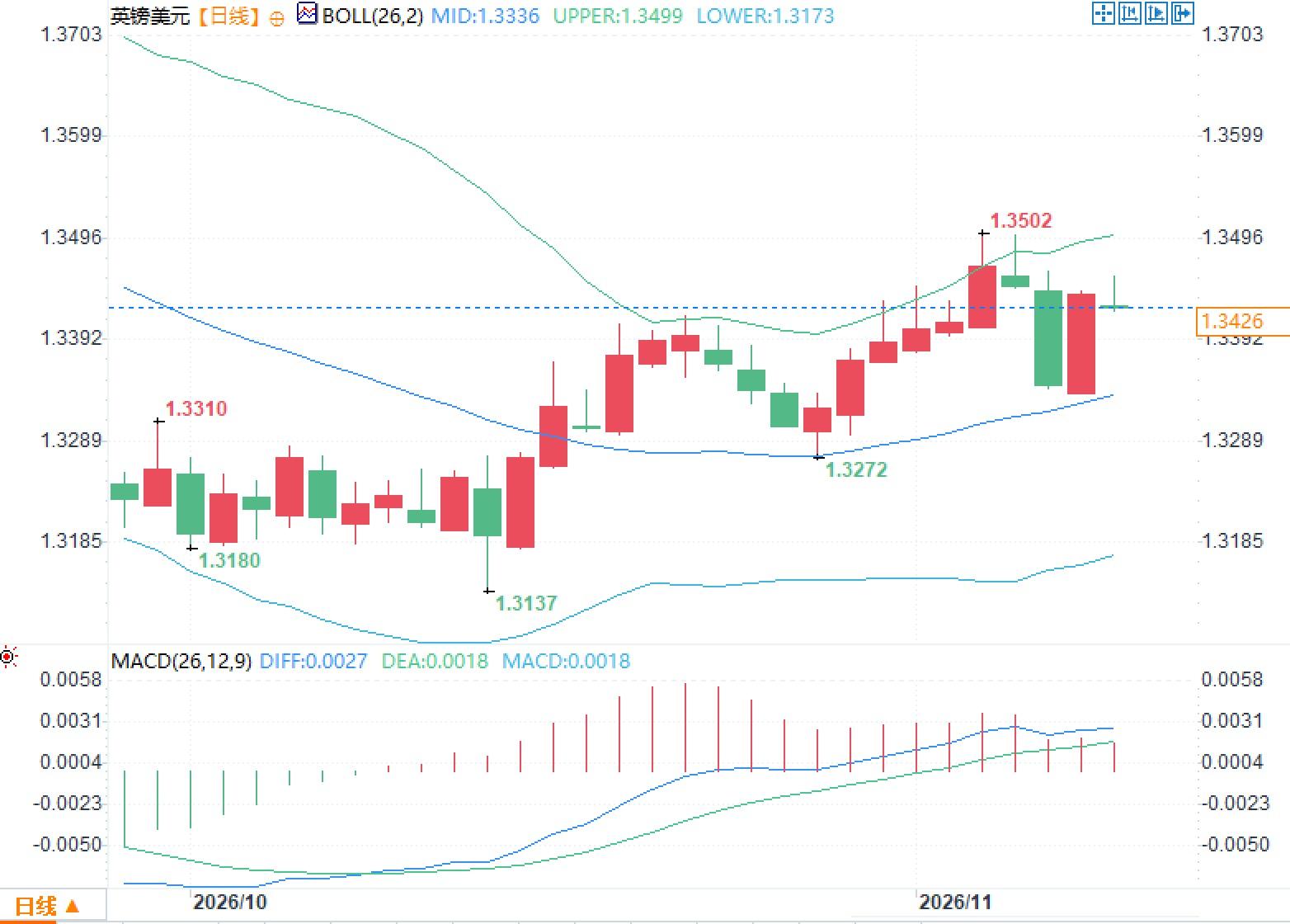
The daily chart shows the GBP/USD pair currently trading around 1.3425. The Bollinger Bands have a middle band at 1.3336, an upper band at 1.3499, and a lower band at 1.3173, with the price fluctuating between the middle and upper bands. The MACD histogram shows the DIFF at 0.0027 and the DEA at 0.0018, with the histogram showing positive values but limited amplitude. The relative position of the price to the middle band, changes in the Bollinger Band width, and the expansion and contraction of the MACD histogram all reflect the current volatility characteristics.Frequently Asked Questions
Question 1: What were the main drivers behind the Bank of England's latest interest rate hike? Answer: The ongoing conflict in the Middle East has pushed up energy prices, causing inflation to rise from a low level to 3.5%, and is expected to approach 5% by mid-2027. The Committee believes that pipeline pressures are sufficient to justify raising interest rates to prevent the indirect effects from widening. Question 2: What is Claire Lombardy's stance on the December meeting? Answer: She clearly stated that she would not rule out another rate hike, but emphasized that information is still insufficient, and the decision depends on the evolution of the conflict, energy prices, and broader data, reflecting a data-dependent nature. Question 3: What is the significance of the upcoming GDP data for policy assessment? Answer: The preliminary UK Q3 GDP data on November 12 will test the resilience of the economy. Stronger-than-expected figures may strengthen inflation vigilance, while weaker-than-expected figures may limit further tightening space, but policy will remain focused on the inflation path.- Risk Warning and Disclaimer
- The market involves risk, and trading may not be suitable for all investors. This article is for reference only and does not constitute personal investment advice, nor does it take into account certain users’ specific investment objectives, financial situation, or other needs. Any investment decisions made based on this information are at your own risk.