Will the incomplete CPI data, which exceeded expectations, affect the Federal Reserve?
2026-11-10 21:44:32
The U.S. Bureau of Labor Statistics released October's CPI price data. Due to the government shutdown last October, there was no official year-on-year data; only month-on-month (current month compared to the previous month) figures could be used to judge price trends. This month's data: Core CPI rose 0.3% month-on-month (expected 0.2%, previous 0.3%), and overall CPI rose 0.4% month-on-month (expected 0.3%, previous 0.6%). Core CPI, which excludes oil and food prices, is the inflation indicator most closely watched by the Federal Reserve.  The market reacted quickly after the data was released: spot gold fell by $30 from $4080 (-1.4%) to $4050 (-2.22%) within one minute; the US dollar index rose by about 30 points in one minute, reaching a high of 102.04.
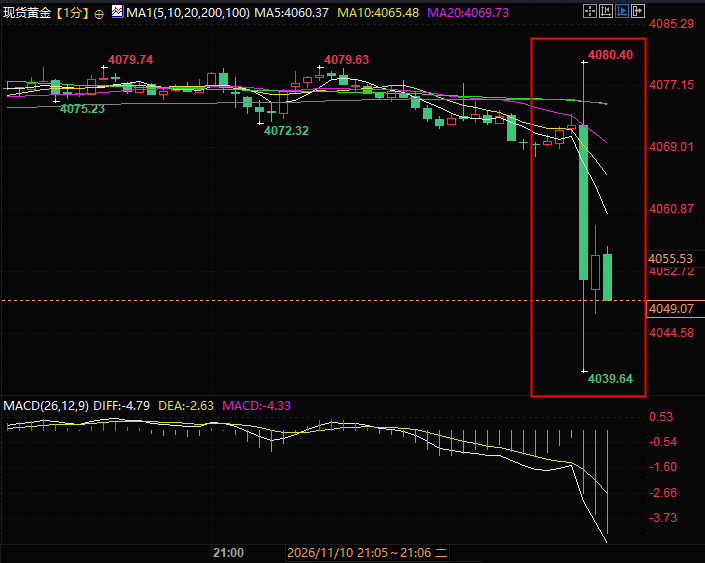 (1-minute chart of spot gold, source: EasyForex)
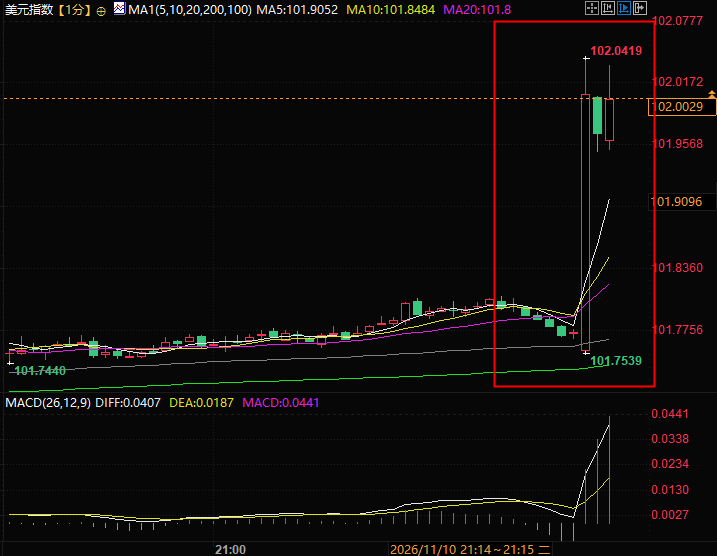 (US Dollar Index 1-minute chart, source: EasyForex) Rising interest rate expectations have increased the attractiveness of US dollar assets. High interest rate expectations are putting pressure on gold, a non-interest-bearing asset, causing a rapid short-term drop in gold prices, while US Treasury yields are rising in tandem. The AI technology sector, which had previously been under pressure, is facing renewed pressure, as high interest rates will suppress the valuations of growth stocks. The market will continue to monitor the service sector sub-sector to determine whether this current inflation stickiness is a short-term disturbance or a continuing trend.
The market reacted quickly after the data was released: spot gold fell by $30 from $4080 (-1.4%) to $4050 (-2.22%) within one minute; the US dollar index rose by about 30 points in one minute, reaching a high of 102.04. (1-minute chart of spot gold, source: EasyForex) (US Dollar Index 1-minute chart, source: EasyForex) Rising interest rate expectations have increased the attractiveness of US dollar assets. High interest rate expectations are putting pressure on gold, a non-interest-bearing asset, causing a rapid short-term drop in gold prices, while US Treasury yields are rising in tandem. The AI technology sector, which had previously been under pressure, is facing renewed pressure, as high interest rates will suppress the valuations of growth stocks. The market will continue to monitor the service sector sub-sector to determine whether this current inflation stickiness is a short-term disturbance or a continuing trend.Price Trend Review: Core inflation stickiness becomes more pronounced, while energy pressures ease somewhat.
Core CPI rose 0.3% month-on-month for two consecutive months in August and September, a key red line for the Federal Reserve. In October, core CPI remained stuck at 0.3%, failing to show the cooling expected by the market, confirming the stickiness of inflation. Overall CPI fell from 0.6% to 0.4%, with the short-term boost from the energy component weakening, but the decline was less than expected. A key limitation here is the lack of a year-on-year comparison. Based solely on this month-on-month data, it's impossible to fully assess inflationary pressure over a one-year timeframe, and it's not possible to directly conclude that inflation has peaked or continues to rise.The lack of year-on-year data significantly constrains the Federal Reserve's judgment.
Year-on-year CPI is a core benchmark used to measure the annual rate of price increases and assess proximity to the 2% target. The lack of data this time presents several shortcomings: it's impossible to use the base effect to determine whether the current reading represents a continuation of the trend or simply an illusion caused by a high/low base from the same period last year; the year-on-year estimates from institutions are merely model projections and lack official validity, meaning the Federal Reserve won't directly accept them. This fragmented and incomplete CPI data is unlikely to support a directional interest rate adjustment on its own. Warsh consistently advocates for seeing continuous, complete, and cross-validated trends before acting, rather than relying on isolated, flawed monthly data for major policy adjustments. Even if the current CPI happens to fall within Waller's warning line, its impact on the Fed's final decision will be diminished; it can only serve as a reference point, not a decisive factor.Interest rate hike expectations have changed dramatically: the risk of a 50 basis point rate hike has risen again.
Prior to the data release, Waller had issued a strong signal: if core inflation remained at 0.3%, a 0.5 percentage point rate hike was not ruled out; a slight cooling of inflation would likely result in a 0.25 percentage point rate hike. Previously, the market had been betting on a decline in inflation, and the tail risk of aggressive rate hikes had cooled. This time, core CPI fell to 0.3%, higher than the expected 0.2%, directly reactivating trading expectations for a 50 basis point rate hike. Market pricing adjusted accordingly: the probability of a December rate hike further increased, some traders began to repric the possibility of a significant rate hike, and expectations for further rate hikes next year also rose. The market generally interprets Waller's previous warnings as not merely verbal threats; 0.3% was his critical threshold. However, opinions within the Federal Reserve are not unified, and given the lack of year-on-year comparisons in this data, an aggressive rate hike plan will not be locked in based solely on this one reading. The subsequent trends in rent, hotel, and other service prices remain key observation items.How do Wall Street institutions interpret this CPI?
Following the data release, institutional opinions diverged significantly. Goldman Sachs viewed the data as hawkish, with inflation stickiness exceeding expectations, bringing the possibility of a 50 basis point rate hike back into play. However, they cautioned that the lack of year-on-year comparisons in this CPI data, coupled with the inherent randomness of single-month figures, meant that a renewed acceleration in inflation could not be definitively concluded, and further data verification was needed. Morgan Stanley believed that inflation had not cooled as expected, and service sector prices remained resilient, making a December rate hike virtually certain. However, considering the data's shortcomings, the Fed was likely to prioritize a 25 basis point hike rather than immediately moving to 50 basis points.What should we focus on next?
This inflation data confirms sticky inflation, but it's an incomplete monthly reading and doesn't necessarily indicate a full-blown inflation rebound. Two key points to watch are Friday's Producer Price Index (PPI), a crucial input to the Fed's core PCE indicator; and subsequent statements from Fed officials to see how they interpret this unique CPI. In short: October's core CPI was flat compared to the previous month but higher than expected, indicating sticky inflation, leading to a dollar rally and a gold price plunge, and bringing back the risk of a 50 basis point rate hike. However, this data itself has flaws, and given Warsh's "see the trend before acting" approach, the Fed will likely remain on the sidelines and won't easily make aggressive interest rate decisions.- Risk Warning and Disclaimer
- The market involves risk, and trading may not be suitable for all investors. This article is for reference only and does not constitute personal investment advice, nor does it take into account certain users’ specific investment objectives, financial situation, or other needs. Any investment decisions made based on this information are at your own risk.