Think tanks criticize the Bank of England for being too conservative in raising interest rates, suggesting that high interest rates may persist for a long time.
2026-11-11 13:44:28
A report released by the renowned think tank, the National Institute of Economic and Social Research (NIESR), criticized the Bank of England for being too cautious in its response to inflation and for its insufficient interest rate hikes. The report argued that if the policy pace remains too soft, UK inflation may remain above the 2% target for an extended period, and interest rates will have to be kept at higher levels for a longer time, plunging the UK economy into a predicament of high inflation and low growth.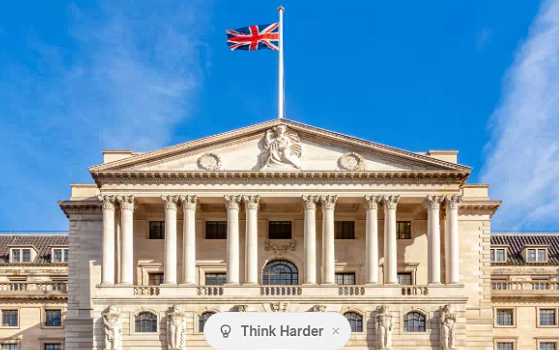
Interest rate hikes are seen as conservative, raising the risk of a wage-inflation spiral.
The Bank of England's Monetary Policy Committee raised its benchmark interest rate from 3.75% to 4% last week, signaling the possibility of further rate hikes if inflationary pressures from the Iranian conflict persist. David Aikman, director of the National Institute of Economic and Social Research, called on the Bank of England to take more aggressive tightening action. He said that various conditions are creating a cycle of wages rising in line with inflation, and UK inflation is expected to exceed 4% after the new year. With the 2027 wage agreement being finalized around this time, the risk of inflation solidification is rising continuously. A mere 25 basis point rate hike is far from enough; the longer the Monetary Policy Committee delays, the greater the tightening will be required later. Currently, UK inflation is at 3.5%, significantly higher than the Bank of England's 2% target. Soaring fuel prices are the core factor driving up prices. Since the escalation of the US-Iran conflict at the end of February, international oil and gas prices have risen rapidly, with Brent crude oil holding above $100 per barrel for several weeks, a significant jump from the pre-conflict price of around $70. However, on Tuesday (November 10), influenced by Trump's statement that he was unlikely to take military action against Iran at this stage, Brent crude oil fell below $90 at one point, hitting a new low since August 31.A brief dip in oil prices failed to dispel underlying concerns, and renewed US inflation data reignited market anxieties.
The decline in oil prices initially eased market sentiment, but investor optimism quickly cooled after the release of US October inflation data. US inflation rose 0.4 percentage points month-on-month from September, demonstrating that the transmission effect of high oil and gas prices continues to push up the costs of various goods and services. On the same day, the S&P 500 index fell 0.9% in the afternoon session on Wall Street. The economic forecasting benchmark of the UK's National Institute of Economic and Social Research (NIESR) is based on the assumption that oil prices will remain at $105 per barrel. NIESR economist Stephen Millard said that although oil prices have fallen, bottlenecks in shipping and refining remain, and the decline in end-consumer prices will be very slow. Furthermore, the decline in oil prices is highly dependent on Trump maintaining his current policy stance, and given his past history of policy shifts, there is considerable uncertainty.Fiscal policy is also hesitant, and dual pressures from both inside and outside the economy are dragging down the economic outlook.
Besides the soft monetary policy, think tanks have also criticized the UK's fiscal arrangements. Chancellor John Healey's budget proposal last month avoided difficult fiscal adjustments, and research institutes estimate that if the operating model of the past decade continues, the fiscal deficit will reach £30 billion next year. David Ekman said that if the market judges that the UK will continue to expand spending in areas such as defense without corresponding cuts to other expenditures, the financial market will punish it by raising the UK's financing costs. Rising energy prices coupled with higher global financing costs are creating a double impact, while both monetary and fiscal policies are delaying key decisions. The institution predicts that the UK's economic growth rate will be 1.6% this year, but under the pressure of high inflation, high interest rates, and fiscal austerity, the growth rate will fall to 0.9% in 2028, significantly dragging down household and business confidence.Conclusion
The UK currently faces the dual challenges of external energy shocks and lagging internal policy adjustments. Think tank warnings suggest that if the Bank of England does not accelerate its tightening pace, the cost of entrenched inflation and persistently high interest rates will be even greater. Oil price fluctuations, the trajectory of US inflation, and the UK's fiscal decisions will collectively determine the medium- to long-term direction of UK inflation and interest rates.- Risk Warning and Disclaimer
- The market involves risk, and trading may not be suitable for all investors. This article is for reference only and does not constitute personal investment advice, nor does it take into account certain users’ specific investment objectives, financial situation, or other needs. Any investment decisions made based on this information are at your own risk.