Why is the pound's upside still limited despite the Bank of England's warning of a second round of inflation?
2026-11-11 19:04:29
On Wednesday, November 11th, the British pound rebounded modestly against the US dollar from a one-and-a-half-week low of around 1.3300, currently trading near 1.332. This movement stemmed from expectations that diplomatic progress in the Middle East conflict would reduce demand for the safe-haven dollar, while the Bank of England's concerns about persistent inflation supported the pound. However, US October inflation data reinforced expectations of further tightening by the Federal Reserve, limiting further upside potential for the currency pair. With fundamental factors intertwined, market volatility remained near its recent average. 
Geopolitical factors moderating demand for safe-haven assets
The Middle East conflict has entered its ninth month, with energy prices remaining above pre-conflict levels. US Secretary of State Marco Rubio recently stated that there is currently no need for large-scale military action. These statements indicate that diplomatic channels are still progressing, with Iran suggesting a shorter timeframe for resuming negotiations. The conflict-related premium has declined, reducing marginal demand for the US dollar as a safe-haven asset. While energy supply disruptions have not been completely eliminated, the probability of short-term military escalation has decreased, providing some support for the pound against the dollar. Traders are focusing on the transmission path of subsequent negotiation progress to crude oil and refined product prices, and its potential impact on cross-asset correlations.Divergence in Monetary Policy Paths and Inflation Transmission
The Bank of England raised its benchmark interest rate by 25 basis points to 4% in early November, with a vote of 8 to 1, one of whom advocated a 50 basis point hike. The committee explicitly warned that rising energy prices could trigger a second-round effect, and that the embedding of inflation expectations needed to be prevented. The UK's September CPI was 3.5% year-on-year, and institutions predict that inflation may rise further in the medium term, driven by energy costs. Policy communication emphasized maintaining a restrained stance to prevent a wage-price spiral. US October CPI data showed a 0.4% month-on-month increase overall and a 0.3% month-on-month increase in core inflation, both higher than market expectations. Federal Reserve Governor Christopher Waller stated in a speech in London that if core inflation remains at 0.3% or higher, a 50 basis point rate hike should be considered at the December meeting; otherwise, it could damage policy credibility. He also pointed out that current interest rates may not be sufficient to adequately curb inflationary pressures. The market has already fully priced in a December rate hike by the Fed, with some participants pricing in the possibility of a larger step. Both the Federal Reserve and the Bank of England are in the process of dealing with energy-driven inflation, but their paths and paces differ, and this divergence constitutes one of the core variables in the pricing of the pound against the dollar.Technical patterns and volatility characteristics
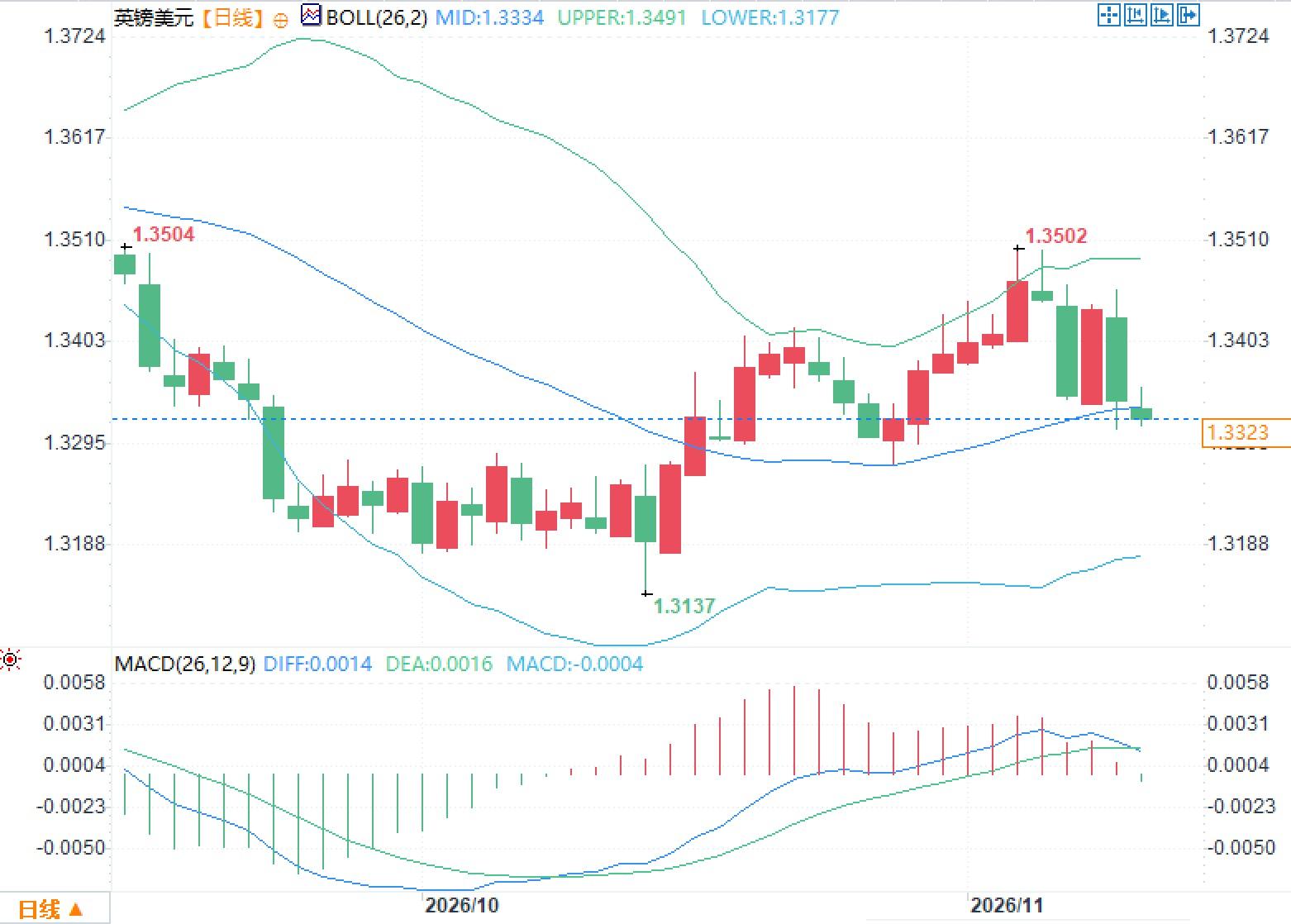
The daily chart shows the GBP/USD price trading near the middle Bollinger Band, which is around 1.3334, with the upper band at 1.3491 and the lower band at 1.3177. The price is relatively midway within its recent trading range. In the MACD indicator, the DIFF reading is 0.0014, the DEA reading is 0.0016, and the histogram is negative. These readings reflect the relative position of short-term momentum and the medium-term moving average, with volatility at typical levels for the past 20 trading days.Pricing logic in a mixed fundamental context
The fundamental backdrop for the British pound against the US dollar remains mixed. The Bank of England's clear warnings of the risk of a second round of inflation, along with declining geopolitical premiums, provided support for the pound. Meanwhile, better-than-expected US inflation data and the Federal Reserve officials' openness to larger rate hikes strengthened demand for the dollar. The path of energy prices remains a key exogenous variable for the inflation outlook in both countries, and the duration of the Middle East conflict and diplomatic progress will determine the strength of its transmission. The market is also focused on whether subsequent inflation data and policy communications from both countries will further widen or narrow the interest rate differential. Trading logic revolves around differences in real interest rate paths and changes in safe-haven demand, rather than a one-sided narrative.Frequently Asked Questions
Question 1: What were the main considerations behind the Bank of England's recent interest rate hike to 4%? Answer: The committee believes that rising energy prices have accumulated sufficient inflationary pressure in the pipeline, necessitating a rate hike to prevent a second round of effects from embedding, although evidence regarding the transmission to other prices and wages remains limited. Question 2: What was the core of Fed Governor Waller's statement on December policy? Answer: He favored a rate hike of at least 25 basis points, noting that if core inflation remains at 0.3% or higher, a 50 basis point hike should be considered to maintain policy credibility. Question 3: How does the progress of the Middle East conflict affect the pound against the dollar? Answer: Statements indicating continued diplomatic efforts and a reduced need for large-scale military action have lowered demand for the dollar as a safe haven, thus providing marginal support for the pound.- Risk Warning and Disclaimer
- The market involves risk, and trading may not be suitable for all investors. This article is for reference only and does not constitute personal investment advice, nor does it take into account certain users’ specific investment objectives, financial situation, or other needs. Any investment decisions made based on this information are at your own risk.