The deployment of three US aircraft carriers increases deterrence, causing the safe-haven premium for crude oil to decline, but tail risks remain.
2026-11-11 19:40:28
By mid-November 2026, the Middle East geopolitical situation has entered a stalemate characterized by limited containment and avoidance of full-scale war. The war risk premium fully priced in by the market in the earlier period has continued to be digested, leading to a significant correction in oil prices. However, structural constraints on the physical supply side have not been eliminated, and the risk exposure from occasional frictional disturbances remains.  Geopolitical Focus: Force Deployment Centered on Deterrence, Low Probability of Large-Scale Conflict The USS Roosevelt Carrier Strike Group has transited the Strait of Malacca and entered the area of responsibility of the U.S. Central Command, forming a short-term three-carrier superposition deployment with the USS George Washington and USS George H.W. Bush already deployed in the Arabian Sea. The group includes a full carrier air wing, the USS Shoshing cruiser, multiple Aegis destroyers, and supporting Marine Corps forces. Its core function is to conduct routine surveillance and maritime deterrence over the Strait of Hormuz and surrounding waterways, ensuring the implementation of the maritime blockade against Iran. Simultaneously, the U.S. has officially launched "Operation Iron Gate," with a special task force established by Central Command to simultaneously intercept Iranian forces along land borders and the Caspian Sea route, in addition to the maritime blockade, to cut off the flow of Iranian weapons, dual-use technologies, sanctioned goods, and illicit oil revenues. According to disclosed information, the U.S. assesses that this coordinated sea-land blockade mechanism has restricted more than $25 billion worth of Iranian oil exports. Based on recent public statements by Trump and Rubio, and considering multiple real-world constraints, the probability of the US initiating a large-scale airstrike and pushing for a full-scale war is relatively low. The US faces strong domestic political costs from past military operations in the Middle East, and domestic public opinion has limited acceptance of a new round of large-scale overseas military action. Israel is mired in its own conflict and is unlikely to cooperate with the US in carrying out a new round of high-intensity military strikes. Following the midterm elections, domestic political maneuvering in the US has intensified, significantly weakening the political basis for expanding military action. The current US strategic framework is clear: using continued blockade and economic pressure as the main means, relying on diplomatic contacts mediated by Gulf states such as Qatar, pursuing a strategy of attrition to force Iran to make internal adjustments, neither initiating war nor rushing to reach a compromise agreement. Trump clearly stated on November 9-10 that Iran's military has been "effectively weakened," and the possibility of a large-scale strike in the short term is extremely low. He also confirmed that the US military is on standby, prioritizing diplomatic channels. Mainstream media interprets this as a shift from anticipated escalation of conflict to a long-term strategy of maximum deterrence and attrition warfare. It's important to note that the forward deployment of the three aircraft carriers serves as a backup force for contingency operations. While there is a desire at the highest levels to avoid a full-scale war, this premise cannot rule out localized frictions such as attacks on oil tankers in shipping lanes, drone confrontations, and sporadic missile exchanges. In the event of such contingencies, the currently diminished safe-haven premium will quickly recover. The US-Iran negotiations are currently at a substantial stalemate: Iran demands the lifting of the blockade and the cancellation of military deterrence before resuming consultations, while the US insists on nuclear inspections and uranium enrichment controls as preconditions. The stalemate is unlikely to be resolved in the short term, maintaining a fragile balance of neither war nor peace. Supply and demand fundamentals: The recovery of crude oil circulation is driving the clearing of the premium, and structural physical constraints are forming a bottom support. Brent crude oil has corrected by more than 20% from its high of over $118/barrel at the end of October, briefly falling below $90/barrel in mid-November, with WTI weakening in tandem. The core driver of this price decline is the market repricing the probability of a large-scale conflict. Oil traffic through the Strait of Hormuz has recovered to most pre-war levels, with a daily throughput of approximately 10.3 million barrels. Coupled with alternative pipeline routes, physical oil circulation has largely recovered. Moderate capacity releases by OPEC members such as Saudi Arabia and Kuwait, coupled with weak demand expectations from major Asian economies, have collectively provided fundamental support for the bearish market. The spot market signals are equally clear: Saudi Arabia lowered its official selling price for crude oil, and the Middle East benchmark premium weakened, reflecting a temporary easing in the spot market. Tim Waterer, chief analyst at KCM Trade, pointed out that the current oil price correction essentially reflects the market's pre-emptive pricing of post-election escalation expectations. With the US signaling de-escalation, the accumulated war premium has been cleared. Eurasia Group simultaneously lowered the probability of a prolonged supply disruption from the Strait of Hormuz, prompting funds to reduce long positions in crude oil. However, the recovery in the physical market exhibits a significant structural imbalance: crude oil circulation is recovering faster than refined oil exports, which have lagged far behind, recovering to only 35%-40% of pre-war levels. Since the outbreak of the conflict, global crude oil inventories have decreased by over 500 million barrels. The IEA has consistently warned that current global commercial inventory buffers are low, indicating a rigid demand for restocking. High shipping costs, coupled with rising war insurance and forward freight premiums on the Gulf route, are pushing up trade costs across the entire supply chain. Even in a prolonged blockade without large-scale conflict, the increased regional energy trade costs will support oil prices, making it difficult for prices to immediately fall back to pre-conflict levels. Institutional Views and Scenario Assessments Market expectations are clearly diverging. The core disagreement lies not in simple bullish or bearish views, but in differing assessments of the adaptability of the blockade and the price sensitivity to supply disruptions. The bearish camp is represented by the crude oil research group led by Daan Struyven of Goldman Sachs. Their baseline assumption is that the Strait of Hormuz will not experience a prolonged and complete shutdown, the blockade will be gradually absorbed by the market, geopolitical premiums will continue to converge, and pricing will return to the traditional supply-demand balance framework. Goldman Sachs' baseline outlook projects that the average Brent crude oil price will shift to the lower end of the range in 2027. Their accompanying scenario calculations suggest that if the oil flow through the Straits Exchange Foundation is halved for a month, Brent crude will only rise by about $4 per barrel; only a complete blockade of the channel and exhaustion of alternative production capacity would trigger a one-time price increase of $15 per barrel. The calculations indicate that under the baseline assumption of only a blockade without large-scale conflict, the upside potential for geopolitical premiums is limited. Goldman Sachs also warns that if the oil stored in floating storage is released in a concentrated manner, it will lead to a temporary increase in supply, further suppressing prices. Rapidan Energy and other companies in the risk-averse camp are also key areas of focus. Their core assessment is that the current fragile equilibrium is highly unstable. Under the economic pressure of the ongoing blockade, Iran has an incentive to escalate the conflict and attack shipping facilities to increase its bargaining power; coupled with low inventories and bottlenecks in refined oil supply, the price elasticity of the crude oil market to supply disruptions is significantly amplified, and even a small flow shock can trigger a significant rebound. Markets tend to gradually erase tail-end risk pricing during periods of sustained stability. However, a sudden shipping attack can trigger a rapid reassessment of risk premiums, a phenomenon known as a "brutal awakening." PVM Petroleum Institute analyst Tamas Varga adds that sporadic attacks in the Strait of Hormuz have not completely ceased, weakening the foundation for a de-escalation strategy. Simply relying on a narrative of de-escalation to short oil prices does not offer a favorable risk-reward ratio. Based on fundamental analysis, under the baseline scenario, the current risk premium embedded in oil prices remains high, suggesting further downside potential. However, a one-sided short-selling strategy faces significant contrarian risks. Uncertainty surrounding the US domestic politics following the midterm elections, sudden shipping attacks, and the breakdown of negotiations are all black swan variables that could quickly trigger a surge in oil prices. Subsequent Tracking Framework Market pricing logic has moved beyond being solely driven by news of troop deployments and now requires continuous tracking of high-frequency physical and policy variables: First, shipping high-frequency data, utilizing Kpler and Vortex to monitor daily flow and floating storage changes of crude oil and refined oil products in the Strait of Hormuz; Second, supply-side variables, including OPEC+ production policies, Saudi official selling price adjustments, and Iranian crude oil export dynamics; Third, demand-side variables, including refinery operating rates and spot purchasing pace in key Asian purchasing countries such as China and India; Fourth, geopolitical variables, including details of US-Iran negotiations, progress of Qatar's mediation efforts, and shipping security incidents in the Strait; Fifth, auxiliary pricing indicators, such as Gulf shipping insurance rates and forward contract premium/discount structures, used to observe changes in implicit risk premiums in the market. Weekly Technical Analysis
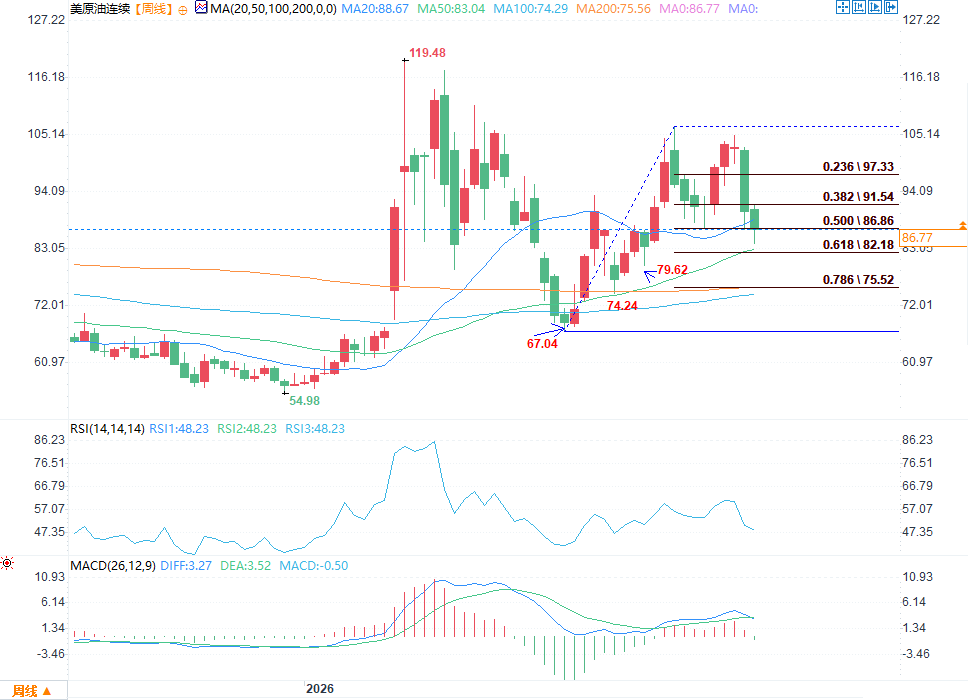 (WTI Crude Oil Weekly Chart Source: EasyForex) US crude oil has been in a pullback phase following the upward wave from 67.04 to 105.14 for several consecutive weeks. Key Fibonacci levels: resistance at 91.54 and 97.33; the dividing line between bullish and bearish sentiment at 86.86; core support at 82.18, with a deeper defense at 75.52. The price is trading between the 20-day and 50-day moving averages, with the 20-day moving average turning downwards to form short-term resistance; the RSI is in a neutral range, indicating a balance between bullish and bearish forces; the MACD has just turned slightly green, a signal of early bullish exhaustion, but not yet a deep bearish trend. In the baseline scenario, the key support level to watch is 82.18. Holding above this level would maintain a wide range of fluctuations and still offer opportunities for a rebound; a decisive break below this level on the weekly chart would destroy the current rebound structure, with a downside target of 75.52. If geopolitical stimuli push the price above 86.86, the bullish structure will be repaired, allowing for a retest of the upper resistance levels. From a technical perspective, the current market is in a consolidation phase after an upward move, and the direction will depend on fundamentals. This analysis only provides reference points for price levels. Overall, the main geopolitical theme has shifted from expectations of escalating conflict to a long-term stalemate. Oil price volatility remains high, and tail risks need to be continuously incorporated into the risk management system.
Geopolitical Focus: Force Deployment Centered on Deterrence, Low Probability of Large-Scale Conflict The USS Roosevelt Carrier Strike Group has transited the Strait of Malacca and entered the area of responsibility of the U.S. Central Command, forming a short-term three-carrier superposition deployment with the USS George Washington and USS George H.W. Bush already deployed in the Arabian Sea. The group includes a full carrier air wing, the USS Shoshing cruiser, multiple Aegis destroyers, and supporting Marine Corps forces. Its core function is to conduct routine surveillance and maritime deterrence over the Strait of Hormuz and surrounding waterways, ensuring the implementation of the maritime blockade against Iran. Simultaneously, the U.S. has officially launched "Operation Iron Gate," with a special task force established by Central Command to simultaneously intercept Iranian forces along land borders and the Caspian Sea route, in addition to the maritime blockade, to cut off the flow of Iranian weapons, dual-use technologies, sanctioned goods, and illicit oil revenues. According to disclosed information, the U.S. assesses that this coordinated sea-land blockade mechanism has restricted more than $25 billion worth of Iranian oil exports. Based on recent public statements by Trump and Rubio, and considering multiple real-world constraints, the probability of the US initiating a large-scale airstrike and pushing for a full-scale war is relatively low. The US faces strong domestic political costs from past military operations in the Middle East, and domestic public opinion has limited acceptance of a new round of large-scale overseas military action. Israel is mired in its own conflict and is unlikely to cooperate with the US in carrying out a new round of high-intensity military strikes. Following the midterm elections, domestic political maneuvering in the US has intensified, significantly weakening the political basis for expanding military action. The current US strategic framework is clear: using continued blockade and economic pressure as the main means, relying on diplomatic contacts mediated by Gulf states such as Qatar, pursuing a strategy of attrition to force Iran to make internal adjustments, neither initiating war nor rushing to reach a compromise agreement. Trump clearly stated on November 9-10 that Iran's military has been "effectively weakened," and the possibility of a large-scale strike in the short term is extremely low. He also confirmed that the US military is on standby, prioritizing diplomatic channels. Mainstream media interprets this as a shift from anticipated escalation of conflict to a long-term strategy of maximum deterrence and attrition warfare. It's important to note that the forward deployment of the three aircraft carriers serves as a backup force for contingency operations. While there is a desire at the highest levels to avoid a full-scale war, this premise cannot rule out localized frictions such as attacks on oil tankers in shipping lanes, drone confrontations, and sporadic missile exchanges. In the event of such contingencies, the currently diminished safe-haven premium will quickly recover. The US-Iran negotiations are currently at a substantial stalemate: Iran demands the lifting of the blockade and the cancellation of military deterrence before resuming consultations, while the US insists on nuclear inspections and uranium enrichment controls as preconditions. The stalemate is unlikely to be resolved in the short term, maintaining a fragile balance of neither war nor peace. Supply and demand fundamentals: The recovery of crude oil circulation is driving the clearing of the premium, and structural physical constraints are forming a bottom support. Brent crude oil has corrected by more than 20% from its high of over $118/barrel at the end of October, briefly falling below $90/barrel in mid-November, with WTI weakening in tandem. The core driver of this price decline is the market repricing the probability of a large-scale conflict. Oil traffic through the Strait of Hormuz has recovered to most pre-war levels, with a daily throughput of approximately 10.3 million barrels. Coupled with alternative pipeline routes, physical oil circulation has largely recovered. Moderate capacity releases by OPEC members such as Saudi Arabia and Kuwait, coupled with weak demand expectations from major Asian economies, have collectively provided fundamental support for the bearish market. The spot market signals are equally clear: Saudi Arabia lowered its official selling price for crude oil, and the Middle East benchmark premium weakened, reflecting a temporary easing in the spot market. Tim Waterer, chief analyst at KCM Trade, pointed out that the current oil price correction essentially reflects the market's pre-emptive pricing of post-election escalation expectations. With the US signaling de-escalation, the accumulated war premium has been cleared. Eurasia Group simultaneously lowered the probability of a prolonged supply disruption from the Strait of Hormuz, prompting funds to reduce long positions in crude oil. However, the recovery in the physical market exhibits a significant structural imbalance: crude oil circulation is recovering faster than refined oil exports, which have lagged far behind, recovering to only 35%-40% of pre-war levels. Since the outbreak of the conflict, global crude oil inventories have decreased by over 500 million barrels. The IEA has consistently warned that current global commercial inventory buffers are low, indicating a rigid demand for restocking. High shipping costs, coupled with rising war insurance and forward freight premiums on the Gulf route, are pushing up trade costs across the entire supply chain. Even in a prolonged blockade without large-scale conflict, the increased regional energy trade costs will support oil prices, making it difficult for prices to immediately fall back to pre-conflict levels. Institutional Views and Scenario Assessments Market expectations are clearly diverging. The core disagreement lies not in simple bullish or bearish views, but in differing assessments of the adaptability of the blockade and the price sensitivity to supply disruptions. The bearish camp is represented by the crude oil research group led by Daan Struyven of Goldman Sachs. Their baseline assumption is that the Strait of Hormuz will not experience a prolonged and complete shutdown, the blockade will be gradually absorbed by the market, geopolitical premiums will continue to converge, and pricing will return to the traditional supply-demand balance framework. Goldman Sachs' baseline outlook projects that the average Brent crude oil price will shift to the lower end of the range in 2027. Their accompanying scenario calculations suggest that if the oil flow through the Straits Exchange Foundation is halved for a month, Brent crude will only rise by about $4 per barrel; only a complete blockade of the channel and exhaustion of alternative production capacity would trigger a one-time price increase of $15 per barrel. The calculations indicate that under the baseline assumption of only a blockade without large-scale conflict, the upside potential for geopolitical premiums is limited. Goldman Sachs also warns that if the oil stored in floating storage is released in a concentrated manner, it will lead to a temporary increase in supply, further suppressing prices. Rapidan Energy and other companies in the risk-averse camp are also key areas of focus. Their core assessment is that the current fragile equilibrium is highly unstable. Under the economic pressure of the ongoing blockade, Iran has an incentive to escalate the conflict and attack shipping facilities to increase its bargaining power; coupled with low inventories and bottlenecks in refined oil supply, the price elasticity of the crude oil market to supply disruptions is significantly amplified, and even a small flow shock can trigger a significant rebound. Markets tend to gradually erase tail-end risk pricing during periods of sustained stability. However, a sudden shipping attack can trigger a rapid reassessment of risk premiums, a phenomenon known as a "brutal awakening." PVM Petroleum Institute analyst Tamas Varga adds that sporadic attacks in the Strait of Hormuz have not completely ceased, weakening the foundation for a de-escalation strategy. Simply relying on a narrative of de-escalation to short oil prices does not offer a favorable risk-reward ratio. Based on fundamental analysis, under the baseline scenario, the current risk premium embedded in oil prices remains high, suggesting further downside potential. However, a one-sided short-selling strategy faces significant contrarian risks. Uncertainty surrounding the US domestic politics following the midterm elections, sudden shipping attacks, and the breakdown of negotiations are all black swan variables that could quickly trigger a surge in oil prices. Subsequent Tracking Framework Market pricing logic has moved beyond being solely driven by news of troop deployments and now requires continuous tracking of high-frequency physical and policy variables: First, shipping high-frequency data, utilizing Kpler and Vortex to monitor daily flow and floating storage changes of crude oil and refined oil products in the Strait of Hormuz; Second, supply-side variables, including OPEC+ production policies, Saudi official selling price adjustments, and Iranian crude oil export dynamics; Third, demand-side variables, including refinery operating rates and spot purchasing pace in key Asian purchasing countries such as China and India; Fourth, geopolitical variables, including details of US-Iran negotiations, progress of Qatar's mediation efforts, and shipping security incidents in the Strait; Fifth, auxiliary pricing indicators, such as Gulf shipping insurance rates and forward contract premium/discount structures, used to observe changes in implicit risk premiums in the market. Weekly Technical Analysis (WTI Crude Oil Weekly Chart Source: EasyForex) US crude oil has been in a pullback phase following the upward wave from 67.04 to 105.14 for several consecutive weeks. Key Fibonacci levels: resistance at 91.54 and 97.33; the dividing line between bullish and bearish sentiment at 86.86; core support at 82.18, with a deeper defense at 75.52. The price is trading between the 20-day and 50-day moving averages, with the 20-day moving average turning downwards to form short-term resistance; the RSI is in a neutral range, indicating a balance between bullish and bearish forces; the MACD has just turned slightly green, a signal of early bullish exhaustion, but not yet a deep bearish trend. In the baseline scenario, the key support level to watch is 82.18. Holding above this level would maintain a wide range of fluctuations and still offer opportunities for a rebound; a decisive break below this level on the weekly chart would destroy the current rebound structure, with a downside target of 75.52. If geopolitical stimuli push the price above 86.86, the bullish structure will be repaired, allowing for a retest of the upper resistance levels. From a technical perspective, the current market is in a consolidation phase after an upward move, and the direction will depend on fundamentals. This analysis only provides reference points for price levels. Overall, the main geopolitical theme has shifted from expectations of escalating conflict to a long-term stalemate. Oil price volatility remains high, and tail risks need to be continuously incorporated into the risk management system.
- Risk Warning and Disclaimer
- The market involves risk, and trading may not be suitable for all investors. This article is for reference only and does not constitute personal investment advice, nor does it take into account certain users’ specific investment objectives, financial situation, or other needs. Any investment decisions made based on this information are at your own risk.