A consensus on interest rate hikes quickly took shape, putting pressure on assets as the dollar strengthened.
2026-11-11 21:04:29
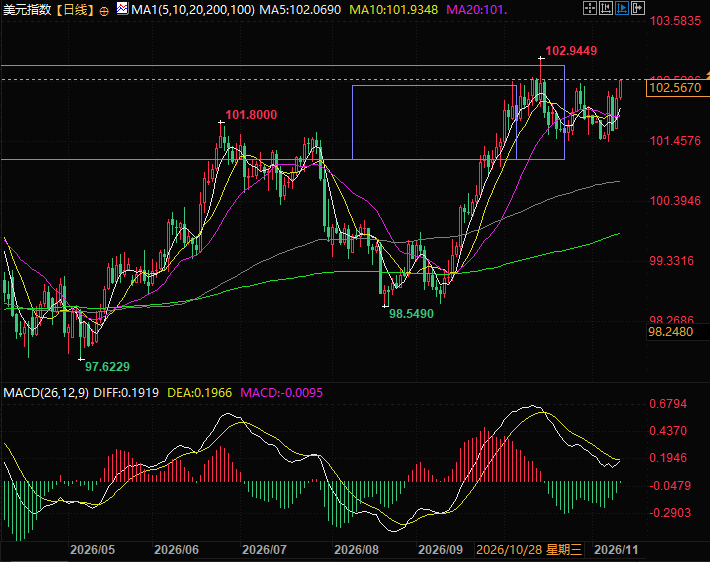
With the midterm elections over and US inflation data exceeding expectations, market expectations for a Federal Reserve interest rate hike have strengthened significantly and are gradually forming a consensus. The US dollar index has strengthened, and this change is affecting the performance of major asset classes. 
Several investment banks have raised their expectations for the path of interest rate hikes and postponed the timing of interest rate cuts.
October's US inflation data again exceeded market expectations, marking the third consecutive month of higher-than-expected inflation. Several foreign investment banks have adjusted their forecasts for the Federal Reserve's interest rate path, while Fed officials have released hawkish signals, leading the market to repric the risk of further rate hikes. Goldman Sachs has reversed its previous prediction that the rate hike cycle would end in December, now forecasting a further 25 basis point rate hike by the Fed in March of the following year. Deutsche Bank's forecast is even more hawkish, predicting a 25 basis point rate hike in January in addition to the December and March hikes. The rise in inflation is mainly driven by factors including the Iranian situation pushing up oil prices, US import tariffs, resilient consumer spending, and strong AI-related investment. Goldman Sachs' chief US economist, David Mericle, believes that a rate hike in March is more likely than in January, with inflation expected to decline slightly by the end of the year, while new price pressures at the beginning of the year will push inflation up again. The bank has also postponed its rate cut schedule, delaying the start of rate cuts to December 2027, followed by cuts in March, June, and September 2028.The probability of a 50bp rate hike in December has increased, but this does not yet constitute the baseline scenario.
Bank of America, Standard Chartered, and Citigroup all pointed out that Waller's hawkish remarks, coupled with recent inflation data, have opened up the possibility of a 50 basis point rate hike in December. However, the existing data is not yet sufficient to establish 50 basis points as a baseline expectation. Standard Chartered's economist team stated that the case for a 50 basis point rate hike in December is stronger than before, but no definitive conclusion has been reached. CME FedWatch data shows that after the release of inflation data, the probability of a 50 basis point rate hike in December rose from near 0 to 13.5%. Citigroup, on the other hand, maintained its baseline assessment of a 25 basis point rate hike in December, while also noting that if subsequent market volatility and tightening financial conditions stabilize, the upside risk of a 50 basis point rate hike would further increase.Hawkish statements from officials impacted the bond market, while the US dollar strengthened in tandem.
Brent crude oil prices have recently fallen sharply from a high of $118 to around $90. Against this backdrop, Federal Reserve Governor Waller signaled a possible hawkish shift, suggesting a potential 50bp rate hike, coupled with overheated inflation data, catching the market off guard. US Treasuries experienced a significant sell-off, with the 2-year Treasury yield recording its largest single-day increase, second only to the period following the tariff shock in April 2025. The US dollar strengthened across the board. Dallas Fed President Logan also stated that there is a possibility of accelerating the pace of rate hikes this winter. The market is also questioning why the Fed did not raise rates at its October meeting. Overall, the threshold for a 50bp rate hike in December remains high, but the market will not ignore this risk. The US dollar is generally maintaining a strong trend, but subsequent data will bring two-way volatility. ING's Chris Turner, in his latest view, is also optimistic about the short-term trend of the US dollar. He mentioned that the US labor market may accelerate its recovery, core inflation is still far from the target, and the expectation of a Fed rate hike supports the dollar. The dollar is expected to continue to strengthen in the coming weeks.Summarize:
Recent expectations of an interest rate hike have risen rapidly and reached a consensus, which will affect gold prices and equity asset trends in the short term. The next key indicator to watch is the PPI data to be released this Friday. If the PPI is also stronger than expected, it will further strengthen the evidence of price pressure, continue to support the US dollar, and the market will further raise its pricing for a 50bp rate hike. Currently, the market estimates a probability of about 12% for this scenario. Previously, the Federal Reserve raised the benchmark interest rate to the 3.75%-4.00% range in September, the first rate hike in three years, and the market has already fully priced in a 25bp rate hike in December.- Risk Warning and Disclaimer
- The market involves risk, and trading may not be suitable for all investors. This article is for reference only and does not constitute personal investment advice, nor does it take into account certain users’ specific investment objectives, financial situation, or other needs. Any investment decisions made based on this information are at your own risk.