Gold and silver prices rebounded after a sell-off triggered by CPI data, while tensions in the Strait of Hormuz pushed up crude oil prices.
2026-11-11 22:22:28
Gold and silver prices rose during the early US trading session on Wednesday (November 11). Despite persistently high US Treasury yields and a strong dollar, bargain hunting and short covering provided support for precious metals, allowing gold and silver to rebound from Tuesday's sharp decline. Earlier, US inflation data exceeded market expectations, reinforcing market expectations of another Fed rate hike in December; meanwhile, renewed concerns about shipping disruptions in the Strait of Hormuz provided some underlying support for safe-haven assets.  Spot gold traded around $4,030.06 per ounce, down $2.67, or 0.07%; spot silver was at $52.467 per ounce, up $0.005, or 0.10%. US October Consumer Price Index (CPI) data showed core inflation rose 0.3% month-over-month, higher than the market expectation of 0.2%. Housing costs rose 0.3% month-over-month, food prices rose 0.5%, and energy prices rose 0.7%, with multiple categories showing continued inflationary pressure. Due to the US government shutdown in October 2025, the Bureau of Labor Statistics lacked comparable statistical samples and therefore did not release year-over-year inflation data for October. Just before this better-than-expected inflation report was released, the employment data released last Friday was also stronger than expected: 165,000 new jobs were added in October, the unemployment rate fell to 4.1%, and average hourly earnings rose 0.4% month-over-month. The combination of these two reports further solidified market judgment that the Federal Reserve will maintain its tight monetary policy stance. The market's current focus is on the possibility of a larger interest rate hike at the Federal Reserve's December 8-9 policy meeting. Fed Governor Christopher Waller stated that persistently high core inflation is sufficient to support a larger policy adjustment, and the market has almost fully priced in the rate hike expectation. On Tuesday, the 10-year US Treasury yield briefly broke through 5.00% before falling back to around 4.98%; the US dollar index remained strong, trading near the 102.30 level. High US Treasury yields and expectations of further policy tightening continue to limit the upside potential for gold. Key US economic data to come: initial jobless claims on Thursday and the October producer price index on Friday, both released at 8:30 AM Eastern Time. If producer inflation data weakens, precious metals may get a breather; if the data exceeds expectations again, it will further strengthen market expectations for a December rate hike. Wednesday is Memorial Day in the US; the US Treasury market is closed, but the stock market is open for trading. Despite recent signals indicating the US's reluctance to launch new military strikes, tensions remain high in the Strait of Hormuz and between the US and Iran. Iranian Security Advisor Mohsen Rezaei stated on Wednesday that Tehran would not allow enriched nuclear materials to leave the country and warned that Iran would retaliate if the US launched another attack. He stated that formal negotiations between the US and Iran have not begun, but both sides have conveyed relevant proposals through Qatar. Continued attacks on commercial shipping remain a significant risk; reports indicate that 37 ships were attacked in October, a record high for a single month since the conflict began. Unresolved nuclear issues, threats to maritime security, and uncertainty stemming from US containment policies have collectively injected a geopolitical risk premium into oil prices. For gold, the underlying logic for safe-haven buying is geopolitical conflict; however, rising energy prices will push up inflation expectations, which in turn will increase pressure on the Federal Reserve to further tighten monetary policy. Oil prices rebounded on Wednesday from a two-month low hit in the previous trading day. Renewed uncertainties in US-Iran diplomacy and concerns about shipping security in the Gulf have offset market expectations for a de-escalation of the situation. Current oil prices have fallen significantly from their October highs, alleviating some of the pressure on energy-driven inflation. However, the Strait of Hormuz remains vulnerable to attacks, making oil prices highly susceptible to geopolitical fluctuations. Before the US market opened, global stock markets were mixed but generally stronger, recovering from Tuesday's decline. Investors assessed the outlook for technology stocks and the impact of tightening monetary policy. Japan's Nikkei 225 rose approximately 1.3%; China's Shanghai Composite Index rose approximately 0.5%, while Hong Kong stocks weakened; Europe's Stoxx 600 index rose slightly in early trading, gaining approximately 0.3%. US stock index futures also indicated a higher opening for US stocks, with the technology sector performing particularly well. On Tuesday, the Dow Jones Industrial Average fell 0.30%, the S&P 500 fell 0.38%, and the Nasdaq Composite fell 0.74%; rising US Treasury yields suppressed stock valuations. Investors are closely watching capital expenditures in the artificial intelligence sector, corporate earnings reports, and the possibility of a significant interest rate hike by the Federal Reserve in December. Other major overseas markets: New York WTI crude oil futures rose, reaching around $87.13 per barrel; Brent crude oil was around $92.69 per barrel. Following Tuesday's inflation data impacting the bond market, the 10-year US Treasury yield was last quoted at around 5.004%. The US dollar index remained strong, trading at 102.86. Rising yields coupled with a stronger dollar continued to exert headwinds on precious metals; however, Wednesday's price rebound indicates that buying power has returned after Tuesday's market sell-off. Gold Technical Analysis
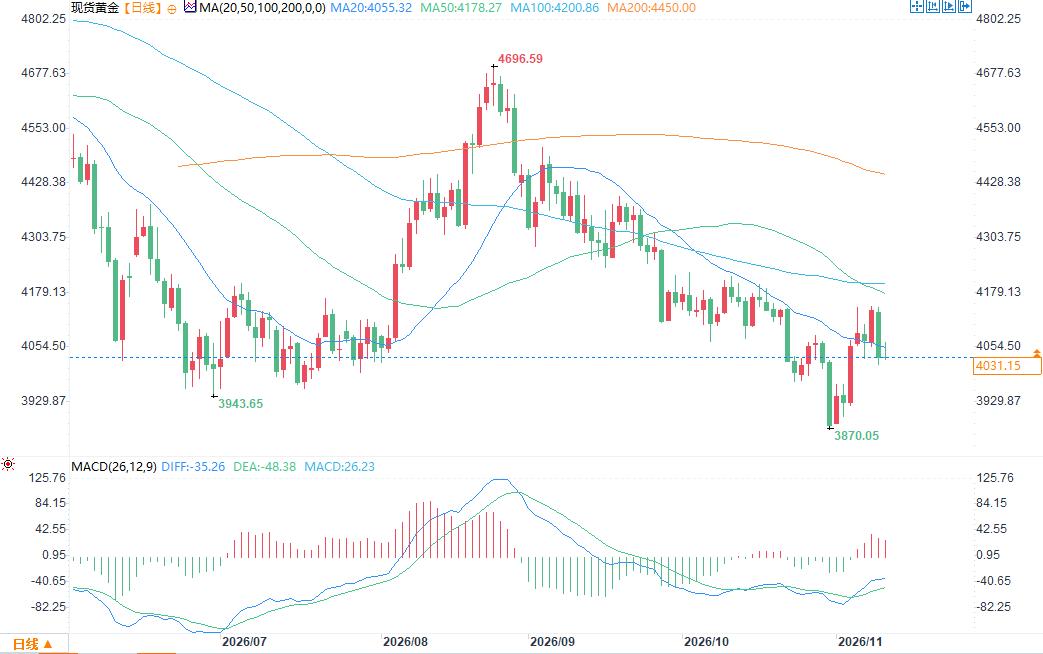 (Spot Gold Daily Chart Source: FX678) The next upside target for spot gold bulls is to push the price above the $4051.45-$4088.51 resistance zone; a successful break above this level would target $4147.62, and further down to $4200.09. The short-term downside target for bears is to push the price below $4021.85, with a deeper downside target of $3991.58. First resistance level: $4051.45, then $4088.51; first support level: $4021.85, then $3991.58. Silver Technical Analysis
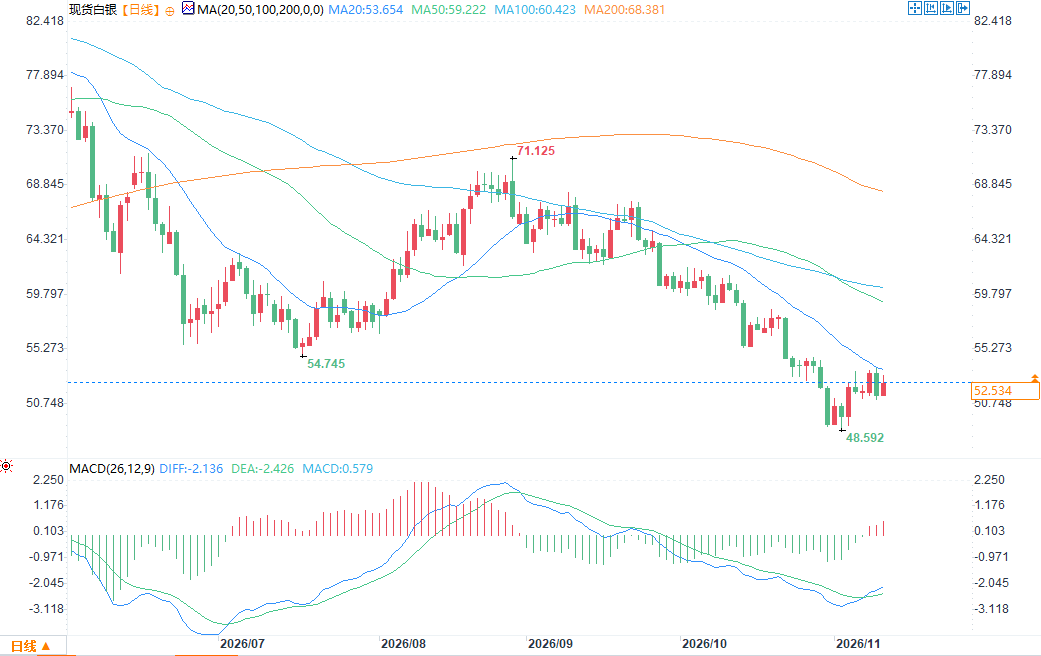 (Spot silver daily chart source: FX678) The next upside target for spot silver bulls is to push the price above the $53.107-$53.710 resistance zone; if this breakout occurs, the target is $54.617, with a further target of $55.360. The short-term downside target for bears is to push the price below $52.120, with a deeper downside target of $51.090. First resistance level: $53.107, then $53.710; first support level: $52.120, then $51.090.
Spot gold traded around $4,030.06 per ounce, down $2.67, or 0.07%; spot silver was at $52.467 per ounce, up $0.005, or 0.10%. US October Consumer Price Index (CPI) data showed core inflation rose 0.3% month-over-month, higher than the market expectation of 0.2%. Housing costs rose 0.3% month-over-month, food prices rose 0.5%, and energy prices rose 0.7%, with multiple categories showing continued inflationary pressure. Due to the US government shutdown in October 2025, the Bureau of Labor Statistics lacked comparable statistical samples and therefore did not release year-over-year inflation data for October. Just before this better-than-expected inflation report was released, the employment data released last Friday was also stronger than expected: 165,000 new jobs were added in October, the unemployment rate fell to 4.1%, and average hourly earnings rose 0.4% month-over-month. The combination of these two reports further solidified market judgment that the Federal Reserve will maintain its tight monetary policy stance. The market's current focus is on the possibility of a larger interest rate hike at the Federal Reserve's December 8-9 policy meeting. Fed Governor Christopher Waller stated that persistently high core inflation is sufficient to support a larger policy adjustment, and the market has almost fully priced in the rate hike expectation. On Tuesday, the 10-year US Treasury yield briefly broke through 5.00% before falling back to around 4.98%; the US dollar index remained strong, trading near the 102.30 level. High US Treasury yields and expectations of further policy tightening continue to limit the upside potential for gold. Key US economic data to come: initial jobless claims on Thursday and the October producer price index on Friday, both released at 8:30 AM Eastern Time. If producer inflation data weakens, precious metals may get a breather; if the data exceeds expectations again, it will further strengthen market expectations for a December rate hike. Wednesday is Memorial Day in the US; the US Treasury market is closed, but the stock market is open for trading. Despite recent signals indicating the US's reluctance to launch new military strikes, tensions remain high in the Strait of Hormuz and between the US and Iran. Iranian Security Advisor Mohsen Rezaei stated on Wednesday that Tehran would not allow enriched nuclear materials to leave the country and warned that Iran would retaliate if the US launched another attack. He stated that formal negotiations between the US and Iran have not begun, but both sides have conveyed relevant proposals through Qatar. Continued attacks on commercial shipping remain a significant risk; reports indicate that 37 ships were attacked in October, a record high for a single month since the conflict began. Unresolved nuclear issues, threats to maritime security, and uncertainty stemming from US containment policies have collectively injected a geopolitical risk premium into oil prices. For gold, the underlying logic for safe-haven buying is geopolitical conflict; however, rising energy prices will push up inflation expectations, which in turn will increase pressure on the Federal Reserve to further tighten monetary policy. Oil prices rebounded on Wednesday from a two-month low hit in the previous trading day. Renewed uncertainties in US-Iran diplomacy and concerns about shipping security in the Gulf have offset market expectations for a de-escalation of the situation. Current oil prices have fallen significantly from their October highs, alleviating some of the pressure on energy-driven inflation. However, the Strait of Hormuz remains vulnerable to attacks, making oil prices highly susceptible to geopolitical fluctuations. Before the US market opened, global stock markets were mixed but generally stronger, recovering from Tuesday's decline. Investors assessed the outlook for technology stocks and the impact of tightening monetary policy. Japan's Nikkei 225 rose approximately 1.3%; China's Shanghai Composite Index rose approximately 0.5%, while Hong Kong stocks weakened; Europe's Stoxx 600 index rose slightly in early trading, gaining approximately 0.3%. US stock index futures also indicated a higher opening for US stocks, with the technology sector performing particularly well. On Tuesday, the Dow Jones Industrial Average fell 0.30%, the S&P 500 fell 0.38%, and the Nasdaq Composite fell 0.74%; rising US Treasury yields suppressed stock valuations. Investors are closely watching capital expenditures in the artificial intelligence sector, corporate earnings reports, and the possibility of a significant interest rate hike by the Federal Reserve in December. Other major overseas markets: New York WTI crude oil futures rose, reaching around $87.13 per barrel; Brent crude oil was around $92.69 per barrel. Following Tuesday's inflation data impacting the bond market, the 10-year US Treasury yield was last quoted at around 5.004%. The US dollar index remained strong, trading at 102.86. Rising yields coupled with a stronger dollar continued to exert headwinds on precious metals; however, Wednesday's price rebound indicates that buying power has returned after Tuesday's market sell-off. Gold Technical Analysis (Spot Gold Daily Chart Source: FX678) The next upside target for spot gold bulls is to push the price above the $4051.45-$4088.51 resistance zone; a successful break above this level would target $4147.62, and further down to $4200.09. The short-term downside target for bears is to push the price below $4021.85, with a deeper downside target of $3991.58. First resistance level: $4051.45, then $4088.51; first support level: $4021.85, then $3991.58. Silver Technical Analysis (Spot silver daily chart source: FX678) The next upside target for spot silver bulls is to push the price above the $53.107-$53.710 resistance zone; if this breakout occurs, the target is $54.617, with a further target of $55.360. The short-term downside target for bears is to push the price below $52.120, with a deeper downside target of $51.090. First resistance level: $53.107, then $53.710; first support level: $52.120, then $51.090.
- Risk Warning and Disclaimer
- The market involves risk, and trading may not be suitable for all investors. This article is for reference only and does not constitute personal investment advice, nor does it take into account certain users’ specific investment objectives, financial situation, or other needs. Any investment decisions made based on this information are at your own risk.