OPEC increased production by nearly 2 million barrels per day, with Saudi Arabia's output surging to 10.6 million barrels per day, putting continued downward pressure on oil prices.
2026-11-12 11:30:29
On Thursday (November 12) during Asian trading hours, US crude oil futures continued their decline, currently trading around $85.50 per barrel, down about 1%, still in the low range since early September. According to media reports, citing the latest monthly data from OPEC, OPEC's crude oil production in October rebounded to near pre-war levels, with Saudi Arabia leading the sharp rebound. Alternative pipelines, ship-to-ship transshipment, and other workarounds have allowed Gulf oil-producing countries to maintain oil flows despite ongoing attacks on shipping. 
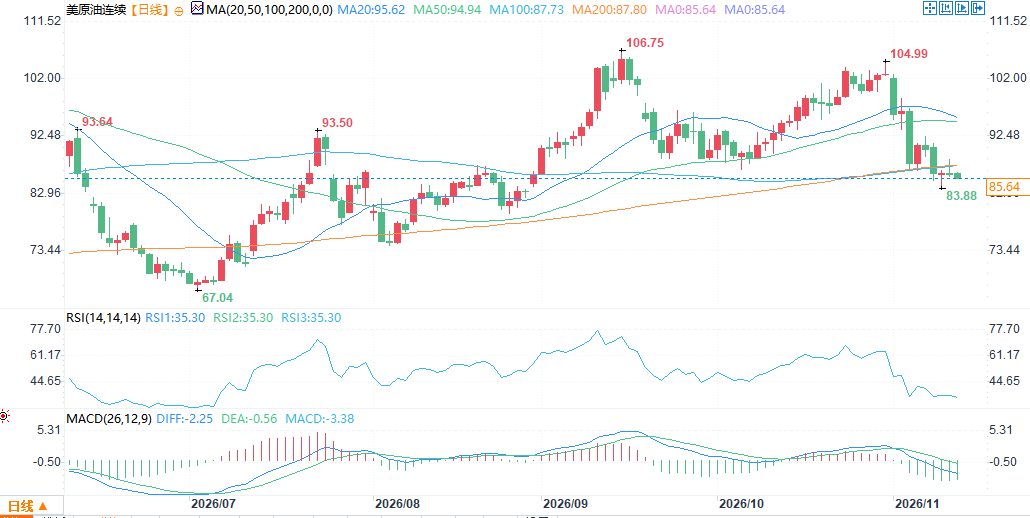 (US crude oil futures daily chart, source: FX678) At 11:27 Beijing time, US crude oil futures were trading at $85.54 per barrel.
Production rebounds: OPEC increases by nearly 2 million barrels per day, Saudi Arabia rises from 8.4 million to 10.6 million barrels per day.
OPEC production increased by nearly 2 million barrels per day last month to approximately 27.2 million barrels per day, compared to about 28.6 million barrels per day in February before the outbreak of the conflict with Iran. Saudi Arabia, the de facto leader of the organization, increased production from about 8.4 million barrels per day in September to about 10.6 million barrels per day. More than eight months into the conflict, US military support, tanker-to-tanker transshipment, and transcontinental pipelines have helped oil-producing countries maintain exports—even as ships in the Strait of Hormuz face repeated attacks and Houthi threats to Red Sea traffic. According to data agencies, Saudi Arabia's crude oil exports averaged about 7 million barrels per day in October, slightly lower than September but still higher than the 2025 average of about 6.2 million barrels per day; loading volumes at eastern Gulf ports have rebounded, after cargoes had shifted to Red Sea ports in the early stages of the war. This recovery in supply did not come from peace, but from alternative routes—pipelines and transshipment bypassed the bottleneck of the Strait, allowing production to recover. However, this recovery is also vulnerable because of this: alternative routes are also exposed to the risk of attack.The bottleneck in the Taiwan Strait remains unresolved: daily throughput is only 4 million barrels, a quarter of pre-war levels.
The strait itself remains a bottleneck. Before the war, it carried about one-fifth of the world's oil and liquefied natural gas. According to data agencies, confirmed passage over the past week averaged about 4 million barrels per day, compared to about 17 million barrels per day before the conflict. These figures are still preliminary, and some tankers passed through with their transponders off. The coexistence of a rebound in OPEC production and sluggish passage through the strait suggests that the current supply recovery relies on "detours" rather than "clearing"—normalization of the strait has not yet occurred, and any upgrades to pipelines or Red Sea routes could quickly reverse the improvement in supply.Amid the uncertainty surrounding the attacks and peace talks, Saudi Arabia compensated buyers with a discount.
Continued attacks and uncertainty surrounding US-Iran peace talks have dampened hopes for de-escalation. Gulf oil producers are offering significant discounts to attract buyers and offset high tanker and freight costs. Saudi Aramco lowered its official selling price for December Arab Light crude to Asia by $2 per barrel, to a $7 discount to the Oman/Dubai benchmark. The coexistence of supply recovery and bottlenecks in the Straits is weakening the pricing power of Gulf crude – producers need to compensate buyers for transportation risks and costs through discounts, a discount that provides a modest benefit to Asian refineries.Macroeconomic implications: Stabilizing supply eases pressure on the Federal Reserve and the Bank of Japan, while disruptions strengthen the case for interest rate hikes.
In the broader macroeconomic landscape, oil remains a primary channel through which conflict transmits to inflation. Stabilizing supply will ease pressure on the Federal Reserve and the Bank of Japan, while renewed disruptions will strengthen the case for further interest rate hikes. OPEC maintained its demand forecast, projecting global consumption to increase by 180,000 barrels per day this year and 2.55 million barrels per day next year; key OPEC+ members agreed earlier this month to maintain production levels in December. Oil price movements are not only a variable in the commodity market but also an input to central bank policy paths—continued supply improvements will cool expectations of interest rate hikes; further attacks on the Strait of Hormuz or pipelines will reignite inflationary pressures, reinforcing a hawkish stance.in conclusion
OPEC production increased by nearly 2 million barrels per day in October to approximately 27.2 million barrels per day, while Saudi Arabia's output rose from 8.4 million to 10.6 million barrels per day. Relying on pipelines, ship-to-ship transshipment, and US military support, Saudi Arabia maintained exports, approaching pre-war levels of 28.6 million barrels per day. However, the Strait of Hormuz bottleneck remains unresolved—confirmed daily traffic volume is only about 4 million barrels, a quarter of the pre-war 17 million barrels, indicating that supply recovery relies on "detours" rather than "unblocking," and its vulnerability stems from the exposure of these alternative routes. Saudi Aramco lowered its December prices to Asia by $2 to a discount of $7, reflecting the weakening pricing power of Gulf crude oil. From a macroeconomic perspective, oil remains the primary channel through which conflict transmits to inflation: stabilizing supply eases pressure on the Federal Reserve and the Bank of Japan, while renewed disruption strengthens the case for interest rate hikes. (US crude oil futures daily chart, source: FX678) At 11:27 Beijing time, US crude oil futures were trading at $85.54 per barrel.
- Risk Warning and Disclaimer
- The market involves risk, and trading may not be suitable for all investors. This article is for reference only and does not constitute personal investment advice, nor does it take into account certain users’ specific investment objectives, financial situation, or other needs. Any investment decisions made based on this information are at your own risk.