Vance's presence at the table could kick off US-Iran talks; Iran's oil tanker explosion strengthens its negotiating leverage.
2026-11-12 16:10:28
On Thursday (November 12th) during the Asian and European sessions, international oil prices experienced a surge followed by a decline and then a rebound over the past two days. This indicates that while there are expectations of easing in oil prices, the risks of further increases cannot be ignored. Specifically, Vance's involvement in US-Iran negotiations and Iran's signals of mediation in the Yemen conflict have led the market to trade on a de-escalation of tensions in the Middle East, suppressing the upside potential of oil prices. However, the sudden tanker explosion in the Strait of Hormuz, posing a continued risk to shipping routes, has become a significant support for oil prices. On one hand, there is the exchange of bargaining chips at the negotiating table; on the other hand, there are real risks in key shipping routes. Coupled with the lack of substantial breakthroughs in the Russia-Ukraine negotiations, oil prices are experiencing wide-ranging geopolitical fluctuations. However, the probability of a large-scale geopolitical conflict has significantly decreased, and the correlation between oil prices and global assets is also weakening. 
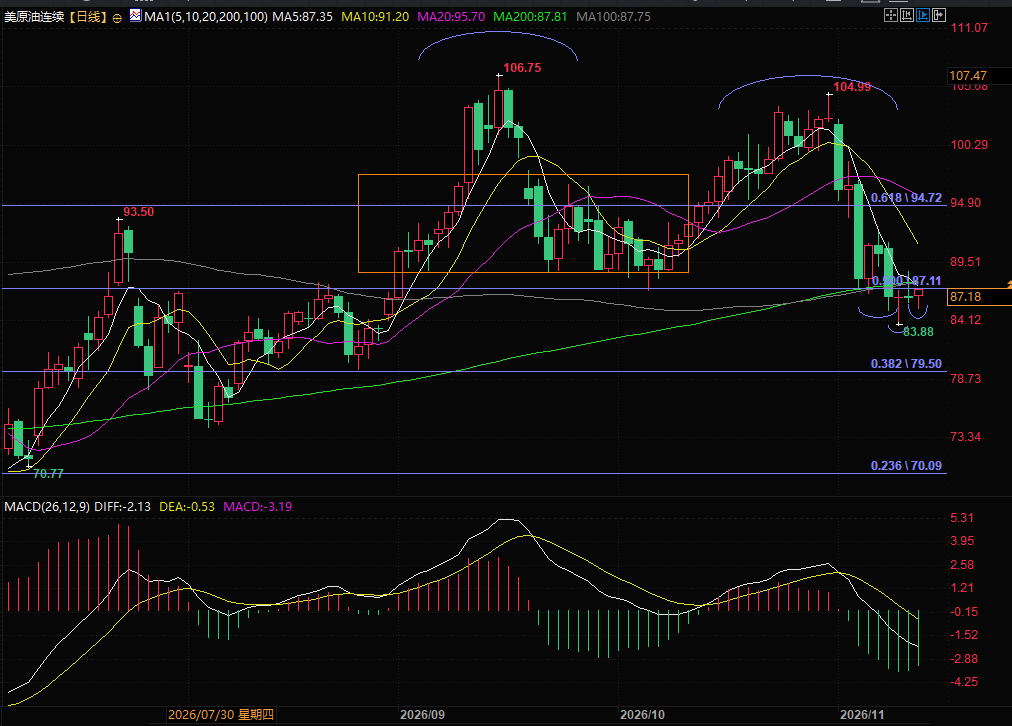 (WTI crude oil futures daily chart, source: EasyTrade) At 16:06 Beijing time, WTI crude oil futures are currently trading at $87.20 per barrel.
A change of negotiator: The US has authorized Vance to lead consultations with Iran.
According to US media reports, Trump has authorized Vice President Vance to lead negotiations with Iran. Vance is pushing forward with face-to-face talks with Rezaei, Secretary of Iran's Supreme National Security Council. Doha is considered a potential meeting place, essentially meaning the US has changed its key negotiator. Vance's influence in Iran diplomacy now surpasses that of Witkov and Kushner. These negotiations carry significant political risks: if they break down, Vance will be seen as a diplomatic failure; if a ceasefire is successfully achieved, he can accumulate considerable political capital. The gap between the two sides' demands is clear: Iran's core demands focus on lifting the naval blockade, unfreezing assets, and easing oil sanctions; the US, on the other hand, is employing a two-pronged approach: retaining the option of military pressure and deploying more aircraft carriers to the Middle East, while stating that a large-scale military strike is not currently needed, relying instead on economic means to maintain pressure.Iran reveals its bargaining chips: signaling its mediation efforts in the Yemen conflict; risks remain in the Strait of Hormuz.
Iran simultaneously played its diplomatic card, with Iranian Parliament Speaker Ghalibaf signaling its willingness to mediate and facilitate a resolution to the differences between Saudi Arabia and the Houthis, should they make a request. This is a crucial clue for de-escalation: Iran holds the Houthis as an important proxy, and its proactive expression of willingness to mediate is tantamount to placing bargaining chips at the negotiating table to ease tensions in the Red Sea and Yemen, reducing the risk of simultaneous conflicts erupting in multiple locations across the Middle East. However, the risks to shipping in the Strait of Hormuz have not completely disappeared. On the 12th local time, the Iranian Islamic Revolutionary Guard Corps Navy reported that two supertankers carrying a total of over 4 million barrels of crude oil exploded while sailing in the Strait of Hormuz the previous night. Iran stated that it had repeatedly warned the tankers that the southern route they chose was illegal and unsafe, and that the ships ignored the warnings, triggering the explosions and halting their voyages. The situation remains volatile, with Houthi attacks continuing unabated, including launching ballistic missiles and drones at Saudi Arabia and attacking airports and oil pumping stations, prompting multiple interceptions by Saudi air defense systems. Localized skirmishes continue, but the market is no longer unilaterally betting on a continued escalation of the conflict. Iran also maintained a hardline stance, with Rezaei clearly stating that its enriched uranium would not be leaked abroad, and that if the US military launched an attack from its European bases, Iran would strike the corresponding US military bases.The ongoing stalemate between Russia and Ukraine is unlikely to contribute significantly to the downward pressure on oil prices.
In stark contrast to the overall trend of détente in the Middle East is the Russia-Ukraine negotiations. The latest round of talks only resulted in a prisoner exchange; neither side is willing to compromise on core territorial claims, and no concrete framework for a peace agreement has been reached, leaving the substantive deadlock unbroken. However, the good news is that market pricing in the Russia-Ukraine conflict has become less sensitive, and shipping costs on routes between Russia and Ukraine have plummeted. The Russia-Ukraine situation is no longer a new variable driving up oil prices, and it is unlikely to independently push up the risk premium for crude oil.Market weakens: Easing expectations dominate market sentiment, with the Straits incident partially supporting oil prices.
Besides expectations of easing geopolitical tensions, supply-side data also weighed on the market: OPEC crude oil production rose in October, and data from the American Petroleum Institute showed an increase in crude oil inventories, further suppressing oil prices. The tanker explosion in the Strait of Hormuz became a significant supporting factor, limiting the decline in oil prices. ING Commodity Strategy Team Commentary: Expectations of improved supply in the Middle East and a rebound in US inventories continue to weigh on the oil market, but the uncertainty surrounding the US-Iran conflict and shipping risks in the Strait of Hormuz still provide a floor for oil prices.Macroeconomic shifts: The influence of oil prices on global assets continues to weaken.
A key change worth noting in this round of market activity is the recent weakening of oil prices' marginal influence on global asset classes. Previously, during periods of tension in the Middle East, oil prices were a core variable in inflation expectations and Federal Reserve policy expectations; fluctuations in oil prices would trigger simultaneous and significant volatility in US Treasury bonds, US stocks, and gold. Now, however, the market has gradually priced in the "temporary easing of conflict," making it difficult for pulsed rises and falls in oil prices to drive synchronized repricing of global assets. Macquarie's strategic viewpoint also indirectly confirms this: with some time still remaining before the Fed's December interest rate meeting, the easing of geopolitical tensions leading to lower oil prices is one of the variables that could potentially hinder the Fed's rate hikes. The focus of macro trading is gradually shifting from "oil prices pushing up inflation" to policy and fundamentals themselves.Summary and Technical Analysis:
The current crude oil market has reached its ceiling, but the path to a complete resolution of the conflict remains unclear. Verbal easing does not equate to a signed agreement. The risks in the Strait of Hormuz are real, and the conflict could recur at any time. The expectation of de-escalation between the US and Iran, and between Yemen, is the main bearish factor, but negotiations are still in their initial stages. The current decline is essentially a retracement of geopolitical risk premiums, not a reversal of supply and demand fundamentals. If no reasonable geopolitical easing plan is reached after a period of time, geopolitical risks and inventory crises could resurface. Key areas to monitor include: the progress of the Doha talks, the safety of ship passage through the Strait of Hormuz, the pace of Houthi attacks, and OPEC's subsequent production policy. Technically, WTI crude oil is oscillating around the 0.500 Fibonacci retracement level of this upward move, currently showing a simple head and shoulders bottom pattern. A break above 87 could trigger a short-term rebound, with resistance around 88.7. (WTI crude oil futures daily chart, source: EasyTrade) At 16:06 Beijing time, WTI crude oil futures are currently trading at $87.20 per barrel.
- Risk Warning and Disclaimer
- The market involves risk, and trading may not be suitable for all investors. This article is for reference only and does not constitute personal investment advice, nor does it take into account certain users’ specific investment objectives, financial situation, or other needs. Any investment decisions made based on this information are at your own risk.