With rising interest rate expectations, the US's fight against inflation may be about to face growing pains.
2026-11-12 21:04:30
The recent surge in the US dollar and the sharp drop in gold prices, coupled with the unchanged expectation of a December rate hike (still one), have led to a significant market reaction to a fragmented CPI report, or rather, the dramatic fluctuations in gold and the dollar. The CPI report indicates that price pressures continue to rise ahead of the midterm elections, with the cost of living becoming a key campaign issue for the Democratic Party. This year, regional conflicts causing energy disruptions, tariff costs, and the data center capital expenditure boom have all contributed to the inflation rate. This is also the last crucial CPI report received by Federal Reserve officials before their policy meeting on December 8-9. The market has already priced in a rate hike at this meeting, and Fed Governor Waller previously clearly stated the threshold: if the core CPI month-on-month increase reaches 0.3% or higher, the Fed needs to consider a 50 basis point rate hike. 
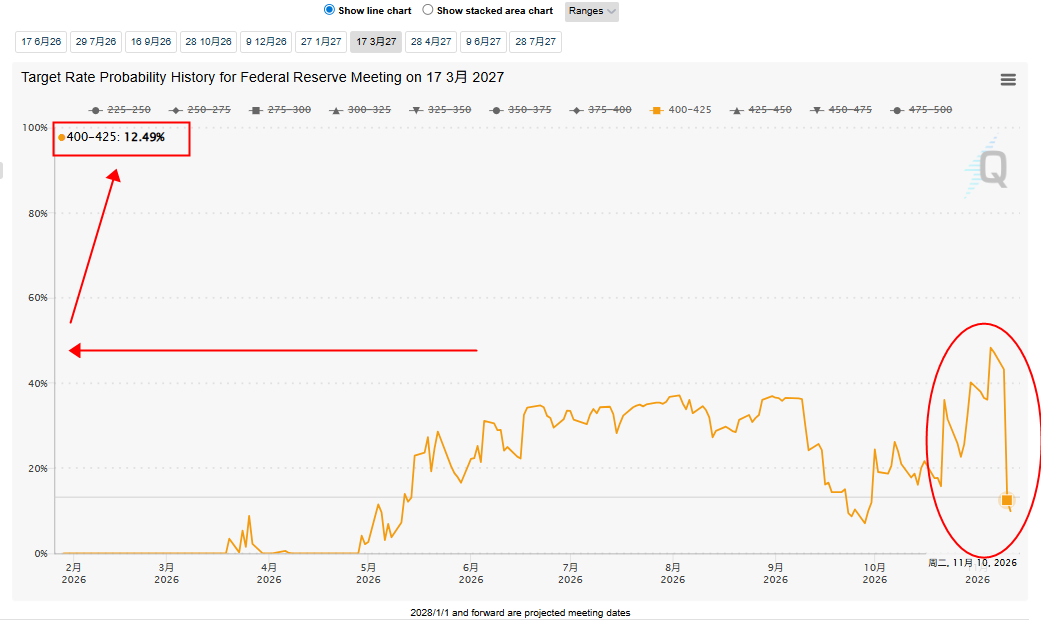 (FedWatch interest rate tool, source: CME Group)
Inflation inflection point revealed: Inflation shifts from a single disturbance to widespread diffusion.
Looking back, this October CPI data may mark a turning point: the risk balance has shifted, making it difficult to smoothly combat inflation, and subsequent tightening policies will likely come at an economic cost. The core CPI rose 0.3% month-on-month, maintaining this level for the third consecutive month; a 0.2% month-on-month growth rate would be more in line with the Fed's long-term inflation target of 2%. Previous rounds of rising inflation could be simply attributed to single disturbances, such as increases in energy, used cars, or communication packages, but the current inflationary diffusion is entirely different. Two sets of inflation indicators from the Cleveland Fed, excluding extreme values, further confirm the stickiness of inflation: the median annualized CPI growth rate is 3.7%, and the cut-off mean annualized CPI growth rate is 4.5%. Although the indicators themselves fluctuate, the signal is clear: the probability of core inflation rising in the short term is higher than falling. Core inflation under the CPI metric is 2.8%, while the Fed's preferred PCE metric for core inflation reaches 3.1%. Many optimistic views, including those of some market analysts, previously held that inflation was merely a pulse caused by one-off shocks such as tariffs and energy, and that it would smoothly fall back to 2% after the external disturbances subsided. This possibility still exists, but the probability is clearly decreasing.Two supporting factors are increasing the risk of prolonged inflation.
Goldman Sachs' tracking data indicates that the transmission of supply shocks has spread to a wide range of consumer goods, no longer limited to typical affected items like airfares, and the transmission has a lag effect, with related impacts potentially extending into the first half of 2027. More importantly, given the resilience of the US economy and a relatively favorable financial environment, companies have gained pricing power, and short-term price increases can easily solidify, leading to persistent inflation. Faced with stable end-user demand, many companies are willing to continuously raise prices for goods and services, passing on upstream costs to consumers, which is a core driver of prolonged inflation. The signals from the labor market are more complex. While the current unemployment rate remains low, nominal wage growth is weak; however, if various benefits and subsidies are included, overall labor costs are not moderate. Continued price increases leading to wage increases, forming a wage-price spiral, are only a matter of time, which will further lock in the inflation center. The market voted with its feet, with interest rate futures showing a sharp drop in the probability of only one rate hike before March next year to 12.49% in a single day. Although the probability and magnitude of the December rate hike did not change much, the overall impact on the market was very clear. (FedWatch interest rate tool, source: CME Group)The path of inflation determines the endpoint of interest rates, and the risk of recession warrants attention.
The path of inflation directly determines the Federal Reserve's interest rate choices. If inflation can fall back to around 2% on its own, the Fed only needs to tighten slightly and maintain a restrictive policy stance. However, if inflation remains stuck around 3%, the Fed must actively create economic slack by suppressing aggregate demand and raising the unemployment rate to curb prices. This means that the final interest rate will be higher than currently expected by the market, and the high interest rate will be maintained for a longer period. As interest rates continue to rise, the risk of recession increases. The 2-year Treasury yield is a leading indicator of the Fed's policy expectations, currently 0.25 percentage points lower than the 10-year yield. Once the 2-year yield surpasses the 10-year yield, i.e., the yield curve inverts, it will be a recession warning from the market, indicating that the backlash from high interest rates on the economy has entered a trading window.- Risk Warning and Disclaimer
- The market involves risk, and trading may not be suitable for all investors. This article is for reference only and does not constitute personal investment advice, nor does it take into account certain users’ specific investment objectives, financial situation, or other needs. Any investment decisions made based on this information are at your own risk.