Trump halts Vance's Iran negotiation window: Geopolitical stalemate leads to a sharp drop in gold prices.
2026-11-12 21:36:29
The core variable currently driving global commodity, exchange rate, and equity market pricing remains geopolitical risk. Whether it's the protracted US-Iran rivalry in the Middle East or the protracted Russia-Ukraine conflict, they all share a common characteristic: all parties are continuously investing significant resources, yet none have achieved decisive results. The game has entered a stalemate with high sunk costs, and the risk of inflationary backlash continues to escalate, constantly disrupting asset prices. 
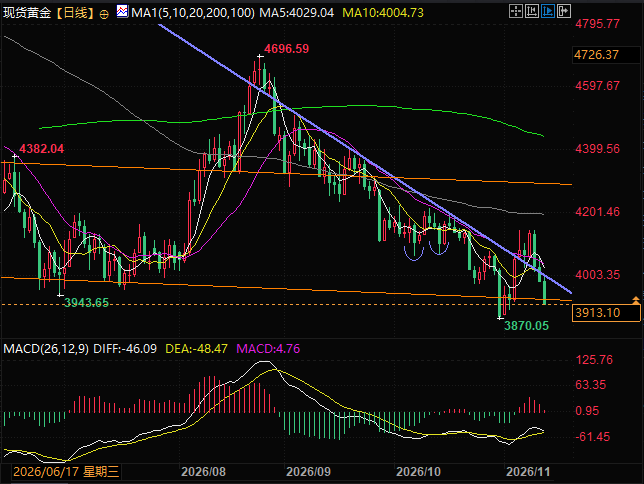 (Spot gold daily chart, source: FX678)
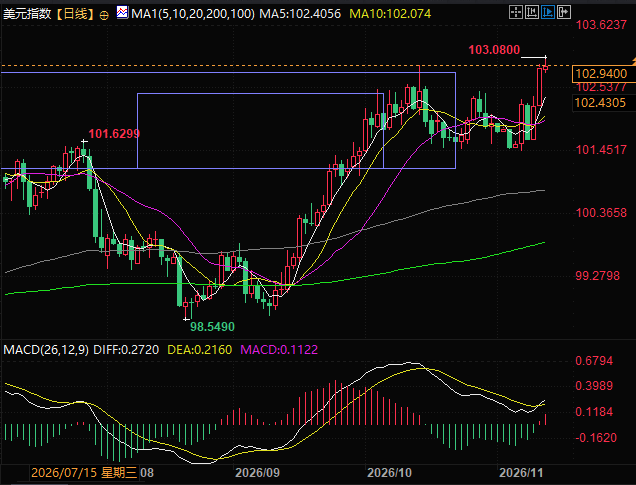 (US Dollar Index Daily Chart, Source: FX678) At 21:33 Beijing time, spot gold is currently trading at $3,902 per ounce, and the US Dollar Index is currently trading at 102.93.
None of the parties have achieved a decisive victory, yet the stakes continue to rise.
The predicaments faced by the United States, the European Union, and Russia are remarkably similar: military actions and sanctions continue to be implemented, but no breakthrough that can quickly secure victory is in sight. In the Middle East, US-Iran negotiations have repeatedly wavered. Reports indicate that Vice President Vance was authorized to hold face-to-face consultations with Iranian leaders, focusing on core disagreements such as lifting the naval blockade, unfreezing assets, and easing oil sanctions. However, Trump subsequently stated that he would no longer seek an agreement with Iran, quickly closing the negotiation window. The US, wielding the power to blockade the Strait and freeze Iranian overseas assets, has been unable to force Iran to concede, while domestic inflation remains high, and the Republican Party is suffering setbacks in Congress and key red states—a manifestation of the transmission of overseas geopolitical costs inward. In Europe, the EU continues to escalate its confrontation with Russia. Ursula von der Leyen officially announced the 22nd round of sanctions against Russia, along with a proposal for long-term funding for Ukraine. Europe has also sent representatives to the Abu Dhabi Russia-Ukraine peace talks. Years of sanctions have not quickly achieved the goal of crushing Russia; instead, they have continuously pushed up European energy costs, dragged down industrial activity, and resulted in recurring inflation and a weakening economy—a long-term cost the EU must bear. Russia, too, continues to pour resources into the conflict, yet it too struggles to quickly gain decisive negotiating leverage. All sides have paid a heavy price, but the tide of battle has not turned in one direction.Stalemate: Sunk costs bind all parties, and none are willing to concede easily.
The most intractable aspect of this round of competition lies in the sunk cost trap. The US, EU, and Russia have all invested enormous sums of money, diplomatic resources, and military resources, and each side harbors a narrative of being "just one step away from victory." From this perspective, proactively making concessions and accepting compromises will be interpreted as all previous investments going down the drain, with extremely high political costs. At the same time, no one can accurately calculate how long they can hold out or what the ultimate cost of continued confrontation will be. On one hand, the expectation of negotiations repeatedly disrupts the market; on the other hand, frictions such as sanctions, blockades, and attacks have never truly ceased. The recent attack on oil tankers near the UAE by unidentified projectiles, reigniting shipping risks, is a typical example of marginal disturbance, which could push up energy premiums at any time. Under these circumstances, the conflict is unlikely to end quickly; the optimal solution is no longer a swift victory, but a prolonged stalemate.The ultimate cost of a prolonged stalemate: inflationary backlash, constraining monetary policy.
The cascading consequences of geopolitical stalemates will ultimately impact inflation. Energy shipping route risks, trade barriers, and supply chain disruptions caused by sanctions continue to transmit costs upstream, pushing up the global inflation center. In the US, inflation stickiness has already exceeded expectations, with core CPI rising 0.3% month-on-month for three consecutive months, forcing the Federal Reserve to maintain a high-interest-rate path. The EU's economic recovery is weak, and continued sanctions will further amplify imported inflationary pressures, limiting the European Central Bank's room for interest rate cuts. If inflation doesn't subside, expectations of easing will be delayed, high interest rates will be maintained for a longer period, and assets such as stocks, bonds, and gold will continue to be repriced under stagflation expectations. The market will no longer trade on the optimistic scenario of a "quick end to the conflict and a drop in inflation," but will instead continue to price in geopolitical premiums and long-term inflation stickiness.Summarize:
In the short term, as long as this stalemate of "huge investment, limited results, and all parties believing they are close to victory" remains unbroken, geopolitics will continue to be the main driver of global asset prices. The end of this game will not be a quick victory for one side, but rather the accumulation of inflation, economic recession, and domestic political pressure to a critical point, forcing all parties back to the negotiating table. Until then, commodity volatility, US Treasury yields, and fluctuations in the US dollar and gold will continue to be driven by geopolitical news. (Spot gold daily chart, source: FX678) (US Dollar Index Daily Chart, Source: FX678) At 21:33 Beijing time, spot gold is currently trading at $3,902 per ounce, and the US Dollar Index is currently trading at 102.93.
- Risk Warning and Disclaimer
- The market involves risk, and trading may not be suitable for all investors. This article is for reference only and does not constitute personal investment advice, nor does it take into account certain users’ specific investment objectives, financial situation, or other needs. Any investment decisions made based on this information are at your own risk.