Gold Trading Alert: Trump's "No Deal Needed" Statement Triggers Oil Price Surge, Gold Prices Plunge to One-Year Low
2026-11-13 07:52:30
On Thursday (November 12), the global gold market experienced a rare and sharp sell-off. Spot gold plunged nearly 3% in a single day, hitting a low of $3,852.33 per ounce, its lowest level since October 2025, before closing at $3,877.33 per ounce. US December gold futures also fell 2.9%, closing at $3,885.30. This marked the third consecutive trading day of declines in gold prices, with market sentiment shifting from cautious to clearly pessimistic in just a few days. On the surface, the gold price correction seems to be a natural reaction to a stronger dollar and rising interest rate expectations. However, a deeper analysis of the multi-market linkages on that day reveals that the real trigger came from a sudden shift in the Middle East situation. Trump's explicit statement on social media that "the United States does not need a deal with Iran" directly extinguished previous market optimism about a de-escalation of the conflict. This seemingly simple statement quickly created a chain reaction among oil, US Treasury bonds, the dollar, and gold, exposing gold's significant weakness amidst the pressures of safe-haven demand and interest rates. On Friday (November 13) in early Asian trading, spot gold hovered at low levels, currently trading around $3,880 per ounce. 
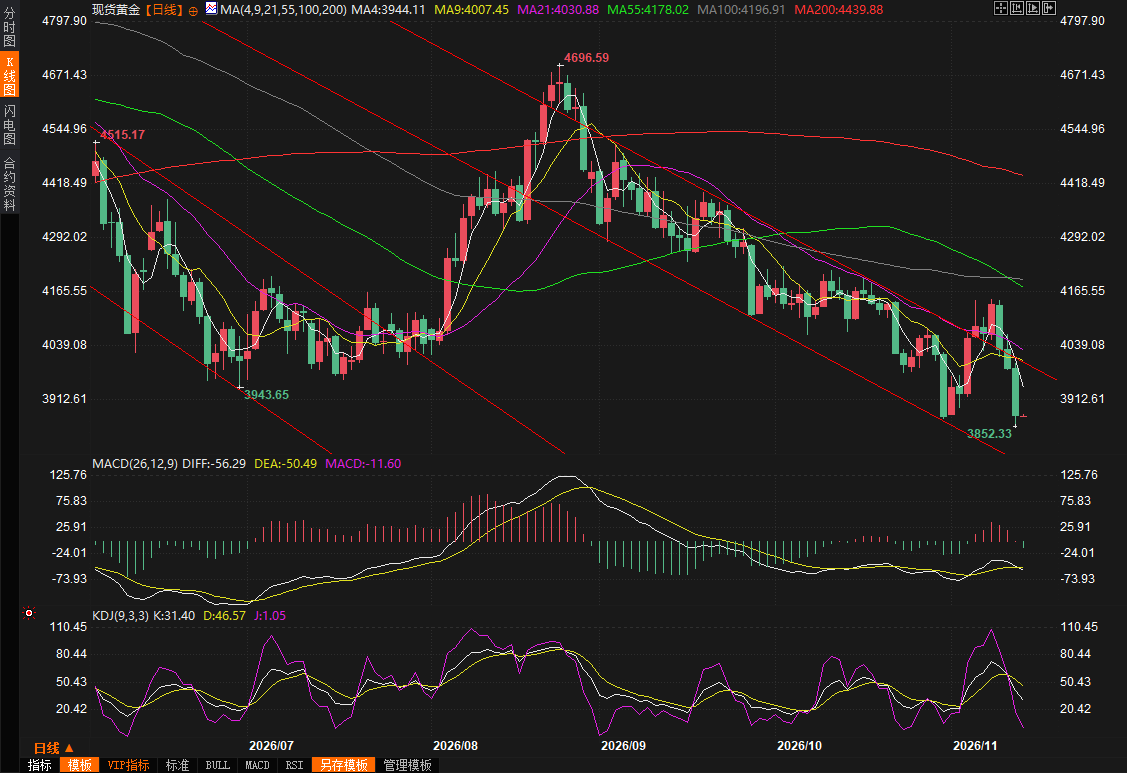 (Spot gold daily chart, source: EasyTrade) At 07:49 Beijing time, spot gold is currently trading at $3881.52 per ounce.
Hopes for Middle East peace have plummeted, and rising oil prices have exacerbated inflation concerns.
Following Trump's statement, market speculation about a ceasefire or agreement in the Middle East quickly dwindled. Simultaneously, a series of geopolitical events occurred: the Houthi rebels in Yemen claimed responsibility for attacks on Saudi Arabia's east-west oil pipeline pumping station, oil facilities in Yanbu, and the Saudi Aramco building in Riyadh; the Saudi-led coalition stated it had intercepted related drones. The Iranian military claimed that four oil tankers were attacked by explosions in the Strait of Hormuz. Ukraine continued its drone strikes against energy infrastructure in northwestern Russia, damaging oil storage facilities at the port of Ust-Luga. These events combined directly pushed up oil prices. Brent crude futures settled up more than $3 at $95.82 per barrel, a 3.3% increase; US crude futures rose 2.6% to close at $88.74. Although crude oil still recorded an overall decline of about 2.5% this week, Thursday's rebound was enough to reignite inflation concerns. For gold, the transmission path of rising oil prices is very clear. If energy prices remain high, it will further solidify the logic of the Federal Reserve maintaining a hawkish stance. High interest rates, or even further increases, will directly diminish gold's appeal as a non-interest-bearing asset. As David Meger, director of metals trading at High Ridge Futures, pointed out, rising energy prices continue to justify the Federal Reserve's hawkish stance, and a higher interest rate environment is clearly detrimental to gold.The rising expectations of a hawkish stance from the Federal Reserve are putting downward pressure on the dollar and U.S. Treasury yields.
Simultaneously with the unfolding situation in the Middle East, there has been a significant shift in expectations for US monetary policy. Stronger-than-expected US inflation data released on Tuesday, coupled with hawkish signals from several Federal Reserve officials this week, led the market to quickly raise its pricing for a December rate hike. The CME Group's FedWatch tool shows that traders now expect a probability of at least a 25 basis point rate hike in December to rise to approximately 100%, with some even discussing the possibility of a 50 basis point hike, with the probability now at 15%. Federal Reserve Governor Waller explicitly stated that even with recent cooling inflation data, short-term interest rates should still be raised in December, and hinted that a larger rate hike could be considered if inflation worsens. Cleveland Fed President Hammarck, Chicago Fed President Goolsby, and San Francisco Fed President Daly also expressed concerns about sticky inflation from different perspectives. These statements, combined with strong inflation data, pushed the two-year Treasury yield to 4.867%, a new high since mid-October; the 10-year Treasury yield also rose to around 5.11%, further flattening the yield curve. Against this backdrop, the dollar index rose 0.27% on Thursday to a near 19-month high, reaching a high of 103.24 during the session. A stronger dollar directly pressures gold prices, which are priced in dollars. Jim Wyckoff, market analyst at the Gold Exchange, attributed the recent gold price decline to the combined effects of "hot inflation data, hawkish comments from Federal Reserve officials, and the dollar reaching a near 19-month high." Multiple negative factors acting almost simultaneously made it difficult for gold to find effective support.Subtle changes in market sentiment and fund flows
Beyond macroeconomic and geopolitical pressures, microeconomic sentiment is also subtly shifting. The departure of Nvidia CEO Jensen Huang has sparked market concerns about the AI giant's future and may influence expectations regarding US chip export policies. While this event is not directly related to gold, it has exacerbated volatility in risk assets to some extent, prompting some funds to reassess their asset allocation. Investors are now turning their attention to the US Producer Price Index (PPI) to be released on Friday. If the PPI continues to show inflationary pressure, market expectations for the Federal Reserve to maintain high interest rates or even increase them may be further strengthened, thus continuing to suppress gold prices. Conversely, if the data shows a significant easing, it may provide a brief respite for gold prices. Looking at a longer timeframe, gold prices have fallen by several hundred dollars from their previous highs. The current correction has entered a relatively sensitive area technically, but there are no clear reversal signals from the fundamentals. If the situation in the Middle East remains tense and oil prices remain high, inflation concerns will be difficult to dissipate; and if the Federal Reserve chooses to raise interest rates in December, the interest rate pressure on gold will become more apparent in the short term.Summary and Outlook
This round of sharp decline in gold prices was not driven by a single factor, but rather by the combined effects of dashed hopes for Middle East peace, rising oil prices boosting inflation expectations, strengthened hawkish signals from the Federal Reserve, and a stronger dollar. Trump's statement that he "doesn't need a deal" became a key catalyst, rapidly altering market assessments of the conflict's trajectory and transmitting this information through oil prices to interest rates and the dollar market, ultimately creating triple pressure on gold. In the short term, gold prices are likely to remain weak amid the tug-of-war between interest rates and geopolitical tensions. The market will closely watch Friday's PPI data and further developments in the Middle East over the weekend. If oil prices continue to rise or Federal Reserve officials release hawkish signals again, gold may face further challenges; conversely, if geopolitical tensions show signs of easing or inflation data cools, gold prices may see a technical rebound. For investors, the current environment is more suitable for caution, closely monitoring Middle East developments, Federal Reserve officials' speeches, and key inflation indicators. While the long-term logic of gold as a traditional safe-haven asset remains fundamentally unchanged, short-term volatility may increase significantly in a period of high interest rates and a strong dollar. How to navigate this volatility will be the focus of market attention in the coming period. (Spot gold daily chart, source: EasyTrade) At 07:49 Beijing time, spot gold is currently trading at $3881.52 per ounce.
- Risk Warning and Disclaimer
- The market involves risk, and trading may not be suitable for all investors. This article is for reference only and does not constitute personal investment advice, nor does it take into account certain users’ specific investment objectives, financial situation, or other needs. Any investment decisions made based on this information are at your own risk.