The rebound in US Treasury bonds faces a real-world test.
2026-11-13 01:46:29
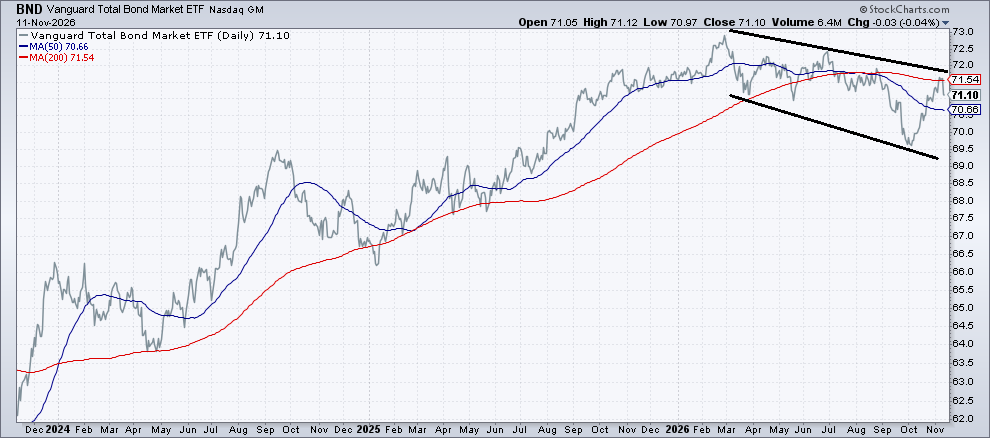
The bond market rebound over the past month has rekindled hopes among fixed-income investors that the worst may be over. Bonds are becoming increasingly attractive as yields rise to more appealing levels. Whether this renewed interest signifies a timely return of funds to the asset class remains to be seen; however, caution is still warranted given the overall trend. In short, the bond market needs to provide more compelling evidence that the bearish sentiment suppressing this asset class has run its course and is giving way to a sustained recovery.  Take the Vanguard Total Bond Market ETF (BND) as an example, a common representative of US investment-grade bonds. Its strong rebound over the past month has fueled predictions that the correction is over. However, this judgment appears premature. This week, the rally stalled after hitting resistance at a key technical level. The downtrend that has dominated most of this year appears to remain intact until BND breaks through its previous high.
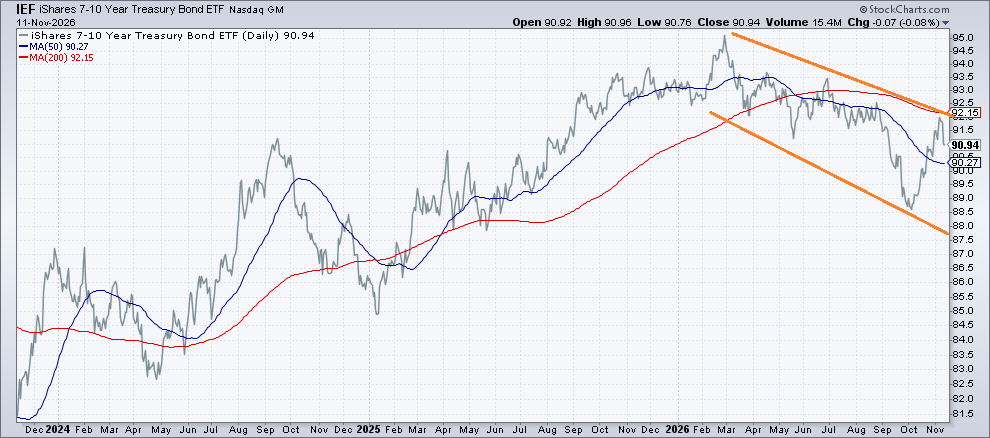
 The situation is similar for US Treasury bonds, and this article uses the iShares 7-10 Year Treasury ETF (IEF) as an example. The fund's trend remains bearish, meaning investors should remain cautious until stronger evidence of a price reversal emerges.
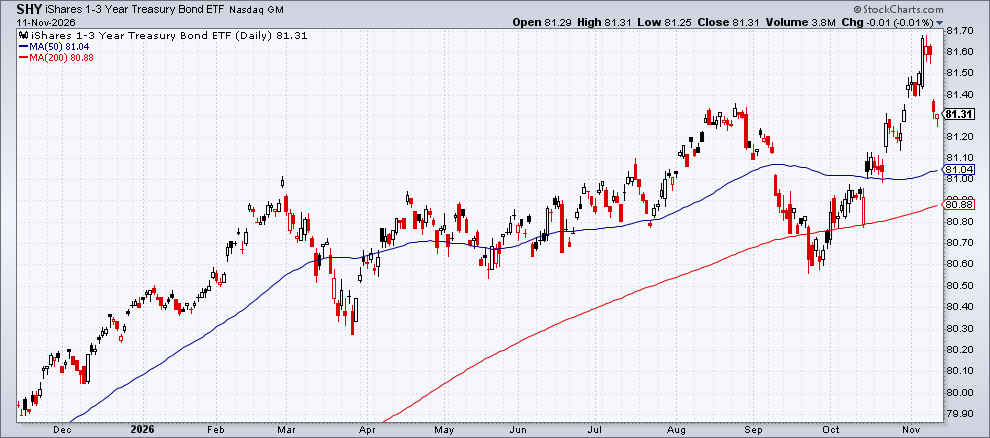
 The market continues to signal weak demand for duration, with investors maintaining a preference for shorter maturities. For example, the iShares 1-3 Year Treasury Bond ETF (SHY) stands in stark contrast to its longer-duration counterparts, exhibiting a bullish trend.
 Amid price trends, investors are navigating complex macroeconomic forces. Inflationary pressures and recent deflationary pressures may be resurfacing, creating a tug-of-war that could limit the bond market's ability to establish a clear direction in the coming weeks. The October Consumer Price Index (CPI) report further reinforced the view that inflation remains stubborn enough to pressure bond prices and push up interest rates. Last month's CPI increase exceeded expectations, reinforcing market expectations that the Federal Reserve will continue to tighten monetary policy. Although the report did not include year-on-year data due to last year's government shutdown, available data shows that the overall CPI rose to approximately 4.0% year-on-year, the highest since May; core CPI was estimated to rise to 2.9%, a 13-month high. In other words, inflation is still heading in the wrong direction, widening the gap with the Fed's 2% target. A key question for investors is whether the recent rise in inflation is temporary or more persistent. The initial trigger was the energy shock related to the war with Iran, meaning that inflation could potentially fall if the conflict continues to de-escalate. However, signs of strengthening inflation expectations raise the risk that price pressures are embedding themselves in the broader economy—potentially keeping inflation high long after the Middle East supply shock has subsided. A recent University of Michigan report highlighted this concern, noting that "after five consecutive years of inflation above target, both short- and long-term inflation expectations have risen in recent months, exposing the risk that high inflation expectations may become entrenched." The New York Fed's consumer expectations survey similarly found that inflation expectations for the next year remained high at 3.9% in October, nearly double the Fed's 2% target. The risk is that even if the energy shock related to the Iran conflict subsides, inflation could persist as long as households continue to expect price increases. However, markets and consumers eventually adapt. If inflation expectations continue to rise, they can in turn reinforce actual inflation, keeping bond yields high and monetary policy restrained. But over time, higher borrowing costs and tighter financial conditions tend to dampen spending, investment, and economic growth. If this process successfully suppresses demand and eases inflationary pressures, bond yields may eventually peak as investors begin to price in slower growth and a less hawkish Fed stance. By then, the case for a sustained bond market rally will be significantly strengthened. Predicting such inflection points is always extremely difficult, but when conditions for a bullish shift are ripe, market trend patterns are among the first indicators to reflect changes in the outlook. However, for now, based on current trend signals in the bond market, such a reversal still appears to be a low-probability scenario.
Take the Vanguard Total Bond Market ETF (BND) as an example, a common representative of US investment-grade bonds. Its strong rebound over the past month has fueled predictions that the correction is over. However, this judgment appears premature. This week, the rally stalled after hitting resistance at a key technical level. The downtrend that has dominated most of this year appears to remain intact until BND breaks through its previous high. The situation is similar for US Treasury bonds, and this article uses the iShares 7-10 Year Treasury ETF (IEF) as an example. The fund's trend remains bearish, meaning investors should remain cautious until stronger evidence of a price reversal emerges. The market continues to signal weak demand for duration, with investors maintaining a preference for shorter maturities. For example, the iShares 1-3 Year Treasury Bond ETF (SHY) stands in stark contrast to its longer-duration counterparts, exhibiting a bullish trend. Amid price trends, investors are navigating complex macroeconomic forces. Inflationary pressures and recent deflationary pressures may be resurfacing, creating a tug-of-war that could limit the bond market's ability to establish a clear direction in the coming weeks. The October Consumer Price Index (CPI) report further reinforced the view that inflation remains stubborn enough to pressure bond prices and push up interest rates. Last month's CPI increase exceeded expectations, reinforcing market expectations that the Federal Reserve will continue to tighten monetary policy. Although the report did not include year-on-year data due to last year's government shutdown, available data shows that the overall CPI rose to approximately 4.0% year-on-year, the highest since May; core CPI was estimated to rise to 2.9%, a 13-month high. In other words, inflation is still heading in the wrong direction, widening the gap with the Fed's 2% target. A key question for investors is whether the recent rise in inflation is temporary or more persistent. The initial trigger was the energy shock related to the war with Iran, meaning that inflation could potentially fall if the conflict continues to de-escalate. However, signs of strengthening inflation expectations raise the risk that price pressures are embedding themselves in the broader economy—potentially keeping inflation high long after the Middle East supply shock has subsided. A recent University of Michigan report highlighted this concern, noting that "after five consecutive years of inflation above target, both short- and long-term inflation expectations have risen in recent months, exposing the risk that high inflation expectations may become entrenched." The New York Fed's consumer expectations survey similarly found that inflation expectations for the next year remained high at 3.9% in October, nearly double the Fed's 2% target. The risk is that even if the energy shock related to the Iran conflict subsides, inflation could persist as long as households continue to expect price increases. However, markets and consumers eventually adapt. If inflation expectations continue to rise, they can in turn reinforce actual inflation, keeping bond yields high and monetary policy restrained. But over time, higher borrowing costs and tighter financial conditions tend to dampen spending, investment, and economic growth. If this process successfully suppresses demand and eases inflationary pressures, bond yields may eventually peak as investors begin to price in slower growth and a less hawkish Fed stance. By then, the case for a sustained bond market rally will be significantly strengthened. Predicting such inflection points is always extremely difficult, but when conditions for a bullish shift are ripe, market trend patterns are among the first indicators to reflect changes in the outlook. However, for now, based on current trend signals in the bond market, such a reversal still appears to be a low-probability scenario.
- Risk Warning and Disclaimer
- The market involves risk, and trading may not be suitable for all investors. This article is for reference only and does not constitute personal investment advice, nor does it take into account certain users’ specific investment objectives, financial situation, or other needs. Any investment decisions made based on this information are at your own risk.