Crude Oil Trading Alert: Inventory Pressures and Geopolitical Disturbances Drive Oversold Rebound in US Crude Oil
2026-11-13 09:24:30
The weekly inventory report released by the U.S. Energy Information Administration (EIA) is the core bearish fundamental factor putting pressure on oil prices. For the week ending November 5th, U.S. commercial crude oil inventories surged by 9 million barrels, compared to a decrease of 5.267 million barrels the previous week. The market consensus was for a decrease of 1 million barrels, meaning the inventory increase significantly deviated from expectations. In addition to crude oil, gasoline and distillate fuel inventories also accumulated this week, reflecting a slowdown in U.S. refinery stockpiling, weak demand for refined products, and seasonal consumption support falling short of market expectations. This loose supply and demand situation is putting downward pressure on oil prices in the medium term.  The increased pressure on the supply side is also significant. The latest OPEC+ monthly report shows that total OPEC+ production in October increased by 2.04 million barrels per day to 41.23 million barrels per day, with Saudi Arabia being the main driver of the increase, its crude oil production rebounding to pre-conflict high levels. Despite occasional attacks in the Strait of Hormuz, actual exports from major Persian Gulf oil-producing countries have continued to recover, increasing the supply in the spot market and continuously diluting geopolitical premiums. Crude oil prices have fallen by nearly 17% this month, with the risk premium previously driven by the conflict continuing to clear. Geopolitical narratives have once again become a variable in short-term market movements. Trump publicly stated that the US is no longer seeking an agreement with Iran, saying "the window for negotiations has long since closed." This statement came just one week after the US midterm election defeat, with Republicans generally attributing the loss to the ongoing conflict with Iran. The market's previous expectations of geopolitical easing negotiations were directly shattered, and the pricing of a prolonged conflict has returned to the market. Meanwhile, attacks erupted in the Red Sea and the Persian Gulf: Houthi rebels attacked Saudi Arabia's East-West oil pipeline pumping station, the Yanbu refinery, and Riyadh Aramco office buildings; the Iranian military reported that several oil tankers that ignored warnings in the Strait of Hormuz were hit by explosions, and some ships caught fire. Commerzbank commented that the landmine incidents in the Strait provided bottom support for Brent crude oil prices and were the direct driver of the recent rebound in WTI crude. However, it is necessary to distinguish the nature of the events: geopolitical shocks are more likely to drive a pulse-like rebound and are unlikely to reverse the trend dominated by supply and demand fundamentals. On the one hand, the Strait has not been completely blocked, and most oil tankers can still detour or pass through at opportune times; the risk of a substantial supply disruption has not yet materialized. On the other hand, the Federal Reserve's continued hawkish policy expectations have raised the dollar and US Treasury yields, putting pressure on dollar-denominated crude oil assets and further limiting the rebound's height. Institutions generally believe that before geopolitical events cause large-scale shipping disruptions, the rebound in oil prices can only be defined as a correction within a downtrend, not a trend reversal. On the daily chart, WTI has tested the lower support of the descending channel and staged an oversold rebound, currently trading at $88.60. However, the overall downtrend structure remains intact. The MACD has not yet formed a golden cross, and the green bars are only slightly contracting, indicating no clear bullish reversal signal. This is merely an oversold corrective rebound within the downtrend and cannot be directly interpreted as a trend reversal. The short-term resistance zone is between $89.50 and $90.00, which is the first key level to test the rebound. Only a firm hold above this range will open up further upside potential, targeting the Bollinger Middle Band at $94.60. The core support level is $85.00. If the rebound is met with resistance and falls below $85, the downtrend channel will reopen, with the next strong support at the lower Bollinger Band at $82.30. The RSI is 40.6, still below the neutral line of 50, indicating some easing of bearish momentum, but insufficient bullish trend signals.
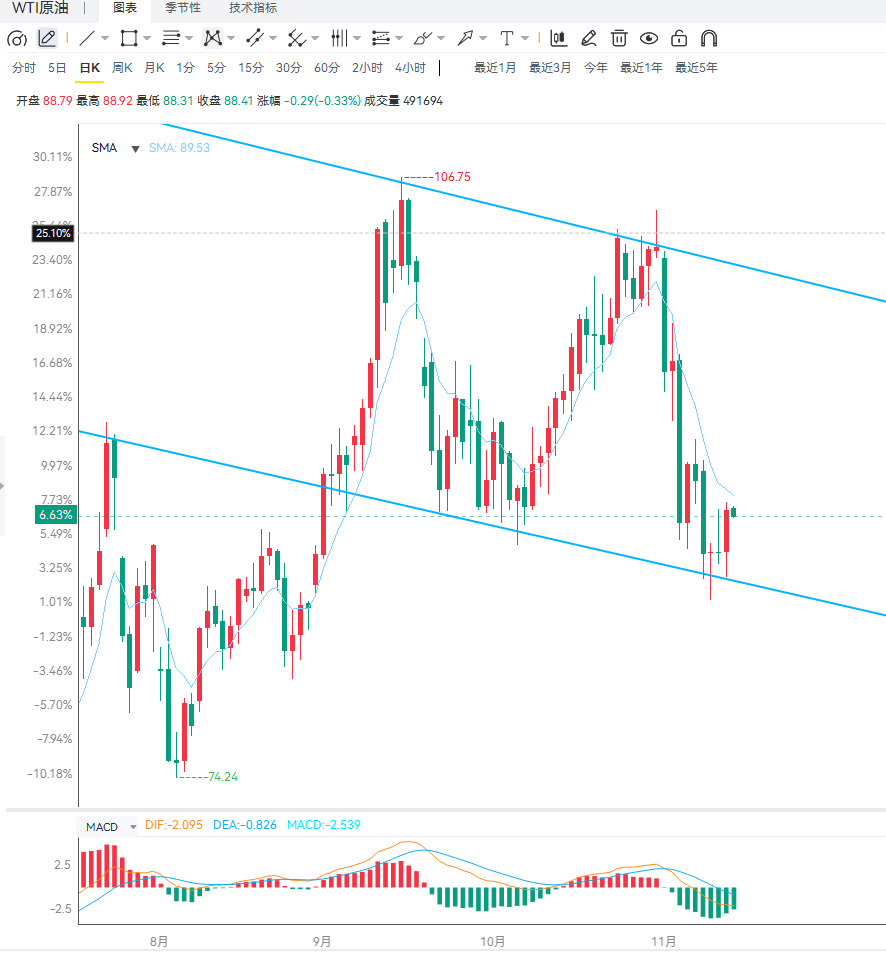 Editor's Summary: Crude oil is currently in a downtrend, experiencing an oversold correction. Loose inventories and increased OPEC+ production are the main medium-term bearish factors, while the recent attacks in the Middle East are a short-term disruptive variable, creating a clear tug-of-war between the two. Excessive fund allocation is not advisable; priority should be given to waiting for the test results of the 89.50-90 resistance zone. A firm hold above this resistance zone would likely lead to a continued rebound; however, if resistance is encountered within this zone, a retest of previous lows cannot be ruled out.
The increased pressure on the supply side is also significant. The latest OPEC+ monthly report shows that total OPEC+ production in October increased by 2.04 million barrels per day to 41.23 million barrels per day, with Saudi Arabia being the main driver of the increase, its crude oil production rebounding to pre-conflict high levels. Despite occasional attacks in the Strait of Hormuz, actual exports from major Persian Gulf oil-producing countries have continued to recover, increasing the supply in the spot market and continuously diluting geopolitical premiums. Crude oil prices have fallen by nearly 17% this month, with the risk premium previously driven by the conflict continuing to clear. Geopolitical narratives have once again become a variable in short-term market movements. Trump publicly stated that the US is no longer seeking an agreement with Iran, saying "the window for negotiations has long since closed." This statement came just one week after the US midterm election defeat, with Republicans generally attributing the loss to the ongoing conflict with Iran. The market's previous expectations of geopolitical easing negotiations were directly shattered, and the pricing of a prolonged conflict has returned to the market. Meanwhile, attacks erupted in the Red Sea and the Persian Gulf: Houthi rebels attacked Saudi Arabia's East-West oil pipeline pumping station, the Yanbu refinery, and Riyadh Aramco office buildings; the Iranian military reported that several oil tankers that ignored warnings in the Strait of Hormuz were hit by explosions, and some ships caught fire. Commerzbank commented that the landmine incidents in the Strait provided bottom support for Brent crude oil prices and were the direct driver of the recent rebound in WTI crude. However, it is necessary to distinguish the nature of the events: geopolitical shocks are more likely to drive a pulse-like rebound and are unlikely to reverse the trend dominated by supply and demand fundamentals. On the one hand, the Strait has not been completely blocked, and most oil tankers can still detour or pass through at opportune times; the risk of a substantial supply disruption has not yet materialized. On the other hand, the Federal Reserve's continued hawkish policy expectations have raised the dollar and US Treasury yields, putting pressure on dollar-denominated crude oil assets and further limiting the rebound's height. Institutions generally believe that before geopolitical events cause large-scale shipping disruptions, the rebound in oil prices can only be defined as a correction within a downtrend, not a trend reversal. On the daily chart, WTI has tested the lower support of the descending channel and staged an oversold rebound, currently trading at $88.60. However, the overall downtrend structure remains intact. The MACD has not yet formed a golden cross, and the green bars are only slightly contracting, indicating no clear bullish reversal signal. This is merely an oversold corrective rebound within the downtrend and cannot be directly interpreted as a trend reversal. The short-term resistance zone is between $89.50 and $90.00, which is the first key level to test the rebound. Only a firm hold above this range will open up further upside potential, targeting the Bollinger Middle Band at $94.60. The core support level is $85.00. If the rebound is met with resistance and falls below $85, the downtrend channel will reopen, with the next strong support at the lower Bollinger Band at $82.30. The RSI is 40.6, still below the neutral line of 50, indicating some easing of bearish momentum, but insufficient bullish trend signals. Editor's Summary: Crude oil is currently in a downtrend, experiencing an oversold correction. Loose inventories and increased OPEC+ production are the main medium-term bearish factors, while the recent attacks in the Middle East are a short-term disruptive variable, creating a clear tug-of-war between the two. Excessive fund allocation is not advisable; priority should be given to waiting for the test results of the 89.50-90 resistance zone. A firm hold above this resistance zone would likely lead to a continued rebound; however, if resistance is encountered within this zone, a retest of previous lows cannot be ruled out.
- Risk Warning and Disclaimer
- The market involves risk, and trading may not be suitable for all investors. This article is for reference only and does not constitute personal investment advice, nor does it take into account certain users’ specific investment objectives, financial situation, or other needs. Any investment decisions made based on this information are at your own risk.