CBOT Agricultural Commodities Analysis: USDA gains ended after two days, wheat fell to a nine-month low, and soybean rebound stalled at the 20-day moving average.
2026-11-13 09:08:31
CBOT grain markets were generally under pressure on Thursday (November 12). January soybeans closed at $12.19 per bushel, down 0.89%, halting a two-day rebound after hitting technical resistance above the 20-day moving average; December corn closed at $4.425 per bushel, down 1.45%, marking its second consecutive day of decline; December wheat closed at $5.842 per bushel, down 3%, its lowest level since mid-February; and December soybean meal closed at $325.40 per short ton, down 1.37%. The "expectation gap rally" triggered by the USDA report lasted only two days before being reversed by a stronger dollar and profit-taking. The dollar index rose to its highest level in about a year and a half, as strong US inflation data triggered a hawkish repricing of the Fed's interest rate path—a strong dollar makes dollar-denominated grains more expensive for overseas buyers, directly suppressing export demand. A statement from an institutional president aptly summarized the differences between commodities: "The lag in the corn market lies in exports, and today the dollar is quite strong; however, soybean exports have been consistently very strong." In other words, the same dollar pressure has a greater impact on corn, whose exports are already weak, while it is relatively manageable for soybeans, whose exports are strong. Currently, CBOT grains are caught in a crossfire between "dollar-dominated macroeconomic pressure" and "differentiation in export fundamentals among commodities." The supply tightening reported by the USDA has been digested, and market pricing power has returned to the dollar and export data. The performance of the basis provides a key contrast—the basis for soybeans and corn in the Midwest has remained stable to rise as buyers try to attract farmers to sell; however, the CIF barge premium in the Gulf has fallen, indicating that demand in the export sector has weakened after the dollar strengthened. A summary of the price changes for related commodities as of 09:01 in the Asian morning session today (November 13th). 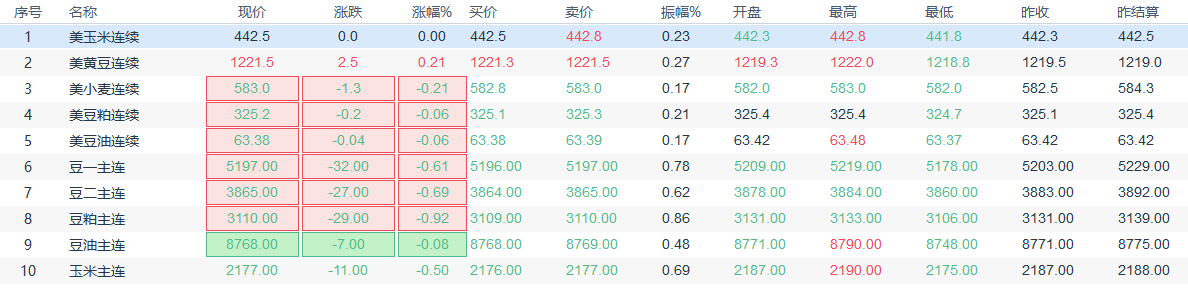 According to FX678's observations, estimates from overseas traders show that on Thursday (November 12), the speculative positions of commodity funds on corn futures, soybean futures, wheat futures, soybean meal futures, and soybean oil futures at the Chicago Board of Trade (CBOT), namely the net positions and average net positions of CBOT commodity funds, are shown in the chart below specially created by FX678:
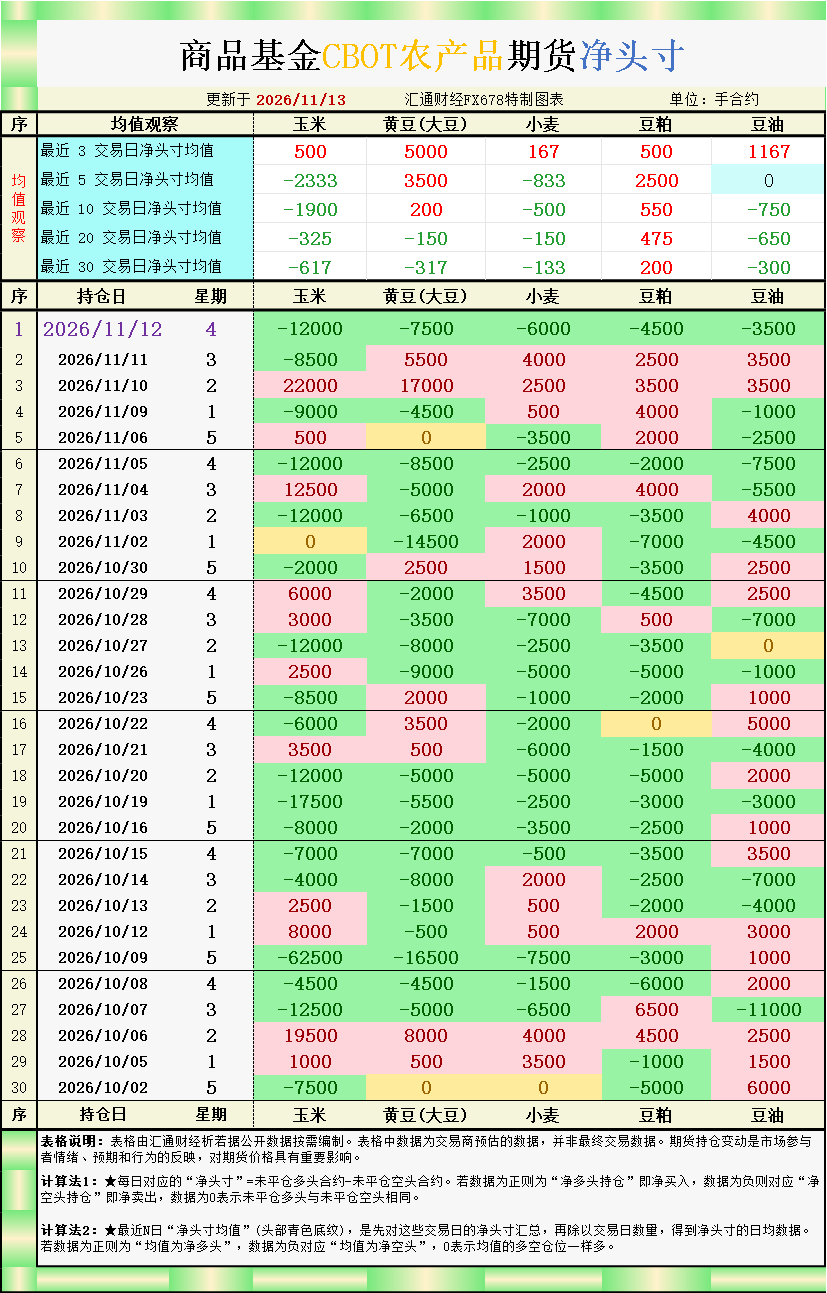 The following is an interpretation of the net positions and averages in the above position charts: [CBOT corn speculative positions: net selling of 12,000 contracts; average net position over the last 3 trading days: net buying of 500 contracts; average net position over the last 5 trading days: net selling of 2,333 contracts; average net position over the last 10 trading days: net selling of 1,900 contracts; average net position over the last 20 trading days: net selling of 325 contracts; average net position over the last 30 trading days: net selling of 617 contracts.] [CBOT soybean speculative positions: net selling of 7,500 contracts; average net position over the last 3 trading days: net buying of 5,000 contracts; average net position over the last 5 trading days: net buying of 3,500 contracts; average net position over the last 10 trading days: net buying of 200 contracts; average net position over the last 20 trading days: net selling of 150 contracts; average net position over the last 30 trading days: net selling of 317 contracts.] [CBOT wheat speculative positions are net selling 6,000 contracts; the average net position over the past 3 trading days is net buying 167 contracts; the average net position over the past 5 trading days is net selling 833 contracts; the average net position over the past 10 trading days is net selling 500 contracts; the average net position over the past 20 trading days is net selling 150 contracts; and the average net position over the past 30 trading days is net selling 133 contracts.] [CBOT soybean meal speculative positions are net selling 4,500 contracts; the average net position over the past 3 trading days is net buying 500 contracts; the average net position over the past 5 trading days is net buying 2,500 contracts; the average net position over the past 10 trading days is net buying 550 contracts; the average net position over the past 20 trading days is net buying 475 contracts; and the average net position over the past 30 trading days is net buying 200 contracts.] [CBOT soybean oil speculative positions are net sold at 3,500 contracts; the average net position over the past 3 trading days is net bought at 1,167 contracts; the average net position over the past 5 trading days is evenly split between long and short positions; the average net position over the past 10 trading days is net sold at 750 contracts; the average net position over the past 20 trading days is net sold at 650 contracts; and the average net position over the past 30 trading days is net sold at 300 contracts.] CBOT grain positions, basis, and international supply and demand reveal new market trends. Detailed analysis of each commodity is provided below.
According to FX678's observations, estimates from overseas traders show that on Thursday (November 12), the speculative positions of commodity funds on corn futures, soybean futures, wheat futures, soybean meal futures, and soybean oil futures at the Chicago Board of Trade (CBOT), namely the net positions and average net positions of CBOT commodity funds, are shown in the chart below specially created by FX678: The following is an interpretation of the net positions and averages in the above position charts: [CBOT corn speculative positions: net selling of 12,000 contracts; average net position over the last 3 trading days: net buying of 500 contracts; average net position over the last 5 trading days: net selling of 2,333 contracts; average net position over the last 10 trading days: net selling of 1,900 contracts; average net position over the last 20 trading days: net selling of 325 contracts; average net position over the last 30 trading days: net selling of 617 contracts.] [CBOT soybean speculative positions: net selling of 7,500 contracts; average net position over the last 3 trading days: net buying of 5,000 contracts; average net position over the last 5 trading days: net buying of 3,500 contracts; average net position over the last 10 trading days: net buying of 200 contracts; average net position over the last 20 trading days: net selling of 150 contracts; average net position over the last 30 trading days: net selling of 317 contracts.] [CBOT wheat speculative positions are net selling 6,000 contracts; the average net position over the past 3 trading days is net buying 167 contracts; the average net position over the past 5 trading days is net selling 833 contracts; the average net position over the past 10 trading days is net selling 500 contracts; the average net position over the past 20 trading days is net selling 150 contracts; and the average net position over the past 30 trading days is net selling 133 contracts.] [CBOT soybean meal speculative positions are net selling 4,500 contracts; the average net position over the past 3 trading days is net buying 500 contracts; the average net position over the past 5 trading days is net buying 2,500 contracts; the average net position over the past 10 trading days is net buying 550 contracts; the average net position over the past 20 trading days is net buying 475 contracts; and the average net position over the past 30 trading days is net buying 200 contracts.] [CBOT soybean oil speculative positions are net sold at 3,500 contracts; the average net position over the past 3 trading days is net bought at 1,167 contracts; the average net position over the past 5 trading days is evenly split between long and short positions; the average net position over the past 10 trading days is net sold at 750 contracts; the average net position over the past 20 trading days is net sold at 650 contracts; and the average net position over the past 30 trading days is net sold at 300 contracts.] CBOT grain positions, basis, and international supply and demand reveal new market trends. Detailed analysis of each commodity is provided below.Soybeans: Net selling of 7,500 contracts reversed three days of net buying; the 20-day moving average became the ceiling for the rebound.
On Thursday, commodity funds saw a net sell of 7,500 soybean contracts, compared to a 3-day average of net buying of 5,000 contracts and a 5-day average of net buying of 3,500 contracts—a significant reversal in daily flows, indicating that the buying spree following the USDA report has quickly turned into profit-taking. The January contract closed at $12.19, down 11.75 cents, retreating after hitting resistance above the 20-day moving average. The core pressure came from the combination of the US dollar and profit-taking. The dollar index rose to a near 18-month high, making dollar-denominated grains more expensive for overseas buyers and suppressing export demand. However, soybean export fundamentals still provided a buffer: the USDA confirmed on Thursday the sale of 136,000 tons of soybeans to a major Asian country; one institutional president stated that "soybean exports have been very strong." However, a report indicating that a major Asian country plans to reduce its 2027 soybean imports by approximately 15 million tons, coupled with the Asian country's demand for the US to implement a $60 billion reciprocal tariff reduction agreement, added further pressure to the market. On the basis front, soybean basis in the Midwest rose at Cincinnati grain depots and Lafayette processing plants as buyers attempted to attract farmers to sell; however, CIF soybean barge premiums in the Gulf remained stable to decline. Analysts expect net soybean sales for the week ending November 5 to be between 850,000 and 2 million tons. The closing price was $12.19, with a downside target of $12.10. A rebound would require a weaker dollar or stronger-than-expected export sales on Friday. The contrast between net selling of 7,500 contracts by funds and net buying over the past three days suggests that short-term long positions have largely exited after the report, and the next direction will depend on whether export data provides a strong boost.Corn: Net selling of 12,000 contracts reversed short-term net buying; weak exports amplified by the US dollar.
Corn commodity funds saw net selling of 12,000 contracts on Thursday, compared to a 3-day average of net buying of 500 contracts and a 5-day average of net selling of 2,333 contracts—the single-day net selling significantly exceeded the short-term averages, indicating concentrated and directional selling pressure from funds. The December contract closed at $4.425, down 5.5 cents, marking its second consecutive day of decline and erasing all gains following the USDA report. The core factor suppressing the market was the combined effect of weak exports and a strong dollar. One institutional president bluntly stated, "The lag in the corn market lies in exports, and today the dollar is quite strong." USDA data shows that export sales so far this year remain at their slowest pace since 2023. In international transactions, the Turkish State Grain Administration temporarily purchased approximately 295,000 tons of feed corn in a tender, with bids ranging from $293.50 to $298 per ton (cost plus freight)—a substantial amount, but this purchase did not alter the overall export pace. In terms of basis, corn basis in the Midwest rose in Cincinnati, Cedar Rapids, Seneca, Consel Bluffs, and at two ethanol plants, as buyers attempted to attract farmers to sell; however, CIF corn barge premiums in the Gulf remained stable to decline. The divergence between a strengthening domestic basis and a falling export basis is consistent with soybeans—domestic demand in the distribution sector is absorbing supply, while exports are weakening due to a stronger dollar. The closing price was $4.425, with a downside target of $4.35. A rebound would require stronger-than-expected export sales. Net selling of 12,000 contracts by funds, coupled with the assessment of "slowest exports," creates a logical loop, making a short-term bearish trend unlikely.Wheat: Net selling surged by 6,000 contracts, hitting a nine-month low amid expectations of a potential trade war.
Wheat commodity funds net sold 6,000 contracts on Thursday, while the 3-day average was net buying of 167 contracts and the 5-day average was net selling of 833 contracts—a significant deviation from the short-term average in daily net selling, indicating that funds increased their short selling in anticipation of Black Sea peace talks. The December contract closed at $5.842, down 15.25 cents, the lowest since mid-February; the Kansas City December hard red winter contract closed at $6.19, down 20-1/2 cents. There are two core factors suppressing the market: First, the Russia-Ukraine peace talks—the trilateral talks between Russia, Ukraine, and the United States concluded in Abu Dhabi on Wednesday, with both sides reaching an agreement on a "large-scale" prisoner exchange, and negotiations will continue. Although there was no breakthrough on the ceasefire and territorial issues, the continuation of negotiations itself weakened the risk premium for Black Sea supply disruptions. Second, Ukraine's stocks—the Ukrainian Minister of Agriculture stated that due to port disruptions, the country's grain stocks may have tripled compared to a year ago. This combination implies that the potential release of Black Sea supplies is not a small, incremental disturbance, but rather a concentrated entry of pent-up stocks into the market. On the basis front, the basis for hard red winter wheat in the US Plains region was mixed due to falling futures prices and thin trading; the protein premium for 11.8% protein wheat fell 10 cents. In international trading, Jordan issued a new tender for 120,000 tons of milled wheat and 120,000 tons of feed barley; Turkey will export 400,000 tons of milled wheat and 100,000 tons of durum wheat from November 17th to 18th—exports from Turkey due to a record harvest are putting additional pressure on prices. The closing price was $5.842, with a downside target of $5.80. The outcome of the negotiations will be the dominant variable in the next phase. Net selling of 6,000 contracts by funds echoes the prediction of a "triple increase in inventory," indicating that short sellers remain unrestrained near nine-month lows.Soybean Meal: Net selling of 4,500 lots reverses short-term net buying; export expectations remain normal.
On Thursday, commodity funds net sold 4,500 contracts of soybean meal, while the 3-day average was a net buy of 500 contracts and the 5-day average was a net buy of 2,500 contracts—a single-day shift from bullish to bearish, reversing the short-term net buying trend. The December contract closed at $325.40 per short ton, down $4.30. The cash basis remained largely stable at the rail and trucking ends due to the decline in futures. Analysts on average expected the USDA to report weekly soybean meal export sales of 250,000 to 450,000 tons on Friday, compared to 390,381 tons last week. This expectation implies that soybean meal export sales are at a normal level, with neither bright spots nor significant deterioration—its price is more closely following the cost transmission of soybeans. The net selling of 4,500 contracts by funds is consistent with the normalized export expectations, indicating that short sellers in soybean meal are following the overall bearish tone of the soybean sector, rather than making independent judgments based on their own fundamentals. $325.40 corresponds to the marginal pricing of new crop crushing supply, and the probability of short-term fluctuations in the $320 to $330 per short ton range is relatively high. A stable basis provides support, but the loose supply situation limits the upside potential.Soybean oil: Net selling of 3,500 lots reverses short-term net buying; limited support from the energy sector.
On Thursday, commodity funds saw a net sell of 3,500 contracts of soybean oil, while the 3-day average was a net buy of 1,167 contracts and the 10-day average was a net sell of 750 contracts—a single-day shift from bullish to bearish, reversing the short-term net buying trend. As a feedstock for biodiesel, soybean oil's pricing logic is tied to both soybeans (cost side) and crude oil (energy side). On Thursday, soybeans fell 11-3/4 cents, dragging down costs; on the energy side, crude oil rose on Thursday, increasing the production cost of polyester, a cotton substitute—this detail, while specifically targeting cotton, also illustrates that the strengthening of the energy side provides marginal support for vegetable oils. Looking at the crushing chain, the decline in soybeans lowers crushing costs, soybean meal follows suit, and export expectations remain normal; changes in crushing profits depend on the difference in the decline rates of the two. Soybean oil currently lacks independent upward momentum, passively following the trends of soybeans and crude oil. The net sell of 3,500 contracts by funds, reversing the short-term net buying, indicates that the drag from costs outweighed the support from the energy side. A slightly weak and volatile short-term trend is likely, but the decline may be limited by the strengthening of crude oil.Summary: Net selling across the board; the 48-hour lifecycle of USDA's gains.
A clear trend emerges from the combined open interest data of the five major commodities: net selling across the board. Specifically, corn saw 12,000 contracts, soybeans 7,500, wheat 6,000, soybean meal 4,500, and soybean oil 3,500. This pattern suggests that the fund's buying spree following the USDA report was a short-term positioning move, not the start of a trend. The net buying in the two days following the report (22,000 contracts for corn and 17,000 for soybeans) quickly reversed in the face of a stronger dollar and profit-taking, with the net selling direction of the five commodities highly consistent. Corn saw the most dramatic net selling (3-day average net buying of 500 contracts versus a single-day net selling of 12,000 contracts), while soybeans showed the most significant reversal (3-day average net buying of 5,000 contracts versus a net selling of 7,500 contracts). Wheat's net selling echoed the progress of the Black Sea peace talks. The divergence between basis and futures prices is a recurring signal. The basis for both soybeans and corn in the Midwest has widened, while the CIF premium for the US Gulf Coast has narrowed – domestic demand in the distribution sector is absorbing supply, while exports have weakened due to a stronger dollar. This divergence implies that domestic demand in the US is genuine, but international buyers are adopting a wait-and-see approach or opting for South American shipments after the dollar's strength. Looking ahead, whether soybeans can hold above $12.10, corn can find support above $4.35, and wheat can stabilize around $5.80 are three key indicators to watch to see if this round of net selling across the board is nearing its end. Friday's USDA weekly export sales data (released one day later due to a federal holiday) is the most important recent confirmation point: analysts expect net soybean sales of 850,000 to 2 million tons, old crop corn of 2 million to 3 million tons, new crop corn of 600,000 to 800,000 tons, and soybean meal of 250,000 to 450,000 tons. If the data falls within the upper limit of expectations, the strength of the basis will be confirmed, supporting the continuation of the rebound; if it falls short of expectations, the weakness in exports will further suppress the market. Furthermore, the direction of the US dollar index and the progress of the Black Sea peace talks are important variables in the medium term. Amidst a landscape of net selling across the board, dollar-dominated macroeconomic pressures, and pending export data, the market remains more sensitive to negative data than positive data – the gains from the USDA report only lasted 48 hours, while funds had already withdrawn their positions.- Risk Warning and Disclaimer
- The market involves risk, and trading may not be suitable for all investors. This article is for reference only and does not constitute personal investment advice, nor does it take into account certain users’ specific investment objectives, financial situation, or other needs. Any investment decisions made based on this information are at your own risk.