The dollar index hit a one-and-a-half-year high, and the Fed's third-in-command said inflation remained stubbornly persistent.
2026-11-13 08:28:31
On Friday (November 13) during Asian trading hours, the US dollar index continued its upward trend, currently trading around 103.20. Overnight, the dollar index reached a new high of 103.24, its highest level since early April 2025. New York Fed President John Williams stated that inflation remains too high and the Fed still has work to do in getting monetary policy back on track, reinforcing market expectations that the central bank will continue to raise interest rates. Williams described inflation as stubbornly persistent during a panel discussion at an event in New York on Thursday evening. He stated that the Fed needs to act over time to bring it back to its 2% target. 
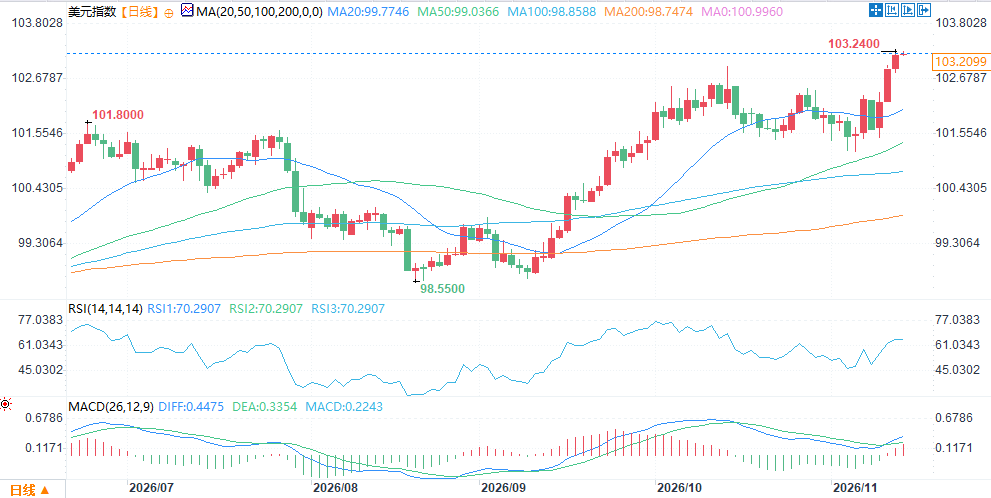 (US Dollar Index Daily Chart, Source: FX678) At 8:26 AM Beijing time, the US Dollar Index was at 103.20.
Economic assessment: Resilient, strong growth, strengthening but not overheated.
Williams expressed confidence in the economy. He stated that the economy has remained resilient and experienced strong growth, and while the U.S. economy is strengthening, it is not overheating. The robust economy gives the Federal Reserve room to further tighten without reversing growth, and the absence of overheating suggests he believes there is no need to rush into action. Williams's "no rush" stems not from concerns about the economy, but from the judgment that "there is no need to rush"—the economy is strong enough to withstand tightening, yet not overheated enough to require a sudden stop, providing a basis for a gradual approach.Policy pace: "Over time" and "stable pace" indicate a gradual approach, rather than a series of large steps.
He also stated that the Federal Reserve has been collecting data at a steady pace—a wording that points to a methodical, meeting-by-meeting approach rather than a sudden change in pace. His comment about the need to act "over time" suggests his support for a continued, gradual tightening. This implies that Williams deliberately avoided wording like "accelerate" or "urgent," anchoring the policy path within a "meeting-by-meeting, data-dependent" framework—directly limiting market speculation about a 50-basis-point tightening.Data Background: After the CPI overheated and before the December meeting, market pricing was mainly around 25 basis points, with 50 basis points at the lower end.
This statement came two days after the higher-than-expected October Consumer Price Report. Overall prices rose 0.4% month-over-month, and core prices rose 0.3%, both exceeding expectations. Subsequently, the market priced in a high probability of a 25 basis point rate hike at the December 9th meeting, and a very low probability of a 50 basis point hike. Governor Waller had previously stated that he favored a 25 basis point hike in December, but might prefer a larger hike if inflation was higher than expected. In his comments, Williams did not commit to specific action in December. However, as a permanent voting member and Vice Chairman of the FOMC, his views carry significant weight. His message was also consistent with his speech in Frankfurt a week earlier, when he stated that inflation was "far too high." Williams' statement provided support for a December rate hike but did not endorse a "larger hike"—between Waller's 50 basis point discussion and Williams' gradual stance, the market received the signal that "the direction is clear, but the magnitude is uncertain."Market Implications: The market is pricing in a December rate hike and limiting bets to 50 basis points, putting downward pressure on gold.
For the market, these comments support the case for a December rate hike but discourage bets on larger moves. The next test is the pre-meeting data, especially further inflation readings—they will determine whether "over time" means one rate hike or multiple hikes. Williams' remarks reinforced the pricing in a December rate hike and the dollar's interest rate advantage, keeping front-end Treasury yields firm; his emphasis on "over time" and a stable, data-dependent approach suggests no urgency for a 50 basis point increase, which could limit the accumulation of bets on larger rate hikes. These comments added pressure on gold—gold prices have been falling as rate hike expectations have pushed up real yields. The "higher and longer" message also keeps oil-price-driven inflation risks at the center of the policy outlook.in conclusion
Williams stated that inflation is too high and persistently stubborn, and the Fed needs to act over time to bring it back to the 2% target; the economy is resilient, growing strongly and strengthening but not overheated; the Fed has been collecting data at a steady pace. His phrases "over time" and "steady pace" point to a continued, gradual tightening, suggesting no urgency for a 50 basis point cut. This statement, following the overheated October CPI and ahead of the December 9th meeting, supports pricing in a December rate hike and the dollar's interest rate advantage, keeping front-end yields firm, but may limit bets on larger rate hikes; it puts pressure on gold as rate hike expectations push up real yields. The "higher and longer" message keeps oil-price-driven inflation risks at the center of the policy outlook. The next test is the pre-meeting inflation data—they will determine whether "over time" means one rate hike or multiple hikes. (US Dollar Index Daily Chart, Source: FX678) At 8:26 AM Beijing time, the US Dollar Index was at 103.20.
- Risk Warning and Disclaimer
- The market involves risk, and trading may not be suitable for all investors. This article is for reference only and does not constitute personal investment advice, nor does it take into account certain users’ specific investment objectives, financial situation, or other needs. Any investment decisions made based on this information are at your own risk.