With Japan's Finance Minister personally mentioning "coordination," has the USD/JPY exchange rate reached its peak?
2026-11-13 09:40:29
On Friday (November 13) during Asian trading hours, the US dollar traded in a narrow range against the Japanese yen, hovering around 159.90; overnight it touched 160.04, a new high since early September. Japanese Finance Minister Satsuki Katayama intensified her warnings about the yen's decline, saying she saw one-way and rapid fluctuations in the currency market and would maintain communication with the US Treasury Department and respond appropriately. 
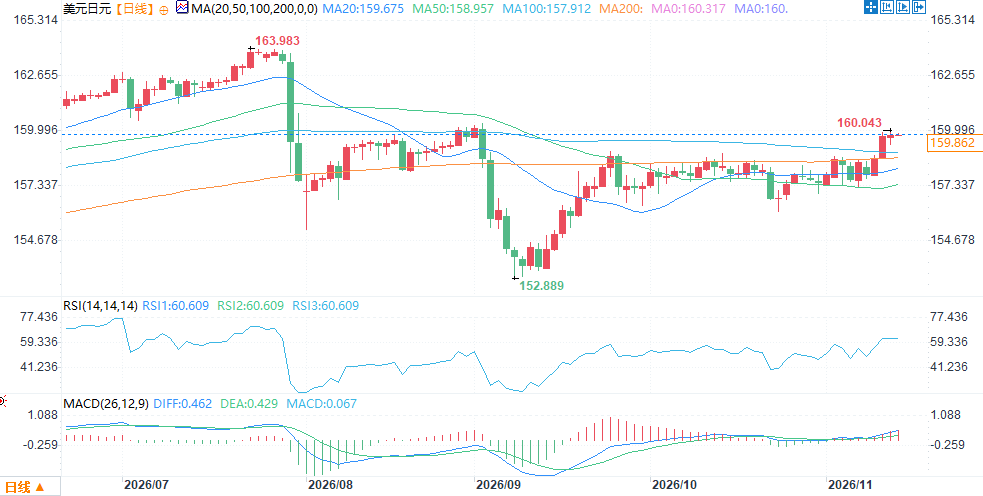 (USD/JPY daily chart, source: EasyForex) At 9:38 Beijing time, USD/JPY was trading at 159.85/86.
The weight of the wording: "one-way," "rapid," and "coordinating with the U.S. Treasury Department."
Katayama stated that the US and Japan expressed a common stance on exchange rates at the summit, suggesting that Tokyo believes Washington agrees on curbing disorderly fluctuations. She declined to comment on the intervention record. This statement follows the New York Fed's disclosure that the US Treasury bought yen in July, the first time since 1998, in conjunction with the Japanese Ministry of Finance. The weight of the wording lies in the fact that Japanese officials typically use terms like "one-way" and "rapid" when concerns escalate; specifically mentioning coordination with the US Treasury adds weight, as Washington has now indicated a willingness to inject its own funds into the yen. The warning is no longer just a one-sided statement from Tokyo, but a bilateral signal supported by the record of US involvement—making the market face a more real risk regarding a test above 160.Signals of Coordination: Kamimura's similar remarks on Thursday and the record of US participation
Japan's Vice Minister of Finance for International Affairs, Kamimura, offered a similar message on Thursday, warning that it was too early to forget about this summer's intervention. The combination of these two statements transforms the "intervention risk" from a vague threat into a traceable policy stance. The ongoing and public communication between Tokyo and Washington on the exchange rate issue, rather than ad hoc and covert, is itself a deterrent, as the market knows that both sides have a history of action and a shared position.The root cause of the yen's weakness: the interest rate differential between the US and Japan has not narrowed, and the Bank of Japan's December rate hike is key.
The renewed weakness of the yen reflects a familiar gap. A resilient US economy, persistent inflation, and rising expectations of a December rate hike are supporting the dollar. The Bank of Japan raised rates in June and September, and the market widely expects another rate hike in December. Before this gap narrows, officials are relying on rhetoric and threats of action to slow the yen's decline. Intervention and rate hikes are two parallel lines of defense—the former acting on speed, the latter on the fundamental interest rate differential; if the Bank of Japan raises rates as expected in December, the interest rate differential will narrow, combining with the intervention's effect; if the rate hike fails to materialize, the effectiveness of the intervention will again face the test of its own strength.Fiscal measures: Early disbursement of winter utility subsidies; weak yen amplifies energy costs.
Katayama also stated that the government has decided to advance subsidies for household utility bills this winter, paid from reserve funds. This move aims to protect households from the impact of high energy costs. High oil prices have driven up these costs, and the weak yen has exacerbated the situation, as Japan relies on imports for almost all of its energy. The effects of the weak yen have already spread from the exchange rate market to household bills, requiring the government to use fiscal tools to buffer imported inflation in addition to currency defense—this also illustrates that the pressure of the weak yen on the Japanese economy has reached a point where a multi-pronged approach is necessary.in conclusion
Katayama warned of one-way, rapid fluctuations in the currency market and stated that she would coordinate with the US Treasury and respond appropriately. She noted that the US and Japan shared a common position on exchange rates at the summit but declined to comment on the intervention record. This followed the New York Fed's disclosure that the US Treasury bought yen in July, the first time since 1998; Kamimura also warned on Thursday that the summer's intervention should not be forgotten. The weight of the wording lies in the combination of "one-way," "rapid," and "coordinated with the US Treasury"—transforming the warning from a unilateral statement from Tokyo into a bilateral signal supported by a record of US involvement. The root cause of the yen's weakness is the US-Japan interest rate differential: the resilience of the US economy, persistent inflation, and expectations of a December rate hike support the dollar, while the interest rate differential has not narrowed despite the Bank of Japan's anticipated December rate hike. On the fiscal front, the government has released winter utility subsidies in advance to buffer energy costs amplified by the weak yen. For the market, these statements increase the risk of traders pushing the USD/JPY above 160—with both sides indicating readiness to act, the risk of another intervention will keep the exchange rate fluctuating around that level in the weeks leading up to the Bank of Japan's December meeting. (USD/JPY daily chart, source: EasyForex) At 9:38 Beijing time, USD/JPY was trading at 159.85/86.
- Risk Warning and Disclaimer
- The market involves risk, and trading may not be suitable for all investors. This article is for reference only and does not constitute personal investment advice, nor does it take into account certain users’ specific investment objectives, financial situation, or other needs. Any investment decisions made based on this information are at your own risk.