













The USD/CAD pair is at its highest level since early October; institutions say the risks are skewed towards a longer US interest rate hike cycle.
2026-11-13 11:10:30
On Friday (November 13) during the Asian session, the US dollar continued its upward trend against the Canadian dollar, currently trading around 1.4255, near its highest level since early October. The US dollar index fluctuated at high levels, currently trading around 103.20, after reaching a new high of 103.24 overnight, the highest since early April 2025. The latest assessment from RBC provides further evidence – US growth and labor market momentum remain strong. RBC Economic Research indicates that US growth and labor market momentum remain strong, with the average GDP forecast for 2026-2027 revised upward to 2.4%, and the unemployment rate expected to remain near the historically low 4.2%. Rising core inflation and producer price data suggest that price pressures are building, reinforcing expectations of further tightening by the Federal Reserve and a longer rate hike cycle in the US compared to Canada. 
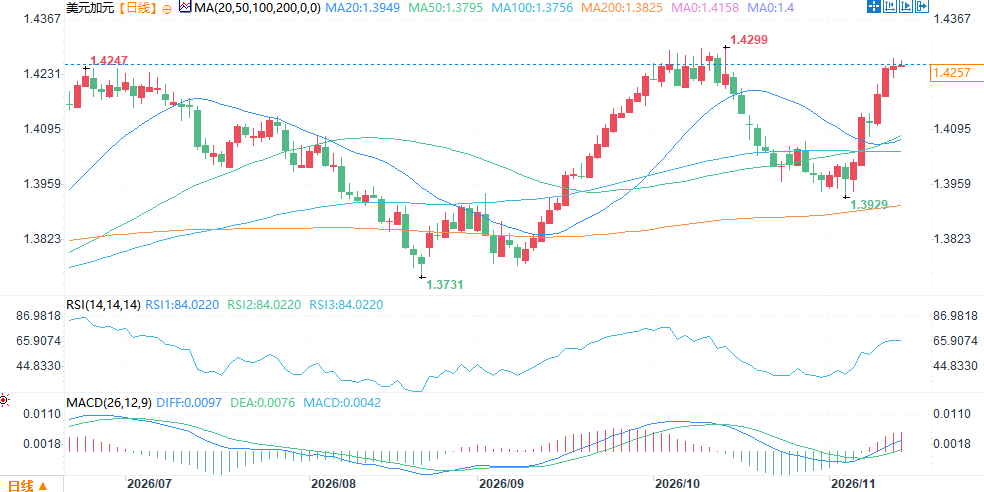 (USD/CAD daily chart, source: EasyForex) At 10:57 Beijing time, USD/CAD was trading at 1.4256/57.
Growth and Employment: GDP forecast revised upward to 2.4%, unemployment rate remains at 4.2%.
A recent report from the RBC Economic Research Team points out that the growth momentum of the US economy and the resilience of the labor market far exceed previous expectations, forming the core basis of the current macroeconomic assessment. The team significantly raised its average annual GDP growth forecast for 2026-2027 from 2.1% and 2.2% to 2.4%. This adjustment is not a simple numerical correction, but a comprehensive assessment based on continued strong consumer spending, a rebound in business investment, and relatively loose fiscal and credit conditions. Meanwhile, the unemployment rate is expected to remain stable near the historically low 4.2% throughout the forecast period, indicating that the labor supply-demand gap has not widened significantly due to previous policy tightening. The simultaneous strength in growth and employment directly provides the Federal Reserve with fundamental support to continue tightening monetary policy. When the economy shows no substantial slowdown and the labor market shows no signs of easing, policymakers have more reason to keep interest rates within a restrictive range, or even consider further increases, to prevent a resurgence of inflation expectations. For the market, this means an increased probability of a "soft landing" for US economic growth, but also simultaneously raises expectations for the peak of policy interest rates and the duration of their high levels, thereby supporting the US dollar through interest rate differentials. Overall, the resilience of the US economy has moved from the "data confirmation" stage to the "policy pricing" stage, becoming one of the key variables affecting global asset allocation.Inflationary pressures: Rising core inflation and producer prices reinforce expectations of interest rate hikes.
The report explicitly points out that core inflationary pressures in the US are re-accumulating, while the labor market remains historically strained, creating a mutually reinforcing cycle. The rebound in core inflation is not solely due to overheated demand, but rather a result of the combined effects of sticky service prices, lagging housing cost transmission, and rising producer price indices. The rise in producer prices suggests that cost pressures on businesses may continue to be passed downstream in the coming quarters, weakening the persuasiveness of the previous narrative of "temporary inflation." The tightness in the labor market provides additional support from the wage side: the job vacancy rate remains higher than pre-pandemic levels, and while wage growth has slowed, it has not yet fallen back to a range fully compatible with the 2% inflation target. This dual pressure of "core prices + tight labor" makes it more difficult for the Federal Reserve to simply attribute the current price increase to a one-off shock or base effect. For policy, this means the end of the rate hike cycle may be further delayed, and the threshold for initiating rate cuts will correspondingly increase. The market's pricing logic of "higher and longer" from the Federal Reserve is thus strengthened, and fluctuations in the US Treasury yield curve and the dollar index revolve more around inflation data than simply growth data. The stickiness of the overall inflationary environment has become the core driving factor behind the divergence of US monetary policy from that of other major economies.Policy Divergence: Risks Lean Towards a Longer US Interest Rate Hike Cycle
The Bank of Canada maintained its balanced risk assessment in its policy outlook, but explicitly pointed out that the risks are skewed towards a larger rate hike cycle in the United States. The core of this assessment lies in the widening fundamental differences between the two countries: the US has stronger growth momentum, a tighter labor market, and stickier core inflation, making the Federal Reserve's policy constraints significantly more stringent than those of the Bank of Canada. The Canadian economy has shown more signs of slowing in trade, housing, and consumption, while the US remains in a combination of "high growth + low unemployment." This fundamental asymmetry determines the asymmetry of monetary policy paths—the Federal Reserve has more room to raise or maintain high interest rates, while the Bank of Canada is more likely to shift to a neutral or accommodative stance earlier. This divergence directly supports the USD/CAD exchange rate through interest rate differentials and affects cross-border capital flows and terms of trade. For investors, the policy divergence between the US and Canada is no longer short-term noise, but a structural theme that needs to be continuously monitored in the medium term. The report emphasizes that this risk bias is not a one-way bet, but a conditional probability judgment based on current data; if US inflation unexpectedly falls or the labor market loosens rapidly, the divergence may converge. However, based on currently available evidence, the risk weight of a larger US rate hike cycle remains higher than the symmetrical scenario.Tariff impact: Targeted and significant impact, but over 80% of exports remain duty-free.
The report maintains a cautiously balanced assessment of US tariff policy: while tariffs have indeed had a targeted and significant impact on specific industries, they have not yet posed a systemic risk sufficient to undermine overall economic growth. Following the implementation of the new measures in August, the share of Canadian exports directly targeted by US tariffs increased, involving sub-sectors such as steel, aluminum, some auto parts, and certain agricultural products. These industries face pressure from rising costs, order shifts, and compressed profits, and regional employment and investment decisions have also been somewhat disrupted. However, from a macro perspective, over 80% of Canadian exports to the US still enjoy duty-free treatment, meaning the direct coverage of tariffs is relatively limited, and the drag on overall trade flows and GDP has been effectively diluted. The report further points out that the tariff impact is mainly concentrated on the scenario of "targeted industries being disrupted while overall growth is controlled," which is highly consistent with the structural differentiation in recent Canadian trade data. Due to the localized nature of the impact, tariffs have not fundamentally changed the direction of the US-Canada interest rate differential, nor have they significantly weakened the relative advantage of the US economy. For policymakers and the market, this means that trade frictions are more of a redistribution at the industry level than a recession trigger at the macro level; investors need to distinguish between “affected sectors” and “the overall economy” to avoid over-extrapolating local shocks into systemic risks.in conclusion
RBC Economic Research believes that strong US growth and labor market momentum have led to an upward revision of GDP forecasts to an average of 2.4% for 2026-2027, with the unemployment rate remaining at a historically low 4.2%. Rising core inflation and producer prices suggest accumulating price pressures, reinforcing expectations of further tightening by the Federal Reserve. The bank believes the Bank of Canada's risk forecast is balanced but biased towards a larger US rate hike cycle—stronger US growth, tighter employment, and stickier inflation make the Fed's path relatively steeper, and this divergence supports the US dollar through interest rate differentials. Regarding tariffs, the new measures in August increased the share of targeted Canadian exports, but over 80% of exports remain duty-free, meaning the impact is concentrated in specific sectors and insufficient to disrupt overall growth. The direction of the US-Canada interest rate differential is driven by fundamental differences and is unlikely to reverse in the short term, thus providing sustained support for the USD/CAD exchange rate. (USD/CAD daily chart, source: EasyForex) At 10:57 Beijing time, USD/CAD was trading at 1.4256/57.
- Risk Warning and Disclaimer
- The market involves risk, and trading may not be suitable for all investors. This article is for reference only and does not constitute personal investment advice, nor does it take into account certain users’ specific investment objectives, financial situation, or other needs. Any investment decisions made based on this information are at your own risk.

