Crude Oil Geopolitical Recap: US-Iran Standoff, Russia-Ukraine Peace Talks Stalled, Houthi Attacks on Energy Facilities
2026-11-13 16:02:37
On Friday (November 13th) during the Asian and European sessions, international oil prices consolidated, almost completely preserving Thursday's gains. WTI crude oil futures rose 2.64% on Thursday. The core pricing theme in recent oil trading has been geopolitical maneuvering. The intertwined storylines of the US-Iran standoff in the Middle East, the Russia-Ukraine peace talks, and the Houthi movement continue to drive geopolitical risk premiums for Brent crude. The market is repeatedly trading in a stalemate of "neither war nor peace." This means that the US, Iran, Russia, Ukraine, and the EU are all continuously involved in this geopolitical struggle, each believing the other is nearing its end, and none are willing to back down due to high sunk costs. 
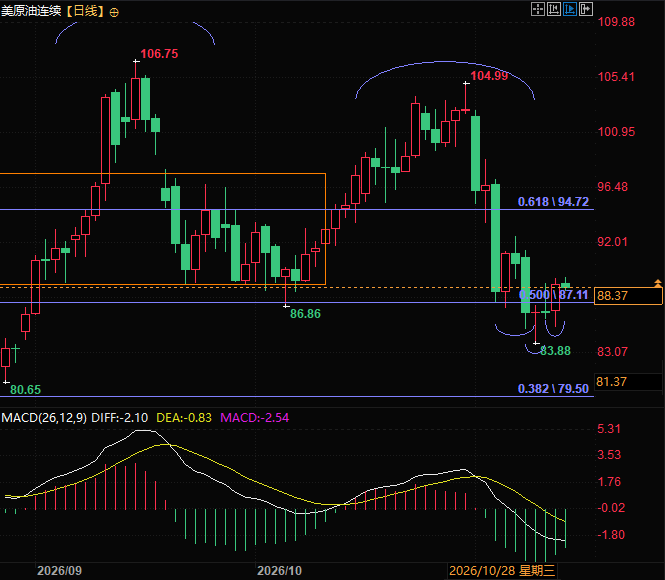 (WTI crude oil futures contract daily chart, source: EasyTrade) At 15:59 Beijing time, WTI crude oil futures contract is currently trading at $88.51 per barrel.
Iran: Negotiation demands are clear; nuclear and deterrence stance continues to escalate.
Iran has drawn clear red lines in the standoff, demanding a firm commitment to negotiations: the lifting of US sanctions, guaranteeing normal navigation in the Strait of Hormuz, and safeguarding its rights related to its nuclear program. Faced with persistent external military threats, hardline voices within Iran are actually rising. One piece of evidence is that the Iranian Conference of Experts has called for a review of its withdrawal from the Treaty on the Non-Proliferation of Nuclear Weapons, a re-examination of its national defense strategy, the establishment of its own deterrent capabilities, and a statement indicating that it no longer trusts relevant international inspection agencies. The Iranian Foreign Ministry has explicitly declared that any entity directly or indirectly involved in aggression against Iran, or cooperating with the economic blockade, including countries deploying naval forces or providing military logistical support in the region, is committing hostile and illegal acts, tantamount to participating in US-Israeli aggression against Iran, and cannot be absolved under the pretext of "freedom of navigation." Recent confrontational actions have escalated: after the military strikes in the Sirik region, the Iranian Revolutionary Guard immediately launched a counterattack, striking a US early warning radar in Bahrain; attacks on ships in the Strait of Hormuz have been frequent, with 37 attacks in October and at least 10 more ships attacked in early November, including an LPG tanker that struck a mine and exploded. Rising shipping insurance premiums across the Taiwan Strait, increased risk aversion among shipowners, and the continued uncertainty surrounding navigation operations are supporting oil prices.The United States: Abandoning the negotiating approach, caught in the crossfire of multiple forces, and with reduced transparency.
US policy has shifted significantly, with Trump publicly stating that the US no longer needs an agreement with Iran and halting diplomatic consultations previously initiated by Vice President Vance. Vance's previous communications focused on issues such as passage through the Strait of Hormuz and restrictions on Iran's nuclear program, but the negotiation window has now shrunk considerably. Trump also revealed that Gulf states such as Saudi Arabia, the UAE, Qatar, and Bahrain have requested the US to maintain the status quo and postpone escalation of the conflict, further limiting the US's option of launching an immediate large-scale offensive. However, Israel continues to exert pressure, with Netanyahu repeatedly urging Trump to launch a new round of strikes against Iran. There are also voices within Israel offering checks and balances, with potential successor Eisencourt warning the caretaker government against rashly launching major military operations during the power transition period, further increasing the uncertainty of the situation. Meanwhile, the US military's information black box problem is worsening, amplifying oil price volatility. The US Navy recently quietly replaced commanders of nuclear submarines and destroyers deployed in the Middle East, breaking with the previous practice of publicly announcing personnel changes. The US Central Command is strictly controlling operational information in the Middle East, restricting the release of satellite imagery of relevant areas, making it difficult for the market to accurately assess the true damage and scale of operations. After the news broke, Brent crude oil prices rose to around $93.4 per barrel.Russia-Ukraine peace talks: Progress made, but deadlock remains over the selection of a European representative.
The Russia-Ukraine peace talks have seen a turning point, but the issue of European participation remains a major obstacle. Kushner and Witkov traveled to Moscow for substantive talks with Putin, and both sides agreed to include European partners in the next round of negotiations. The Kremlin officially announced that Putin will meet with Trump during the APEC summit. European countries generally agree that they should participate in the negotiations, but a unified negotiating team has yet to be finalized. At the European Political Community summit in Dublin, opinions were clearly divided: some countries supported EU High Representative for Foreign Affairs and Security Policy Kalas or European Council President Costa as representatives, while others advocated for multiple representatives; no unified plan has been reached to date. The direction of the Russia-Ukraine negotiations is a medium-term variable for oil prices: if the peace talks proceed smoothly, restrictions on Russian crude oil exports are expected to ease, putting downward pressure on oil prices; if the disagreements among European representatives continue to delay negotiations, the market will continue to price in the uncertainty of Russian oil supply, providing support for oil prices.Houthi rebels launch another attack, targeting key Saudi energy infrastructure.
The Houthi rebels near the Red Sea have launched renewed attacks on energy targets, further tightening the buffer space for Middle Eastern crude oil exports. The Houthis issued a statement claiming to have used drones to attack the No. 7 pumping station of the Saudi East-West Pipeline and to strike Yanbu oil facilities with ballistic missiles, asserting that all targets had been achieved. Simultaneously, the Houthis denied firing munitions at holy cities such as Mecca and Medina, refuting Saudi accusations. Saudi Arabia has not yet responded. The Saudi East-West Pipeline and the Yanbu refining and export facilities are important diversion channels for Persian Gulf crude oil, serving as a key supply alternative outside the Strait of Hormuz. Continued attacks on these facilities will weaken the flexibility of Middle Eastern crude oil exports, becoming a secondary driver of oil price bullish sentiment.Summary and Technical Analysis:
The current crude oil market is in a typical "neither war nor peace" trading environment. Iran's nuclear policy is hardening, and attacks on ships in the Strait of Hormuz are becoming routine, indicating persistent near-term risks. The US has abandoned its negotiating approach but is constrained by Gulf states and will not easily launch a full-scale war. There are expectations of easing tensions in the Russia-Ukraine peace talks, but internal constraints in Europe make the implementation pace uncertain. The Houthis continue to attack Saudi energy facilities, further compressing the supply buffer. Overall, the geopolitical risk premium is unlikely to dissipate quickly in the short term, and oil prices are highly sensitive to sudden attacks, diplomatic statements from various parties, and retaliatory actions. Key trading points include continuously monitoring the navigation situation in the Strait of Hormuz, adjustments to Iran's nuclear policy, and whether the US and Israel will escalate military strikes. The progress of Gulf state mediation and the pace of the Russia-Ukraine negotiations are the core clues for suppressing the risk premium in the short term. Technically, as summarized in yesterday's article, oil prices rebounded based on the recent head and shoulders bottom pattern, and have once again risen above the key 0.500 level, while encountering resistance around 88.5. Currently, the measured upside of this pattern is around 90.5. (WTI crude oil futures contract daily chart, source: EasyTrade) At 15:59 Beijing time, WTI crude oil futures contract is currently trading at $88.51 per barrel.
- Risk Warning and Disclaimer
- The market involves risk, and trading may not be suitable for all investors. This article is for reference only and does not constitute personal investment advice, nor does it take into account certain users’ specific investment objectives, financial situation, or other needs. Any investment decisions made based on this information are at your own risk.