Despite repeated warnings, why haven't the USD/JPY bulls been deterred?
2026-11-13 14:14:30
On Friday (November 13) during Asian trading hours, the US dollar continued its upward trend against the Japanese yen, reaching a high of 160.07, a new high since early September. With the dollar/yen pair touching 160.00 again this week, Tokyo is ensuring traders know "someone is watching." Japanese Prime Minister Sanae Takaichi was the latest official to join the statement, saying: she would not comment on exchange rate levels; she would maintain close communication with US fiscal authorities regarding exchange rates; she would strive to maintain an orderly foreign exchange market; exchange rates are determined by multiple factors; economic and fiscal policies are not intended to manipulate exchange rates; and she would manage economic and fiscal policies while closely monitoring market developments. These are all fairly familiar phrases, but as always, the timing of the statement is crucial. 
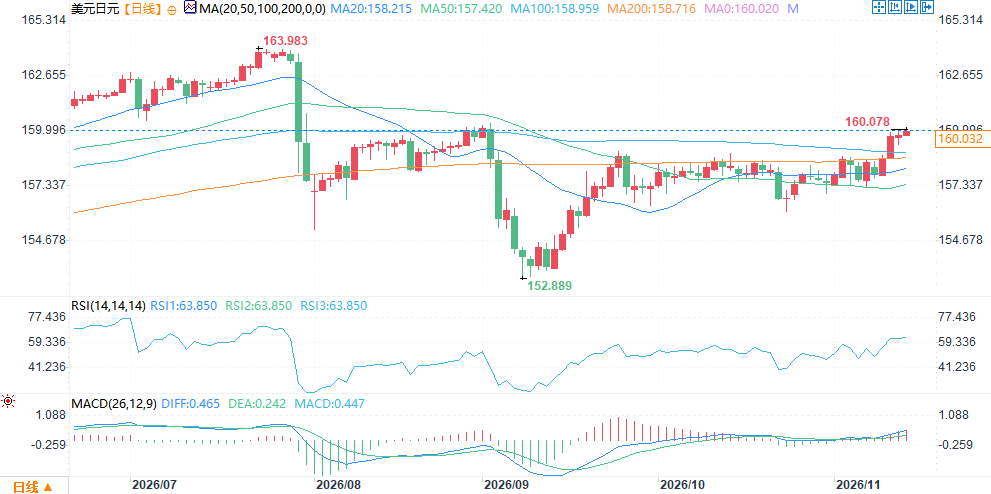 (USD/JPY daily chart, source: EasyForex) At 14:09 Beijing time, USD/JPY was trading at 160.06/07.
Timing and Context: The "Familiar Danger Zone" near 160
The USD/JPY pair briefly broke through 160.00 yesterday and continues to hover around that level today, bringing traders back to the high-risk zone most familiar since the intervention this summer. Japanese authorities have previously demonstrated through practice that when exchange rates experience sharp and disorderly fluctuations, Tokyo not only has the will to intervene but also receives coordinated support from Washington. Sanae Takaichi's statement at this time, emphasizing close communication with the US and reiterating the stance of maintaining an orderly foreign exchange market, is far from simple diplomatic rhetoric. The core signal is that while the warning wording itself is routine, the timing of its release, precisely at the critical juncture of the exchange rate approaching 160 again, gives the language additional deterrent power. The US's previous history of coordinated intervention further transforms "close coordination" from a polite expression into a credible indication of potential action. The market must therefore reassess that any rapid surge near 160 could trigger a joint response from Tokyo and Washington, not just a unilateral verbal warning.160 is not the magic red line: the authorities are focused on speed and disorder, not level itself.
It must be clear that breaking through 160.00 does not itself constitute a mechanical red line automatically triggering intervention. The Japanese Ministry of Finance and the Bank of Japan have consistently emphasized that their primary concern is the speed and degree of disorder in exchange rate fluctuations, rather than a fixed level. If the exchange rate moves upward in a relatively gradual and predictable manner, even a brief crossing of 160 carries a relatively low urgency for intervention; conversely, a sharp jump in a short period, a rapid deterioration in liquidity, or an acceleration of speculative selling significantly increases the probability of government action. This distinction is crucial for traders: simply viewing 160 as a "must-defend level" can easily lead to misjudgment; what truly needs monitoring is the slope of price movements, the degree of volume increase, and signs of uncontrolled market sentiment. Historical experience shows that Japanese authorities tend to intervene when "disorder" is evident, rather than simply because the number has crossed a certain integer level. Therefore, the market should currently shift its focus from the level itself to a real-time assessment of the rhythm and order of fluctuations.Limitations of verbal warnings: The dollar's momentum this week came from yields and interest rate hike expectations.
Despite clear verbal warnings from Tokyo, the USD/JPY bulls still have solid fundamental support. This week's dollar rebound was mainly driven by the continued rise in US Treasury yields and increasing market expectations that the Federal Reserve will maintain higher interest rates or even tighten further. The directional force brought by the interest rate advantage is far more lasting than the constraint of verbal intervention on the "speed" of the move. Verbal warnings can temporarily suppress speculative acceleration and slow the upward surge of the exchange rate, but they are unlikely to reverse the medium-term trend driven by the yield gap alone. As long as US long-term yields remain high and the Fed's policy path remains hawkish, the relative attractiveness of the dollar will not easily fade. This means that even if the Japanese authorities successfully slow the sharp rise near 160, if US Treasury yields continue to strengthen, the exchange rate may still test higher levels again after a brief consolidation. Therefore, the effectiveness of verbal intervention is more of a "braking" than a "turning point."Who blinks first: The momentum of the dollar bulls and Tokyo's willingness to act.
The current situation has once again evolved into a classic "who blinks first" game. Dollar bulls, leveraging their yield advantage and policy expectations, possess clear momentum, while Tokyo, through its actual intervention record this summer and statements coordinated with the US, has demonstrated its willingness to act. The focus of the standoff is concentrated around the psychologically and technically sensitive area of 160. If the exchange rate rises slowly and orderly, Tokyo may continue to primarily issue verbal warnings; however, in the event of a sharp and disorderly surge, the risk of intervention will rise rapidly. The market therefore faces two-way uncertainty: bulls may continue to test higher levels due to fundamental support, while bears may gain a brief respite due to potential government action. Ultimately, which side concedes first depends on the speed of exchange rate fluctuations in the coming days, the trend of US Treasury yields, and whether the Japanese authorities determine that the market has entered a "disorderly" state. Each test of the 160 level simultaneously accumulates pressure on both sides.in conclusion
Japanese Prime Minister Sanae Takaichi became the latest official to speak on the exchange rate, stating that she maintains close communication with the US Treasury authorities and will maintain an orderly foreign exchange market, but did not comment on the exchange rate level. The dollar/yen pair briefly broke through 160 yesterday and is now hovering near that level again, bringing traders back to familiar, dangerous territory—Tokyo has demonstrated Washington's willingness to help this summer, turning "coordination" from diplomatic rhetoric into a credible threat. However, 160 is not a magic red line that automatically triggers intervention; authorities are more concerned with the speed and disorder of fluctuations. The dollar's momentum this week has come from rising US Treasury yields and a more hawkish Federal Reserve outlook. Verbal warnings alone are unlikely to reverse this interest rate advantage—warnings affect "speed," while the interest rate advantage affects "direction." Therefore, the market is back to the familiar "who blinks first" game: dollar bulls have momentum, and Tokyo is willing to cooperate with the US; as the exchange rate continues to test the 160 level, one side will eventually have to concede. (USD/JPY daily chart, source: EasyForex) At 14:09 Beijing time, USD/JPY was trading at 160.06/07.
- Risk Warning and Disclaimer
- The market involves risk, and trading may not be suitable for all investors. This article is for reference only and does not constitute personal investment advice, nor does it take into account certain users’ specific investment objectives, financial situation, or other needs. Any investment decisions made based on this information are at your own risk.