Eurozone growth second estimate confirmed but structural pressures remain; ECB rate hike expectations rise.
2026-11-13 19:00:28
On Friday, November 13th, Eurostat released its second estimate of the Eurozone's third-quarter GDP, confirming a quarter-on-quarter growth of 0.4% and a year-on-year growth of 1.3%, perfectly in line with the initial estimate. The market had previously expected only a quarter-on-quarter growth of 0.2%. This result further confirms that the Eurozone economy continued to expand in the third quarter, but the growth rate slowed compared to 0.6% in the second quarter. During the same period, the euro fluctuated around 1.105 against the US dollar, with a narrow trading range. Market focus was concentrated on the unevenness of the growth structure and the complex impact this would have on the European Central Bank's subsequent policy path. 
Secondary estimates confirm expansion, but momentum weakens.
The second estimate of Eurozone GDP for the third quarter was unchanged from the initial estimate, at 0.4% quarter-on-quarter and 1.3% year-on-year, with employment remaining stable. This figure was higher than the market expectation of 0.2%, indicating that the Eurozone economy still possesses a certain degree of resilience despite high energy prices. Second-quarter growth was 0.6% quarter-on-quarter and 1.2% year-on-year, with quarter-on-quarter momentum declining this quarter, while year-on-year growth increased slightly. In terms of contribution structure, industrial activities led by multinational corporations in some member states provided support, but the performance of major economies was weak, and the overall quality of expansion remains to be seen. The European Central Bank currently maintains its deposit rate at 2.5%, and the market widely expects a possible 25 basis point increase at the December meeting. Although the growth data did not show a significant downward revision, it failed to effectively alleviate policymakers' dual concerns about sticky inflation and the sustainability of growth.The performance of major economies is clearly divergent.
Ireland's third-quarter growth of 5.5% was a standout performance in the region, primarily driven by multinational corporate activity in the information and communication and manufacturing sectors. This type of growth is often accompanied by contract manufacturing and the repatriation of global profits, making it highly volatile and having limited impact on local demand and employment; therefore, it should not be simply equated with the health of the domestic economy. In contrast, Germany grew by only 0.2% quarter-on-quarter, Italy remained flat at 0.0%, and France contracted by 0.1%. Spain and the Netherlands both recorded relatively robust growth of around 0.6% quarter-on-quarter. The weak performance of major economies suggests that the region's overall resilience relies more on peripheral countries and specific industries than on a broad improvement in core demand. This structural imbalance increases the difficulty for the European Central Bank in assessing its policy stance, especially given the continued pressure of energy prices on some member states.The cross-effects of inflation data and policy path
The Eurozone's Harmonized Index of Consumer Prices (HICP) rose 4.0% year-on-year in October, up from 3.8% in September, reaching a three-year high, while core inflation remained at 2.5%. The energy component saw a year-on-year increase of 20.8%, the main driver, while service and unprocessed food prices also accelerated slightly. French inflation rose to 3.8%, and Spanish inflation to 4.9%. These figures, released simultaneously with the second estimate of growth, did not significantly weaken market expectations for a December rate hike by the European Central Bank (ECB). ECB officials previously pointed out that rising energy costs have tilted inflation risks to the upside, and policy direction still requires vigilance. The current deposit rate is 2.5%, and if it is raised to 2.75% in December, it will further approach or even slightly exceed the upper limit of some estimated neutral ranges. While growth has not stalled, insufficient momentum in major economies presents policymakers with the potential for a coexistence of slowing growth and high inflation. Markets remain divided on whether a single rate hike will be necessary or further action is required.Euro/Dollar Market Trading Characteristics
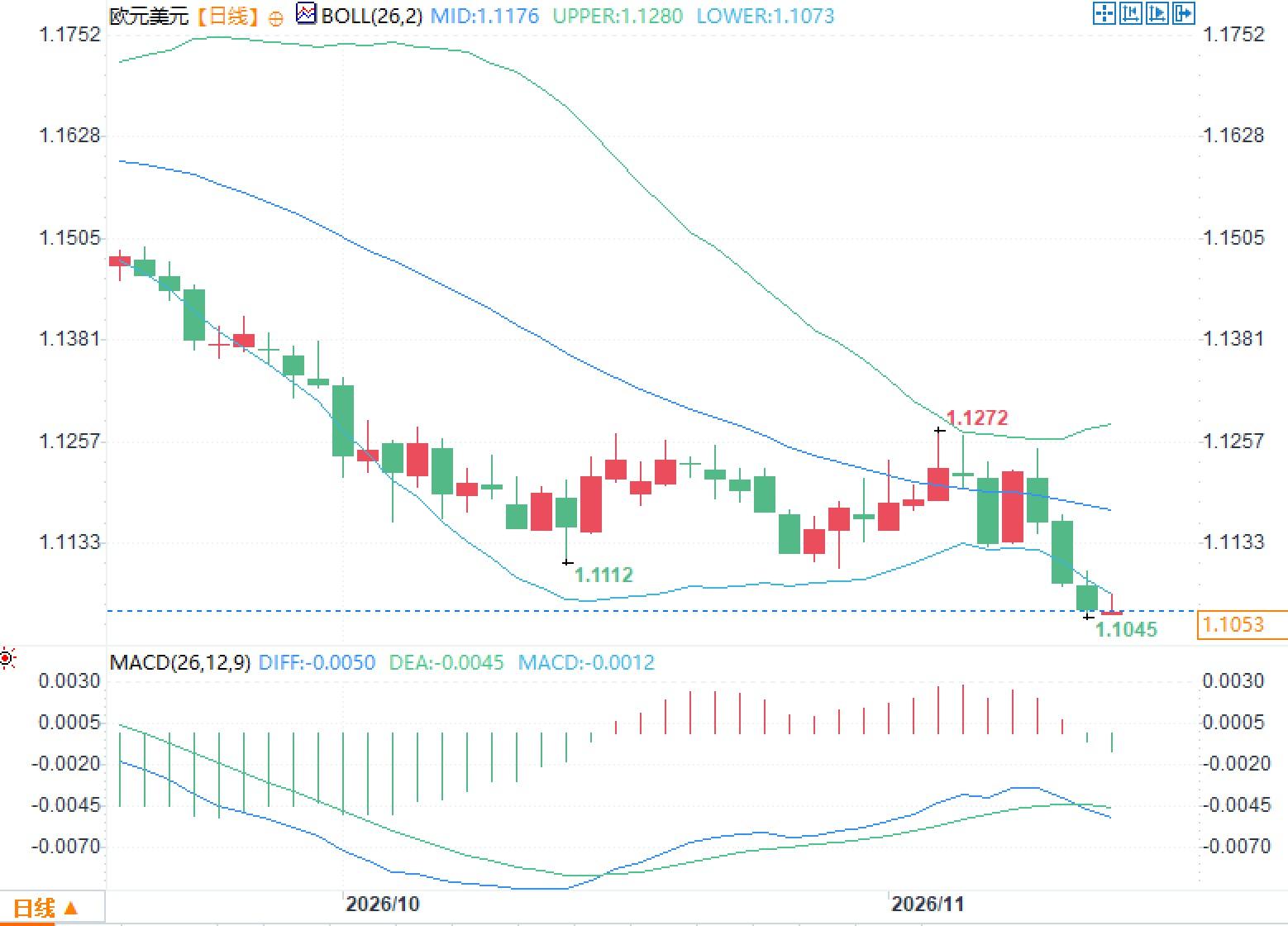
The euro traded relatively steadily against the dollar after the data release, holding around 1.105. The daily chart shows the price trading below the Bollinger Band's middle band (around 1.1176) and near the lower band (around 1.1073), with the price recently approaching the lower band area. The MACD indicator shows a DIFF of -0.0050 and a DEA of -0.0045, with the histogram also negative, indicating weak short-term momentum. Exchange rate fluctuations are more closely related to the interaction between regional growth structures, inflation paths, and expectations of European Central Bank policy. Weak growth in major economies coupled with energy-driven inflationary pressures keep the euro sensitive to the interplay between interest rate expectations and growth prospects. Market participants continue to focus on subsequent sub-data such as employment and industrial production, as well as further statements from European Central Bank officials regarding the trade-off between growth and inflation.Frequently Asked Questions
Question 1: Why did the second estimate of the Eurozone's third-quarter GDP not see a revision, yet still spark discussion about the quality of growth? Answer: The second estimate confirmed a quarter-on-quarter growth of 0.4% and a year-on-year growth of 1.3%, consistent with the initial estimate and higher than expected, indicating continued overall expansion. However, Ireland's high growth of 5.5% was mainly driven by multinational corporate activity, making it highly volatile. Meanwhile, major economies such as Germany, Italy, and France only grew by 0.2%, remained flat, or contracted by 0.1%, respectively. This structural imbalance raises questions about overall resilience. Question 2: How will current inflation and growth data affect the ECB's December policy assessment? Answer: Inflation rose to 4.0% in October, with the energy component at 20.8% and core inflation remaining at 2.5%. Data from France and Spain were also high. While growth is confirmed to be expanding, insufficient momentum in major economies forces the ECB to weigh inflation risks against the sustainability of growth, given its existing deposit rate of 2.5%. The market expects a possible 25 basis point increase in December.- Risk Warning and Disclaimer
- The market involves risk, and trading may not be suitable for all investors. This article is for reference only and does not constitute personal investment advice, nor does it take into account certain users’ specific investment objectives, financial situation, or other needs. Any investment decisions made based on this information are at your own risk.