Geopolitical instability fuels a surge in real interest rates; Federal Reserves collectively warn of inflation, putting downward pressure on gold.
2026-11-13 18:02:36
On Friday (November 13th) during the Asian and European sessions, spot gold rose slightly before falling back. Trump's remarks about not negotiating with Iran were the trigger for the price drop. Gold prices accelerated their decline on Thursday after the news, falling more than 3% at one point, hitting a low of 3852, and are currently trading around 3898 after a slight rebound. The ongoing geopolitical tensions in the Middle East are pushing up oil prices and extending inflation expectations. Coupled with hawkish warnings from Federal Reserve officials, gold prices have been significantly sold off. The geopolitical conflict is not simply bringing safe-haven buying, but rather a repricing of inflation and a rise in real interest rates. This, coupled with the Federal Reserve's warning that the Nvidia controversy will impact risk appetite and market liquidity contraction, has put downward pressure on gold prices. Over the past three trading days, the 10-year TIPS yield has risen from 2.66% to 2.86%, with real interest rates rising rapidly, becoming the core pricing anchor for this round of gold price correction. 
 (The 10-year TIPS yield represents the real interest rate. Source: Federal Reserve)
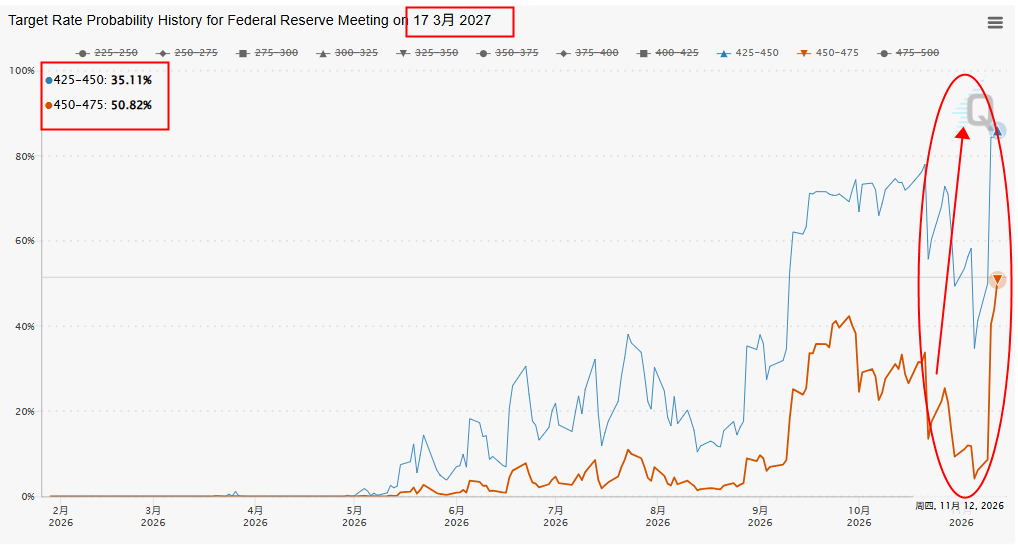 (FedWatch interest rate tool, source: CME Group) Jefferies suggests that if the current stalemate in the Middle East continues into early next year, there is a possibility of another interest rate hike in January. The market is focused on the October PPI data, which will directly impact the core PCE on November 25th and is key to determining whether inflation can reach the FOMC's 3.4% target. Against the backdrop of rising inflation expectations and a continued consolidation of interest rate hike expectations, TIPS yields have risen rapidly. Higher real interest rates directly increase the opportunity cost of holding gold, a non-interest-bearing asset, creating sustained valuation pressure.
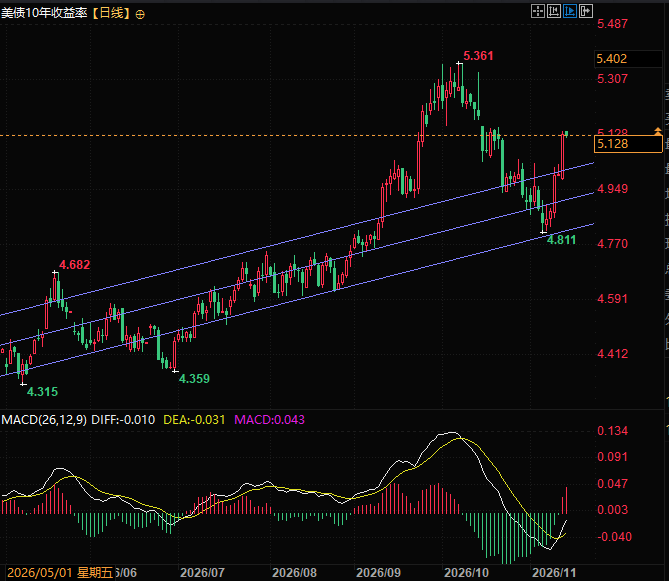 (US 10-year Treasury yield, source: FX678)
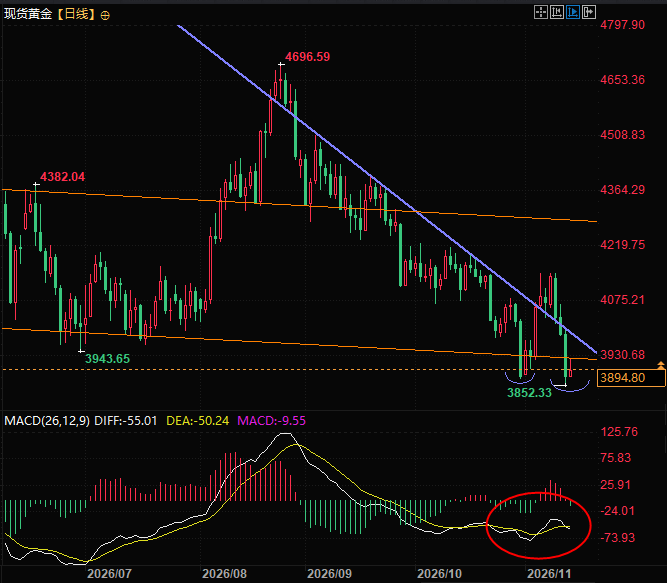 (Spot gold daily chart, source: EasyTrade) At 17:57 Beijing time, spot gold is currently trading at $3988.58 per ounce.
The US-Iran standoff is pushing up oil prices, and inflation expectations are forcing real interest rates to jump.
The US-Iran standoff remains in a stalemate of "neither war nor peace." Trump has stated he will no longer seek an agreement with Iran, directly halting the diplomatic negotiations led by Vance. Iran maintains a hardline stance, with internal calls for withdrawing from the Treaty on the Non-Proliferation of Nuclear Weapons (NPT). Attacks on ships in the Strait of Hormuz have become frequent, with 37 attacks in October alone, and at least 10 more ships attacked in early November, including an LPG tanker that struck a mine and exploded. Meanwhile, the Houthi rebels continue to attack Saudi oil pipelines and energy facilities in Yanbu, further compressing the buffer space for Middle Eastern crude oil exports. Crude oil prices surged nearly 3%, with Brent briefly reaching $93.4 per barrel. The rise in oil prices directly exacerbates market concerns about sticky inflation, laying the foundation for rising real interest rates. (The 10-year TIPS yield represents the real interest rate. Source: Federal Reserve)Federal Reserve officials have spoken out in quick succession, with officials from across the political spectrum jointly warning of inflation risks.
This week, several Federal Reserve officials made statements, and a significant issue is that, regardless of whether they were hawkish or dovish, the focus of their speeches was entirely on inflation stickiness, further solidifying expectations of interest rate hikes. Chicago Fed President Goolsby, traditionally categorized as dovish and a 2017 FOMC voter, has recently shifted his views significantly towards cautious hawkishness. He initially expected inflation to cool significantly after tariffs receded and oil prices fell, but the October CPI's second consecutive monthly increase broke expectations. He stated bluntly that US inflation has reached a dangerous point, as endogenous service sector inflation, such as in the service industry and healthcare, is independent of oil prices and tariffs, making it very difficult to manage. He broke down inflation into two drivers: external supply shocks like tariffs and oil prices, and overheated demand from AI data center construction. Currently, AI-related inflation is confined to the technology industry chain, but the Fed is closely monitoring the risk of it spreading outwards; once it does, inflation will be even more difficult to suppress. San Francisco Fed President Daly, consistently dovish and also a 2017 FOMC voter, also signaled a tightening stance this time. She judged that inflationary pressures were widespread, not just from oil prices and tariffs. More and more businesses in her jurisdiction were planning to pass on rising input costs to end consumers, thus further interest rate hikes remained necessary. Her assessment was similar to Goolsby's: the price increases brought about by AI infrastructure were currently mild and had not yet spread to overall prices. She was optimistic about AI's long-term impact on productivity, but believed that AI could not suppress inflation in the short term. Kansas City Fed President Schmid, a staunch hawk with a 2018 voting right, directly stated that the Fed had not yet defeated inflation, and emphasized that rising material and labor costs would continue to push up housing costs. He stated that housing inflation was the stickiest part of service inflation and would drag down prices in the long term. While his speech did not directly comment on the interest rate path, his stance anchored on inflation risks. New York Fed President Williams, the third-ranking official at the Fed and a permanent FOMC voter, held a neutral and moderate stance, and his statements carried the most weight. Williams explicitly emphasized that current inflation remains too high, and continued policy action is necessary for some time to push inflation steadily back to the 2% target. He also maintained a bottom line for the dual-target policy, stating that tightening policy must avoid unnecessarily damaging full employment. He judged that the overall US economy is not severely imbalanced, leaving room for the Fed to continue tightening. Given the collective tightening stance from officials, the money market is currently pricing in an 87% probability of a 25bp rate hike in December and a 13% probability of a 50bp hike. Meanwhile, the probabilities of at least two and three rate hikes before March 2027, starting November 9th, are 50% and 8.6% respectively, which have now risen to 86% and 50.8% as of November 13th – a very alarming rate of change. (FedWatch interest rate tool, source: CME Group) Jefferies suggests that if the current stalemate in the Middle East continues into early next year, there is a possibility of another interest rate hike in January. The market is focused on the October PPI data, which will directly impact the core PCE on November 25th and is key to determining whether inflation can reach the FOMC's 3.4% target. Against the backdrop of rising inflation expectations and a continued consolidation of interest rate hike expectations, TIPS yields have risen rapidly. Higher real interest rates directly increase the opportunity cost of holding gold, a non-interest-bearing asset, creating sustained valuation pressure.The Nvidia CEO saga impacted risk appetite, leading to a passive contraction in market liquidity.
Beyond rising interest rates, the black swan event of Nvidia's management reshuffle further disrupted overall risk appetite, triggering cross-asset deleveraging and a passive tightening of liquidity. The news of Nvidia's CEO's dismissal impacted the AI sector, amplifying volatility in tech stocks and leading to concentrated reductions in exposure and margin calls. In this environment, gold ceased to be a simple safe-haven asset, instead becoming a highly liquid asset easily sold off for cash. When institutions needed to recoup funds and address margin pressures on equities, gold long positions were prioritized for liquidation, amplifying the decline in gold prices. Research reports also mentioned that the concentrated sell-off in the AI sector and the flow of safe-haven funds into US Treasuries would temporarily suppress precious metals, and institutions believe a large-scale correction in the AI market is more likely to occur early next year than during the year-end holiday window. US Treasury Trading Structure: Long-term yields remain high, making it difficult for gold prices to escape interest rate pressure in the short term. US Treasury yields generally maintained upward pressure, with the selling pace slowing during Friday's Asian session. The 2-year yield stabilized at 4.861%, while the 10-year yield rose 2.6 basis points to 5.128%. Societe Generale's strategy perspective points out that US inflation is spreading more broadly, and the Federal Reserve's hawkish rationale is more compelling than that of the ECB. Demand for 30-year US Treasury bonds in the primary market remains relatively strong, with a high proportion of end-buyers, confirming that in a rising interest rate environment, funds prioritize allocation to coupon-bearing US Treasuries rather than zero-interest assets like gold. The current trading logic has shifted: geopolitical conflicts no longer directly benefit gold, but rather become a negative variable for gold through the path of oil prices → inflation → real interest rates. Only when the conflict escalates to full-blown war and triggers a systemic liquidity crisis will safe-haven buying potentially regain dominance over gold prices. (US 10-year Treasury yield, source: FX678)Summary and Technical Analysis:
This round of gold price decline is driven by two main factors: First, Middle East geopolitical tensions pushed up oil prices, coupled with warnings from multiple Federal Reserve officials about the stickiness of inflation from various perspectives, leading to increased market expectations for long-term inflation. TIPS yields rose by 20 basis points in three trading days, significantly increasing real interest rates and suppressing gold prices from a valuation perspective. Second, the Nvidia controversy impacted the technology sector, causing a decline in market risk appetite, passive reduction of leveraged funds, and liquidity contraction, leading to concentrated liquidation of gold long positions. Going forward, we will focus on three key signals: whether there will be a larger-scale shipping disruption in the Strait of Hormuz, whether the October PPI data will be stronger than expected, and whether Federal Reserve officials will further raise their interest rate hike expectations. In the short term, as long as real interest rates continue to rise and the AI sector remains volatile, it will be difficult for gold prices to experience a sustained upward trend. Only when inflation data cools significantly, the market lowers its interest rate hike expectations, and real interest rates turn downward will gold have a chance to regain support. Technical Analysis: Spot gold has broken below the lower boundary of a key channel, but the MACD shows a divergence. However, if the recent rebound is weak and fails to return above the channel, the MACD divergence will be corrected, and gold prices may continue to test lower levels. If gold prices can rebound, a double bottom pattern on the daily chart may form. (Spot gold daily chart, source: EasyTrade) At 17:57 Beijing time, spot gold is currently trading at $3988.58 per ounce.
- Risk Warning and Disclaimer
- The market involves risk, and trading may not be suitable for all investors. This article is for reference only and does not constitute personal investment advice, nor does it take into account certain users’ specific investment objectives, financial situation, or other needs. Any investment decisions made based on this information are at your own risk.