The 2-year US Treasury yield surged 30 basis points in a single week: With the Fed's hawkish stance returning, where are the opportunities in forex, gold, and crude oil?
2026-11-13 18:20:29
The global bond market is experiencing a sharp sell-off. Over the past two trading days, the yield on the 2-year U.S. Treasury note has surged by more than 30 basis points, approaching 4.89%, nearing its highest level since June 2024; the 10-year yield has simultaneously jumped 26 basis points, reaching 5.13%, a new high since mid-October. The two-day increase in the 2-year yield is the largest since March 2023, while the 10-year yield recorded its largest single increase since April 2025.  The core factors driving this reversal are very clear: higher-than-expected CPI data, hawkish statements from Federal Reserve officials, and the market's repricing of further monetary tightening. Investors are increasingly betting that the Fed will continue to raise interest rates. Meanwhile, yields in Japan and Australia are approaching multi-year highs, while French yields have surged again due to fiscal and political concerns.
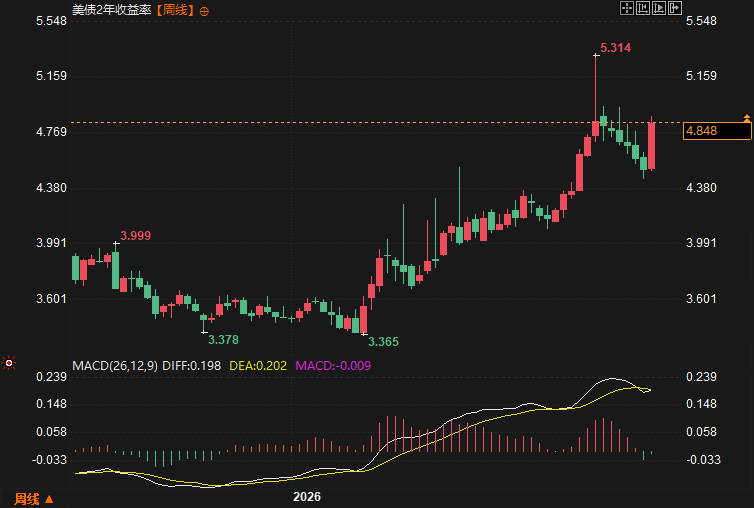 Currently, across eight major economies, the market has priced in an average policy rate increase of more than 50 basis points over the next 12 months, compared to an expectation of only 33 basis points on November 6th. The global bond market sell-off may have only just begun.
The core factors driving this reversal are very clear: higher-than-expected CPI data, hawkish statements from Federal Reserve officials, and the market's repricing of further monetary tightening. Investors are increasingly betting that the Fed will continue to raise interest rates. Meanwhile, yields in Japan and Australia are approaching multi-year highs, while French yields have surged again due to fiscal and political concerns. Currently, across eight major economies, the market has priced in an average policy rate increase of more than 50 basis points over the next 12 months, compared to an expectation of only 33 basis points on November 6th. The global bond market sell-off may have only just begun.Why did US Treasury yields suddenly "take off"?
This round of bond market sell-off is not an isolated event. October CPI data exceeded market expectations, indicating that inflation stickiness persists, especially with core inflation remaining strong for several consecutive months. Federal Reserve officials subsequently released hawkish signals, with some even publicly discussing a possible 50-basis-point "significant rate hike" at the December meeting. The money market reacted swiftly. Traders almost entirely priced in a December rate hike and began factoring in further rate increases. Short-term yields (especially 2-year yields) were most sensitive to policy expectations, resulting in the most dramatic increases. Long-term yields were simultaneously driven by rising inflation expectations and a rebound in term premiums. The global linkage effect is also amplified. When US Treasury yields rise sharply, bond yields in other major economies are often forced to follow suit, otherwise their currencies will face greater depreciation pressure. Yields in Japan and Australia are near multi-year highs, while France is under additional pressure due to fiscal uncertainty, further exacerbating tensions in the global fixed-income market.What does this mean for gold traders?
Gold is highly sensitive to real interest rates and the US dollar. A rapid rise in US Treasury yields directly increases the opportunity cost of holding non-interest-bearing assets. Especially when real yields (nominal yield minus inflation expectations) rise, gold typically faces significant selling pressure. However, the current environment is not entirely bearish. Inflation data itself is relatively strong, coupled with geopolitical risks (evident in recent oil price fluctuations), and gold's attributes as an inflation hedge and safe-haven asset continue to play a role. If subsequent PPI or other data continue to reinforce the narrative of "stubborn inflation," gold may find temporary support after a period of consolidation at high yield levels. In terms of trading strategy, short-term traders should be wary of the downside risks from continued yield increases, especially if the US dollar strengthens in tandem. In the medium to long term, attention should be paid to whether real interest rates are truly and sustainably rising, and whether the Fed's final rate hike will exceed current pricing. Key resistance and support levels need to be flexibly adjusted in conjunction with technical analysis to avoid blindly shorting or bottom-fishing during periods of high volatility.Crude Oil Market: The Game Between Inflation and Demand
Crude oil prices are highly correlated with inflation expectations. The rising CPI often carries the burden of energy price increases, and current oil prices have returned to a relatively high range. A higher interest rate environment should theoretically suppress economic growth and oil demand, but in the short term, if inflation data continues to exceed expectations, the market may focus more on supply-side risks and geopolitical premiums than on a slowdown in demand. A sell-off in the bond market pushing up the dollar typically puts pressure on dollar-denominated crude oil. However, if the market interprets this as "high inflation will lead to persistently high energy costs," crude oil may show relative resilience. Traders should closely monitor US inventory data, OPEC+ actions, and the situation in the Middle East, while also using US Treasury yields as an important macroeconomic indicator. Short-term crude oil volatility may intensify, making it suitable to focus on entry opportunities after breakouts or pullbacks; in the medium term, however, caution should be exercised regarding the lagged impact of high interest rates on demand.Foreign Exchange Market: The US dollar strengthens again, putting pressure on non-US currencies.
The most direct beneficiary of bond market sell-offs is often the US dollar. The widening yield spread between US Treasury bonds and other major currencies attracts capital back to the US, pushing up the dollar index. Non-US currencies such as the euro, yen, and Australian dollar thus come under pressure. The yen and Australian dollar, in particular, while their domestic yields are also rising, the magnitude is still insufficient compared to the hawkish stance of the Federal Reserve. The Eurozone faces additional drag from its own fiscal and political risks. For forex traders, the current environment is more favorable for going long on the US dollar against major currency pairs, especially during a window of continued strengthening expectations of a Fed rate hike. However, risks should be noted: if subsequent data unexpectedly cools down, or if Fed officials adopt a more dovish stance, a rapid decline in yields could trigger a sharp correction in the dollar. In terms of risk management, it is recommended to strictly control position size and pay attention to key technical levels and overnight volatility.How long will the bond market sell-off last?
The market has already significantly raised its average interest rate hike expectations for the next 12 months, indicating that selling momentum remains. If today's or subsequent PPI data continues to be overheated, yields may test higher levels further. Conversely, if the data shows a significant cooling, a short-term rebound is possible, but a trend reversal requires clearer evidence. The global bond market is repricing towards a "higher and longer" interest rate path. The transmission of this storm to commodity and foreign exchange markets is far from over. Traders should remain highly vigilant, translating macroeconomic changes into actionable trading plans rather than passively enduring volatility. Data and Fed communications in the coming weeks will determine whether this sell-off is a temporary correction or the start of a new tightening cycle.- Risk Warning and Disclaimer
- The market involves risk, and trading may not be suitable for all investors. This article is for reference only and does not constitute personal investment advice, nor does it take into account certain users’ specific investment objectives, financial situation, or other needs. Any investment decisions made based on this information are at your own risk.