What will happen to oil prices if shipowners start avoiding the Hormuz?
2026-11-16 08:34:30
On Monday (November 16) during Asian trading hours, US crude oil futures fluctuated slightly higher, currently trading around $88.60 per barrel. Iran's Revolutionary Guard stated on Sunday that two oil tankers struck mines while using what Tehran calls an unauthorized route through the Strait of Hormuz. They claimed that one of the supertankers, carrying over 2 million barrels of crude oil, sank in the southern Gulf. Neither incident has been independently confirmed. 
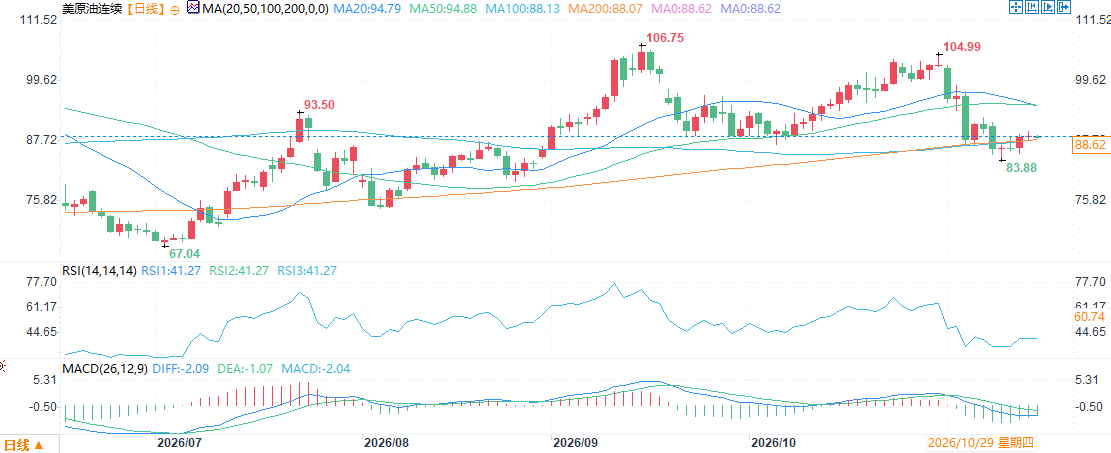 (US crude oil futures daily chart, source: FX678) At 8:27 Beijing time, US crude oil futures were trading at $88.59 per barrel.
Accounts and disagreements: The Revolutionary Guard claims two ships, while the regular Navy claims one; neither has disclosed the ship's name.
In a statement broadcast on Iranian state television, the Revolutionary Guard Navy claimed that both vessels had their transponders switched off. It stated that the second tanker was still burning and warned other vessels against what it called “US-backed covert passage and deception.” The Revolutionary Guard did not disclose the names or flags of the vessels, nor did it provide crew information. Another statement from the Iranian regular navy offered a narrower description: a tanker navigating in a restricted area east of the Strait of Hormuz with its navigation system off struck a mine and caught fire; it stated that any passage not coordinated by the Iranian armed forces would result in striking a mine and catching fire. The two statements differ on the number of vessels, their locations, and whether any vessels sank, and it is unclear whether they describe the same event. Even within Iran, descriptions of the event are inconsistent—making verification more difficult and causing markets to remain cautious about the most impactful claim of a “2 million barrel supertanker sinking.”External verification: UK maritime authorities were aware of another report but were unable to link it.
The UK Maritime Trade Action Centre stated that it was aware of the Indian shipping authorities' report of an attack on an oil tanker in the Gulf, but could not confirm whether it was the same incident. There is indeed an independent lead regarding an "oil tanker attack," but a link has not yet been established between this lead and Iran's claim of a "supertanker sinking"—until verification, the market is facing two levels of information: "confirmed attack reports" and "unconfirmed sinking claims."Pattern and Background: Iran has recently made several similar statements, restricting passage through the Strait of Hormuz.
These statements follow a series of similar announcements from Tehran in recent weeks—often attributing ship fires in the strait to mines. Iran has restricted passage through the waterway and insists that ships must use its authorized routes. The U.S. military says it has cleared mines from major shipping lanes, and the U.S. has also imposed a naval blockade on Iranian ports. Iran's statements are not isolated incidents, but rather an extension of its policy stance of "restricting passage and demanding coordination"—even if specific incidents cannot be verified, the very signal that "unauthorized passage is unsafe" is enough to influence the behavior of shipowners and insurance companies.Market Implications: Risk premium and behavioral risk; confirmation or non-confirmation determines whether the premium remains.
If confirmed, the sinking of a fully loaded supertanker would be one of the worst shipping losses since the conflict began—both in terms of the lost crude oil and the signal it sends to shipowners and insurance companies. Confirmation from shipping monitoring agencies, the vessel's identity, and any U.S. response will determine the extent of this escalation. For the oil market, this news will have two impacts: first, a risk premium—even without independent confirmation, the claim of a fully loaded supertanker sinking in one of the world's most important oil chokepoints will add a risk premium to Brent and WTI crude futures; second, behavioral risk, which is greater—if shipowners deem the U.S.-cleared channels and covert passage unsafe, traffic at the Strait of Hormuz could shrink further, and freight and war risk costs could rise. However, if the claim remains unconfirmed or proves exaggerated, given how many similar Iranian statements the market has already priced in, the initial surge could quickly subside.Risk premiums may disappear quickly, but behavioral risks will remain.
The impact of this event on US crude oil futures needs to be understood through two channels, and the sustainability of these two channels is drastically different. The first is the risk premium channel: even without independent confirmation, the claim that a fully loaded supertanker sank in one of the world's most important oil chokepoints is enough to drive oil prices higher in the market. However, the impact of this channel may be short-lived—given how many similar Iranian statements the market has already priced in, if the claims are not confirmed or proven exaggerated, part of the initial jump may quickly subside, consistent with the "headline-driven, then falling" pattern of the past few weeks. The second is the behavioral risk channel, and this channel has a larger and more lasting impact. If shipowners and insurance companies determine that the US-cleared channels and covert passages are not safe, traffic at the Strait of Hormuz may shrink further, and freight and war risk costs will rise accordingly. This channel is more lasting because it acts on "passage costs" rather than "a single event"—rising insurance rates and route avoidance will continuously increase the transportation cost of each barrel of crude oil, and the cost pressure will not disappear even if the specific event's hype fades. For oil prices, the combined effect of these two factors means that while short-term prices may jump due to headlines, their sustainability depends on whether shipowners and insurance companies change their behavior. If the allegations are confirmed and there is a response from the US, the premium will be supported; if the claims fade, prices may fall back to previous levels.in conclusion
The Iranian Revolutionary Guard claims that two oil tankers with their transponders off struck mines in an unauthorized route through the Hormuz, with one supertanker carrying over 2 million barrels of crude oil sinking and the other burning. However, the Iranian regular navy only reports that one tanker struck a mine and caught fire. The two sides differ on the number of vessels, their locations, and whether the tanker sank, and there is no independent confirmation. British maritime authorities are aware of another report from Indian shipping authorities about an attack on an oil tanker but cannot link it. This statement is a continuation of a series of similar announcements from Tehran, serving its policy stance of "restricting passage and demanding coordination." For the oil market, the impact will be twofold: risk premium – even without confirmation, the claim of a fully loaded supertanker sinking will increase the premium between Brent and WTI crude futures; and behavioral risk – if shipowners deem the route unsafe, Hormuz traffic could further shrink, and freight and war risk costs could rise. This channel has a greater and more lasting impact. Confirmation, the identities of the vessels, and the US response will determine whether the premium remains or diminishes. (US crude oil futures daily chart, source: FX678) At 8:27 Beijing time, US crude oil futures were trading at $88.59 per barrel.
- Risk Warning and Disclaimer
- The market involves risk, and trading may not be suitable for all investors. This article is for reference only and does not constitute personal investment advice, nor does it take into account certain users’ specific investment objectives, financial situation, or other needs. Any investment decisions made based on this information are at your own risk.