Japan's third-quarter GDP fell short of expectations. Will the Bank of Japan raise interest rates in December?
2026-11-16 08:22:31
On Monday (November 16) during Asian trading hours, the USD/JPY pair fluctuated narrowly, currently trading around 159.65, almost unchanged for the day. Japan's economy stagnated in the July-September quarter. Preliminary data showed that real GDP contracted at an annualized rate of 0.1%, below economists' expectations of 0.3% growth and a significant slowdown from the 1.4% growth in the second quarter. On a quarter-on-quarter basis, output was flat, lower than the expected 0.1% growth. 
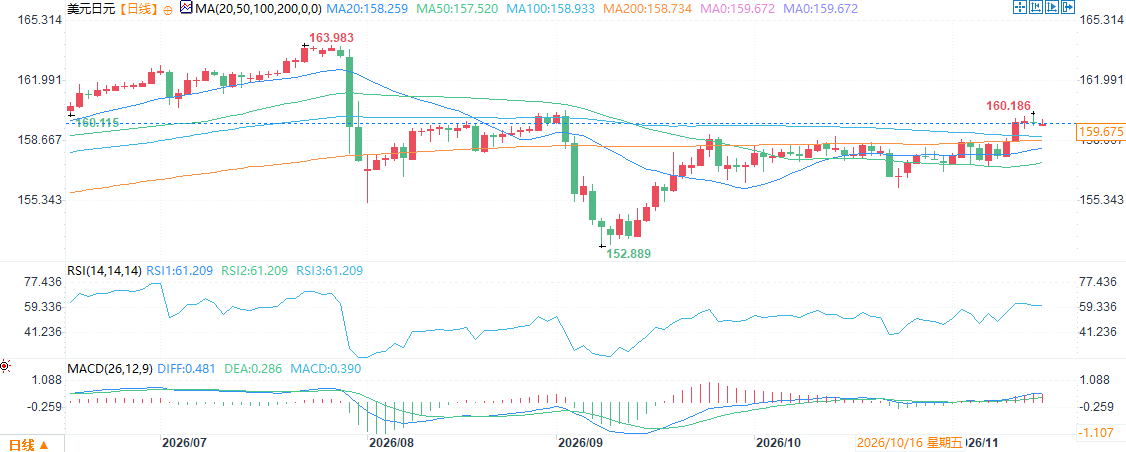 (USD/JPY daily chart, source: EasyForex) At 8:17 Beijing time, USD/JPY was trading at 159.64/65.
The drag came from external demand, which fell by 0.6 percentage points, and private consumption, which declined by 0.3%.
The weaker-than-expected growth came from two sources. External demand dragged down growth by 0.6 percentage points, more than the expected 0.4 percentage points, with exports declining by 0.2% quarter-on-quarter. Private consumption, which accounts for more than half of the economy, fell by 0.3%, slightly deeper than the expected 0.2% decline. The stagnation in the third quarter was a "trade story" rather than a "domestic story"—the drag from external demand and consumption was the main source. Of the two, the drag from external demand was larger and more likely to be one-off (due to quarterly fluctuations in exports), while the weakening of consumption is more noteworthy because it relates to whether the "demand-driven inflation" valued by the Bank of Japan can hold.Highlights: Capital expenditure increased by 1.6%, exceeding expectations; domestic demand contributed 0.6 percentage points.
Business investment was a bright spot. Capital expenditure jumped 1.6% quarter-on-quarter, slightly above the expected 1.5%, reversing a 0.9% decline in the April-June quarter. Domestic demand contributed 0.6 percentage points to growth, indicating that the weakness was concentrated in trade rather than the overall domestic economy. The strong capital expenditure and the positive contribution of domestic demand suggest that underlying demand in the Japanese economy has not deteriorated—this is precisely the basis for policymakers to "see through" the overall figures; the resilience of business investment also provides fundamental support for the Bank of Japan's tightening path.Prices: The GDP deflator rose 2.4%, lower than expected but still above the 2% target.
Price pressures across the economy also softened slightly. The GDP deflator—a broad indicator of prices across the economy—rose 2.4% year-on-year, lower than the expected 2.6% and the previous quarter, but still significantly above the Bank of Japan's 2% target. While price pressures have eased marginally, the 2.4% level is still well above the target, and the Bank of Japan has no reason to ease monetary policy due to the decline in inflation—the softening of the deflator is more a sign that it is "no longer accelerating" rather than "turning downward."Policy implications: Expectations for a December rate hike remain largely unchanged.
These data releases come at a sensitive time for the Bank of Japan—which maintained its policy rate at 1.25% in October, with the market widely expecting a rate hike to 1.5% in December. A flat quarter driven by trade, coupled with robust capital spending and positive domestic demand, gave policymakers a basis for "seeing through" the overall figures. However, weaker consumption readings will provide arguments for more cautious committee members. The GDP data did not change the basic expectation of a December rate hike—strong capital spending and domestic demand supported the interpretation that the "trade drag was one-off"; but the weakening consumption provided material for cautious voices within the committee, meaning that while there is a consensus on a December rate hike, there are not no disagreements. The focus now shifts to the speech of Bank of Japan board member Takada on Monday—he has recently dissented at meetings and advocated for faster tightening, and his interpretation of the data will be closely watched for clues as to whether there will be any changes in the December debate.Weaker-than-expected GDP growth weakened support for the yen, but resilient domestic demand limited its downside.
With the USD/JPY pair nearing 160 and Japanese officials issuing repeated warnings of intervention, this data failed to provide any substantial support for the yen. Instead, it provided dollar bulls with a narrative of "Japanese economic weakness," making the exchange rate more resilient near 160. However, this impact is limited, not directional. This is due to the data's inherent structure: capital expenditure grew by 1.6%, exceeding expectations, while domestic demand contributed only 0.6 percentage points, indicating weakness concentrated in trade rather than the overall domestic economy—precisely the basis for the Bank of Japan's "seeing through" the overall figures. The basic expectation of a December rate hike to 1.5% remained unshaken by this data, and the path of narrowing interest rate differentials remains intact. Therefore, the downward pressure on the yen is a "marginal increase" rather than a "trend strengthening." The interplay of these two forces determines the short-term pattern of USD/JPY: weaker-than-expected GDP weakens yen support, but resilient domestic demand limits its downside; two-way risks remain near 160, and a true directional breakout requires confirmation from the hawkishness of Takada's speech on Monday and the actual actions of the Bank of Japan's December meeting.in conclusion
Japan's real GDP contracted by 0.1% annualized in the third quarter, below the expected 0.3% growth, and remained flat quarter-on-quarter. External demand dragged down the economy by 0.6 percentage points, with exports falling 0.2% quarter-on-quarter and private consumption declining 0.3%, a larger drop than expected. However, capital expenditure rose 1.6%, exceeding expectations and reversing the decline in the second quarter, while domestic demand contributed 0.6 percentage points, indicating that the weakness was concentrated in trade rather than the overall domestic economy—giving policymakers a basis for "seeing through" the overall figures. The GDP deflator rose 2.4%, lower than expected but still well above the 2% target, indicating that price pressures are "no longer accelerating" rather than "turning downward." As the data was released, the Bank of Japan maintained its interest rate at 1.25% in October, and the market widely expected a rate hike to 1.5% in December: strong capital expenditure and domestic demand kept the basic expectation of a December rate hike largely unchanged, but weakening consumption provided arguments for caution within the committee. The focus shifted to Takada's speech on Monday—he has recently advocated for faster tightening, and his interpretation of the data will influence the direction of the December debate. (USD/JPY daily chart, source: EasyForex) At 8:17 Beijing time, USD/JPY was trading at 159.64/65.
- Risk Warning and Disclaimer
- The market involves risk, and trading may not be suitable for all investors. This article is for reference only and does not constitute personal investment advice, nor does it take into account certain users’ specific investment objectives, financial situation, or other needs. Any investment decisions made based on this information are at your own risk.