The US dollar rose against the Canadian dollar for the fifth consecutive day. Where is the top of the exchange rate?
2026-11-16 10:46:31
The US dollar rose for the fifth straight day against the Canadian dollar in Asian trading on Monday (November 16), trading around 1.4275, near its highest level since mid-last month, as speculation intensified that the Federal Reserve would raise interest rates at its December policy meeting, supporting the dollar. Key economic data is due soon: the US October retail sales report will be released on Tuesday, followed by the FOMC meeting minutes on Wednesday. 
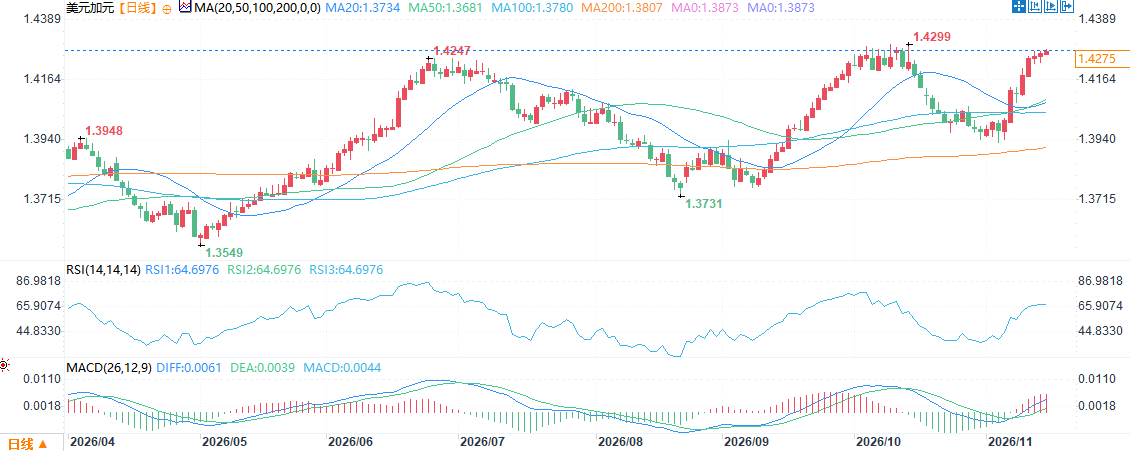 (USD/CAD daily chart, source: EasyForex) At 10:45 Beijing time, USD/CAD was trading at 1.4276/77.
US Dollar: 100% probability of a December rate hike; Schmidt says there's still work to be done on inflation.
The Federal Reserve is widely expected to raise its current target range of 3.75% to 4.0% by 25 basis points at its December meeting, followed by another increase in January. According to the CME FedWatch tool, the probability of a 25 basis point rate hike in December is 92.1%, and the probability of a 50 basis point hike is 7.9%. Kansas City Fed President Schmid stated last Sunday that the central bank has the tools and responsibility to address “overheated” price pressures and that “there is still some work to be done on inflation,” highlighting the central bank’s continued focus. The dollar’s support comes not only from the pricing of rate hikes but also from officials’ characterization that “inflation remains out of control”—this makes the path of rate hikes appear to be far from over, thus perpetuating the interest rate advantage.Canadian Dollar: Falling Oil Prices and Lack of Domestic Cyclical Support
Meanwhile, the Canadian dollar faced downward pressure from falling oil prices, which boosted the USD/CAD exchange rate. Oil prices declined as traders weighed signs of strong Middle East supply against easing signals – Tehran indicated a diplomatic solution remained possible, and Trump stated additional strikes against Iran might no longer be necessary. Analysts noted that the Canadian dollar "continues to lack strong domestic cyclical support," highlighting a monetary context where weaker domestic fundamentals make the Canadian dollar more reliant on external drivers and broader North American policy dynamics. The weakness of the Canadian dollar has two channels – falling oil prices directly erode terms of trade, while the lack of domestic cyclical support leaves it vulnerable to a strong US dollar; these two channels combined make the USD/CAD uptrend more sustainable.Institutional Views
Scotiabank's latest forecast shows the USD/CAD exchange rate at 1.39 by the end of 2026, further declining to 1.34 by the end of 2027, and reaching 1.33 by the end of 2028, exhibiting an overall path of moderate appreciation for the Canadian dollar. The bank believes the Federal Reserve's policy rate path has clearly shifted from its previous hawkish pricing, with short- and medium-term risks to the US dollar skewed to the downside. The Bank of Canada has already raised its policy rate to 2.50% and expects further tightening room, reaching 3.25% by the end of 2027. Narrowing interest rate differentials, coupled with a projected Canadian economic growth of 2.3% in 2027, will support the Canadian dollar. At the same time, the bank maintains a structurally cautious stance on the US dollar, pointing to the twin deficits in the US and excessive allocation of US dollar assets by investors as medium- to long-term risks. While the Canadian dollar is currently constrained by weak employment and trade uncertainty, the USD/CAD exchange rate is expected to gradually decline as commodity prices (such as crude oil) stabilize and policy divergence weakens. JPMorgan Chase forecasts the USD/CAD exchange rate to be at 1.41 in December 2026, before falling back to around 1.39 in September 2027. The bank is cautious on the near-term Canadian dollar, noting that weak third-quarter growth in Canada (tracking approximately 1.5% annualized, below the central bank's expectations) may have overpriced further significant rate hikes by the Bank of Canada; its economists expect only one more rate hike (around January 2027), while the market is pricing in even higher. Therefore, interest rate differentials will offer limited support for the Canadian dollar, and the USD/CAD exchange rate is expected to recover to around 1.41 by the end of the year. However, the bank also acknowledges that the Canadian dollar's recent resilience has exceeded expectations and anticipates a modest recovery of some lost ground in 2027 as the policy path becomes clearer and fundamentals adjust.in conclusion
The USD/CAD pair rose for the fifth consecutive day to around 1.4275, supported by both bets on a Fed rate hike and falling oil prices. On the dollar side, the probability of a December rate hike is 100%, with Schmid stating that price pressures are overheating and the central bank still has work to do, highlighting that the path to rate hikes is not yet over. On the Canadian dollar side, oil prices fell due to strong Middle East supply and signs of geopolitical easing, with institutions noting that the Canadian dollar "continues to lack strong domestic cyclical support" and is more reliant on external drivers and North American policy dynamics. Short-term direction depends on Tuesday's US retail sales and Wednesday's FOMC minutes—if the data strengthens rate hike expectations, USD/CAD may test higher levels; if momentum falters, it may retreat towards moving average support. (USD/CAD daily chart, source: EasyForex) At 10:45 Beijing time, USD/CAD was trading at 1.4276/77.
- Risk Warning and Disclaimer
- The market involves risk, and trading may not be suitable for all investors. This article is for reference only and does not constitute personal investment advice, nor does it take into account certain users’ specific investment objectives, financial situation, or other needs. Any investment decisions made based on this information are at your own risk.