The US dollar index remained strong, while the British pound consolidated near a one-month low against the dollar.
2026-11-16 11:08:31
The overall strength of the US dollar is the primary factor suppressing the pound against the dollar. The dollar index remains in its highest range since April 2025, with high US inflation readings coupled with hawkish signals from a group of FOMC officials, further digesting market expectations of a December rate hike by the Federal Reserve. This has led to rising US Treasury yields, which is beneficial to the dollar. Meanwhile, the ongoing conflict between the US and Iran continues to provide support for the safe-haven dollar due to geopolitical risk premiums.  Tensions in the Middle East have escalated again, with Iran launching a drone strike on Sunday against a US military base in Bahrain. The Houthi rebels accused Saudi warplanes of launching 75 airstrikes and attacks on civilian areas in the past 24 hours. Iran's Deputy Foreign Minister stated that Iran will not wait for the US to launch a preemptive strike, believing the US is using diplomatic maneuvering to buy time to prepare for a new round of military action. The escalating conflict has led to a continued flow of safe-haven funds into the US dollar, further weakening the pound's resilience. Even with market expectations of another Bank of England rate hike in December, the buying power generated by this expectation is limited and unlikely to reverse the current market trend. No major economic data releases from the UK or US are scheduled for Monday. Short-term price movements will primarily follow two variables: public speeches by key officials such as Federal Reserve Chairman Warsh, and ongoing updates on Middle Eastern geopolitical developments. Market focus will shift to Tuesday's UK employment report. Wage and unemployment data will recalibrate the probability of further Bank of England rate hikes, providing a clear catalyst for volatility in the pound against the dollar. Strong employment data will provide a temporary boost to the pound; weak employment data will put further pressure on the pound. From a technical perspective, on the daily chart, after a sustained decline from above 1.3400, the GBP/USD pair has been consolidating in a recent low range. A break below the 1.3200 support level would unleash further selling pressure, opening up deeper downside potential. On the upside, the pair needs to rebound back to the 1.3300-1.3350 area, a zone of high trading volume, to alleviate current selling pressure and improve the short-term technical outlook. This area represents strong resistance from the previous decline, and any rebound reaching this level is likely to encounter renewed selling pressure. On the 4-hour chart, the moving averages are in a bearish alignment, with the price consistently trading below key moving averages. The RSI is in a neutral-to-bearish range, not yet in extreme oversold territory, indicating that bears still hold the upper hand, but there is a possibility of short-term consolidation at lower levels. Until a clear break above 1.3300-1.3350 occurs, a bearish bias is maintained overall.
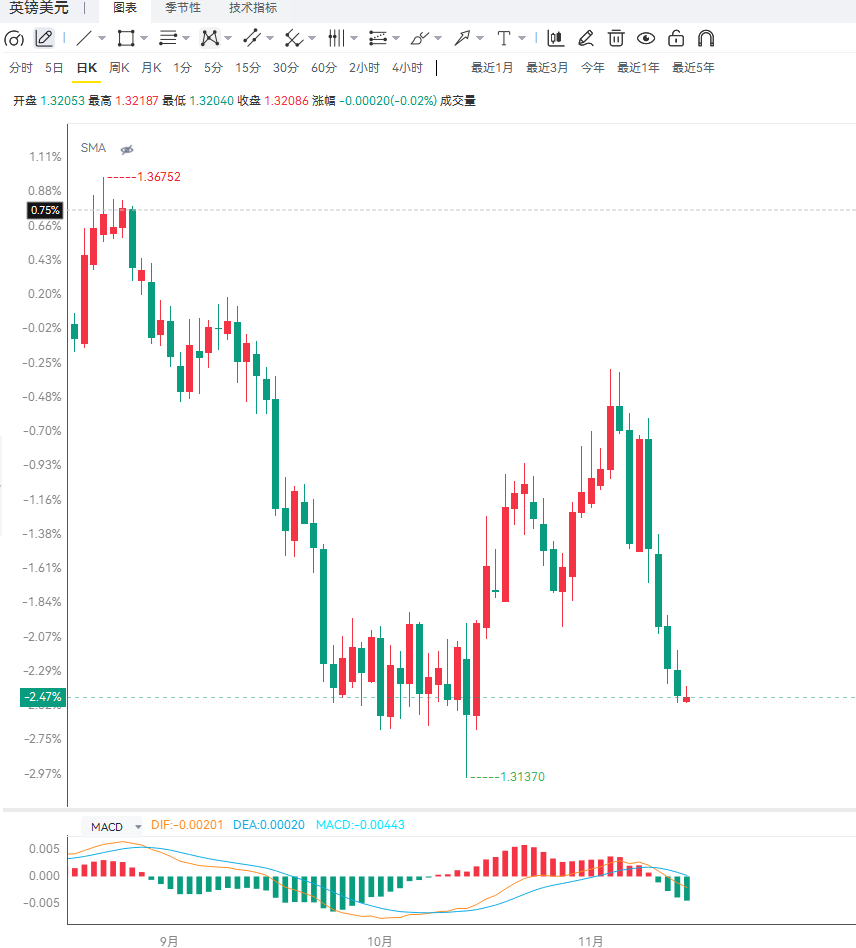 Editor's Summary: The British pound is currently under pressure from a strong US dollar. Expectations of a Bank of England rate hike offer only a slight buffer and cannot counteract the upward momentum of the dollar driven by expectations of Federal Reserve tightening combined with geopolitical risk aversion. 1.3200 is a short-term support/resistance level; a decisive break below this level would open up further downside potential. Holding above this level would likely lead to low-level consolidation, awaiting the direction provided by Tuesday's UK employment report.
Tensions in the Middle East have escalated again, with Iran launching a drone strike on Sunday against a US military base in Bahrain. The Houthi rebels accused Saudi warplanes of launching 75 airstrikes and attacks on civilian areas in the past 24 hours. Iran's Deputy Foreign Minister stated that Iran will not wait for the US to launch a preemptive strike, believing the US is using diplomatic maneuvering to buy time to prepare for a new round of military action. The escalating conflict has led to a continued flow of safe-haven funds into the US dollar, further weakening the pound's resilience. Even with market expectations of another Bank of England rate hike in December, the buying power generated by this expectation is limited and unlikely to reverse the current market trend. No major economic data releases from the UK or US are scheduled for Monday. Short-term price movements will primarily follow two variables: public speeches by key officials such as Federal Reserve Chairman Warsh, and ongoing updates on Middle Eastern geopolitical developments. Market focus will shift to Tuesday's UK employment report. Wage and unemployment data will recalibrate the probability of further Bank of England rate hikes, providing a clear catalyst for volatility in the pound against the dollar. Strong employment data will provide a temporary boost to the pound; weak employment data will put further pressure on the pound. From a technical perspective, on the daily chart, after a sustained decline from above 1.3400, the GBP/USD pair has been consolidating in a recent low range. A break below the 1.3200 support level would unleash further selling pressure, opening up deeper downside potential. On the upside, the pair needs to rebound back to the 1.3300-1.3350 area, a zone of high trading volume, to alleviate current selling pressure and improve the short-term technical outlook. This area represents strong resistance from the previous decline, and any rebound reaching this level is likely to encounter renewed selling pressure. On the 4-hour chart, the moving averages are in a bearish alignment, with the price consistently trading below key moving averages. The RSI is in a neutral-to-bearish range, not yet in extreme oversold territory, indicating that bears still hold the upper hand, but there is a possibility of short-term consolidation at lower levels. Until a clear break above 1.3300-1.3350 occurs, a bearish bias is maintained overall. Editor's Summary: The British pound is currently under pressure from a strong US dollar. Expectations of a Bank of England rate hike offer only a slight buffer and cannot counteract the upward momentum of the dollar driven by expectations of Federal Reserve tightening combined with geopolitical risk aversion. 1.3200 is a short-term support/resistance level; a decisive break below this level would open up further downside potential. Holding above this level would likely lead to low-level consolidation, awaiting the direction provided by Tuesday's UK employment report.
- Risk Warning and Disclaimer
- The market involves risk, and trading may not be suitable for all investors. This article is for reference only and does not constitute personal investment advice, nor does it take into account certain users’ specific investment objectives, financial situation, or other needs. Any investment decisions made based on this information are at your own risk.