Weaker-than-expected Japanese GDP figures and the risk of intervention dampened bullish sentiment, causing the USD/JPY pair to hover below the 160 level.
2026-11-16 11:12:31
Japan's Cabinet Office released preliminary third-quarter GDP figures on Monday, showing a significantly weaker-than-expected performance. Japan's third-quarter GDP was flat quarter-on-quarter, compared to 0.4% growth in the second quarter and market expectations of 0.1%. The annualized year-on-year growth rate was -0.1%, compared to 1.4% in the second quarter and expectations of 0.3%, indicating a clear weakening of economic momentum. Normally, a weak economy would reduce expectations of a Bank of Japan interest rate hike, putting downward pressure on the yen. However, the yen actually found support after the data release, primarily driven by increased risks of official intervention.  Japanese Finance Minister Satsuki Katayama issued a statement, noting the recent unilateral and rapid fluctuations in the exchange rate. He stated that the government will maintain close communication with the US Treasury and will take appropriate countermeasures. BBH's strategy team reviewed the extent of previous intervention: From late July to early August, Japan used a record 15.4 trillion yen of its foreign exchange reserves to support the yen, approximately 10% of its total reserves. The USD/JPY pair quickly fell from a high of 163.74 to 155.23, and has since struggled to hold above the 160 level. The institution concludes that high US Treasury yields favor a bullish medium-term outlook for USD/JPY, but the risk of intervention above 160 significantly worsens the risk-reward ratio for chasing higher levels, becoming the primary constraint for bulls. The Federal Reserve's hawkish narrative continues to support the US dollar. Kansas City Fed President Schmid's speech was hawkish, receiving a 7 out of 10 rating from FXS, above the historical average of 6.9. He acknowledged that curbing inflation is becoming increasingly difficult, with inflation significantly above the 2% target. Even excluding energy, inflation remains close to 3%, and demand is the core source of price pressures. The Fed needs to continue tightening policy. The FXS Fed Sentiment Index rose 1 point to 148.44, clearly in hawkish territory. The market continues to price in the Fed's tightening path, putting pressure on low-interest currencies like the yen and providing underlying support for the USD/JPY exchange rate. This week's risk events are concentrated in the US: Tuesday's US October retail sales and Wednesday's FOMC meeting minutes. Stronger data will push up US Treasury yields, briefly boosting USD/JPY; weaker data could trigger profit-taking and amplify yen buying driven by expectations of Japanese intervention. On the daily chart, USD/JPY maintains a short-term bullish tone, trading above the 100-day moving average and the Bollinger middle band, in the upper half of its recent trading range. The 14-period RSI reading is 62.19, within the bullish zone and not yet overbought, indicating that bullish momentum remains but hasn't reached extreme overextension. It's more likely to be a range-bound consolidation near the upper edge of the range than a one-sided accelerated rise. The immediate resistance is at the upper Bollinger Band at 160.12, a highly sensitive area where market intervention is likely; a price move to this level would significantly increase the willingness of bullish investors to take profits. The first support level is the 100-day moving average at 158.95; the second is the middle Bollinger Band at 158.30; and deeper structural support lies at the lower Bollinger Band at 156.45. As long as the price holds above the 100-day moving average, the daily bullish pattern will remain intact; however, a decisive break below 158.30 would slow the current upward momentum and lead to a deeper pullback. On the 4-hour chart, the moving averages are in a bullish alignment, but being close to the upper edge of the range, volatility is driven by news, a typical scenario of "a trend with a ceiling." It is not advisable to chase the price higher near the 160 level in the short term. It is better to wait for a pullback to support before reassessing the situation. At the same time, we should be highly vigilant against sudden verbal intervention or direct market intervention that could cause a rapid gap down, and strictly manage risk.
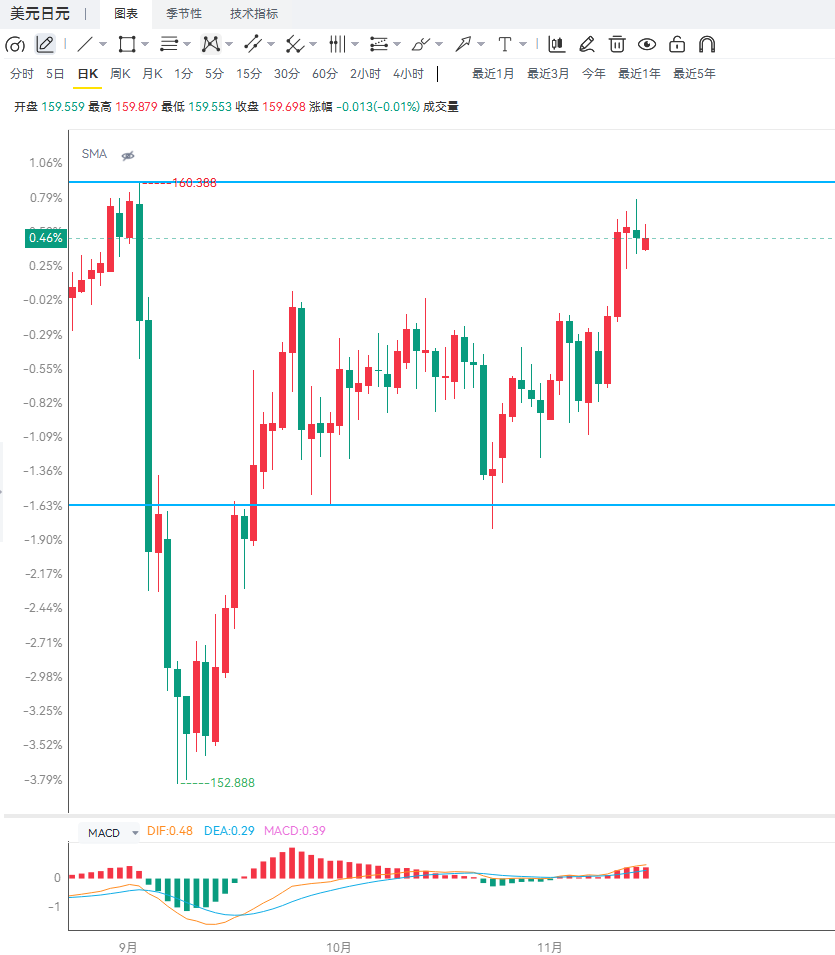 In summary, the USD/JPY pair is currently in a typical bullish-bearish tug-of-war: expectations of a Fed rate hike and high US Treasury yields form the underlying bullish logic, while continued warnings of intervention from the Japanese government and historical memories of strong intervention have created a strong psychological ceiling at the 160 level. Weak GDP data has not reversed the main market trend, and short-term price action will likely involve a back-and-forth struggle between US Treasury yields and the risk of intervention.
Japanese Finance Minister Satsuki Katayama issued a statement, noting the recent unilateral and rapid fluctuations in the exchange rate. He stated that the government will maintain close communication with the US Treasury and will take appropriate countermeasures. BBH's strategy team reviewed the extent of previous intervention: From late July to early August, Japan used a record 15.4 trillion yen of its foreign exchange reserves to support the yen, approximately 10% of its total reserves. The USD/JPY pair quickly fell from a high of 163.74 to 155.23, and has since struggled to hold above the 160 level. The institution concludes that high US Treasury yields favor a bullish medium-term outlook for USD/JPY, but the risk of intervention above 160 significantly worsens the risk-reward ratio for chasing higher levels, becoming the primary constraint for bulls. The Federal Reserve's hawkish narrative continues to support the US dollar. Kansas City Fed President Schmid's speech was hawkish, receiving a 7 out of 10 rating from FXS, above the historical average of 6.9. He acknowledged that curbing inflation is becoming increasingly difficult, with inflation significantly above the 2% target. Even excluding energy, inflation remains close to 3%, and demand is the core source of price pressures. The Fed needs to continue tightening policy. The FXS Fed Sentiment Index rose 1 point to 148.44, clearly in hawkish territory. The market continues to price in the Fed's tightening path, putting pressure on low-interest currencies like the yen and providing underlying support for the USD/JPY exchange rate. This week's risk events are concentrated in the US: Tuesday's US October retail sales and Wednesday's FOMC meeting minutes. Stronger data will push up US Treasury yields, briefly boosting USD/JPY; weaker data could trigger profit-taking and amplify yen buying driven by expectations of Japanese intervention. On the daily chart, USD/JPY maintains a short-term bullish tone, trading above the 100-day moving average and the Bollinger middle band, in the upper half of its recent trading range. The 14-period RSI reading is 62.19, within the bullish zone and not yet overbought, indicating that bullish momentum remains but hasn't reached extreme overextension. It's more likely to be a range-bound consolidation near the upper edge of the range than a one-sided accelerated rise. The immediate resistance is at the upper Bollinger Band at 160.12, a highly sensitive area where market intervention is likely; a price move to this level would significantly increase the willingness of bullish investors to take profits. The first support level is the 100-day moving average at 158.95; the second is the middle Bollinger Band at 158.30; and deeper structural support lies at the lower Bollinger Band at 156.45. As long as the price holds above the 100-day moving average, the daily bullish pattern will remain intact; however, a decisive break below 158.30 would slow the current upward momentum and lead to a deeper pullback. On the 4-hour chart, the moving averages are in a bullish alignment, but being close to the upper edge of the range, volatility is driven by news, a typical scenario of "a trend with a ceiling." It is not advisable to chase the price higher near the 160 level in the short term. It is better to wait for a pullback to support before reassessing the situation. At the same time, we should be highly vigilant against sudden verbal intervention or direct market intervention that could cause a rapid gap down, and strictly manage risk. In summary, the USD/JPY pair is currently in a typical bullish-bearish tug-of-war: expectations of a Fed rate hike and high US Treasury yields form the underlying bullish logic, while continued warnings of intervention from the Japanese government and historical memories of strong intervention have created a strong psychological ceiling at the 160 level. Weak GDP data has not reversed the main market trend, and short-term price action will likely involve a back-and-forth struggle between US Treasury yields and the risk of intervention.
- Risk Warning and Disclaimer
- The market involves risk, and trading may not be suitable for all investors. This article is for reference only and does not constitute personal investment advice, nor does it take into account certain users’ specific investment objectives, financial situation, or other needs. Any investment decisions made based on this information are at your own risk.