With the risk of supertankers sinking still present, why is Goldman Sachs still bearish on oil prices next year?
2026-11-16 13:42:29
Brent crude futures fell slightly in Asian trading on Monday (November 16), currently trading around $95.40 per barrel. Goldman Sachs expects oil prices to gradually decline over the next year as the market returns to oversupply. The bank forecasts an average Brent crude price of $88 per barrel in 2027, falling to $78 by December 2027, but warns of near-term upside risks – from attacks on Middle Eastern shipping lines. For US crude futures, the bank expects an average price of $78 in 2027, falling to $70 by the end of 2027. Refined product prices should also decline, but remain well above historical levels, with US wholesale diesel expected to average $150 per barrel in 2027. Goldman Sachs' path for next year is "downward quarter by quarter" – the 2027 average price of Brent crude futures at $88 is nearly $8 lower than current levels, and $78 by the end of the year is about $18 lower; this provides a clear medium-term anchor for oil market bears. 
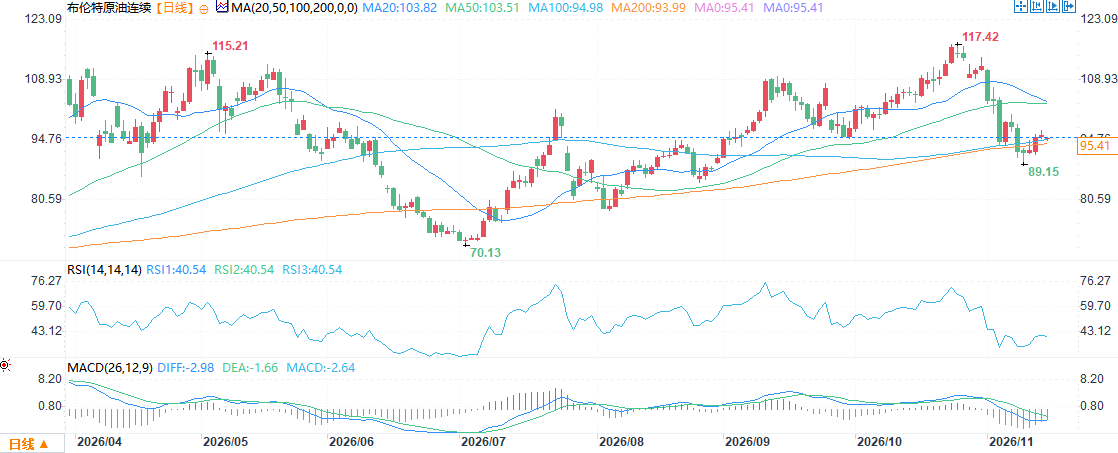 (Brent crude oil futures daily chart, source: EasyTrade) At 13:41 Beijing time, Brent crude oil futures were trading at $95.35 per barrel.
Core logic: A supply surplus of 2 million barrels per day in 2027.
The core of this assessment is supply. In Goldman Sachs' baseline scenario, oil production will exceed end-user demand by 2 million barrels per day in 2027. This surplus is sufficient to pull prices down from current levels, even if some war-related risk premiums remain. Goldman Sachs' bearish view is not based on a collapse in demand, but on a recovery in supply—a 2 million barrel per day surplus means the market will shift from "tight" to "loose," a shift in itself sufficient to drive the price center down without additional demand shocks.The two-way nature of risk: near-term upside and medium-term downside.
The bank cautiously presented risks in two directions. In the near term, prices could rise if shipping attacks escalate, oil infrastructure is damaged, or risk premiums are rebuilt. In the medium term, the risks are skewed to the downside—through stronger supply, weaker demand, or a risk premium smaller than assumed. Goldman Sachs' "medium-term bearish" does not preclude a "short-term bullish" outlook—the two are compatible in terms of time horizon, and market pricing essentially switches between these two time horizons.The veracity of near-term risks: Iran claims supertanker sank, but there is no independent confirmation.
This near-term risk is real. Iran's Revolutionary Guard claimed over the weekend that two oil tankers struck mines in the Strait of Hormuz, with one supertanker carrying over 2 million barrels of crude oil sinking. There is currently no independent confirmation. If the claims are confirmed, Goldman Sachs' expectation that the risk premium "will subside" could be quickly rebuilt, and the short-term price increase would conflict with its medium-term forecast—which is why the bank explicitly listed "near-term risks skewed to the upside."Price discrepancy with forecast: Brent crude at approximately $95.50 to a 2027 average price of $88.
Even so, oil prices fell on Monday due to expectations of a supply glut. Shipments via the Strait of Hormuz were reportedly near pre-war levels, and Washington eased domestic fuel transportation by extending Jones Act exemptions. Brent crude futures traded around $95.40 in Asian trading, well above Goldman Sachs' 2027 average price—meaning significant downside if the bank's glut view materializes. The gap between current prices and the projected path leaves the oil market hanging on one question—whether the supply disruptions in the Gulf will subside or reignite. For traders, Goldman Sachs' message is "patience": a glut is coming, prices should fall, but the risks in the coming weeks still point to the upside until things calm down in the Gulf.in conclusion
Goldman Sachs projects Brent crude futures to average $88 in 2027, falling to $78 by December 2027, and WTI crude futures to average $78 in 2027, reaching $70 by the end of the year, due to a supply glut of 2 million barrels per day in 2027. The average price of US wholesale diesel in 2027 is projected at $150 per barrel, a decline but still well above normal levels. The core logic is supply recovery rather than a demand collapse—a 2 million barrel per day surplus is sufficient to shift the price center downwards. Risks are two-way: near-term upside (shipping attacks, infrastructure damage, risk premium rebuilding), medium-term downside (stronger supply, weaker demand, smaller premiums). Near-term risks are real—Iran claims a supertanker sank in the Hormuz, but this has not been independently confirmed; if confirmed, the risk premium that Goldman Sachs expects to "dissipate" could be quickly rebuilt. The price gap between forecasts and actual prices is significant: Brent crude futures are around $95.50, well above the 2027 average of $88, and if the oversupply view materializes, there is considerable downside potential. The oil market therefore hinges on one question: will the supply disruptions in the Gulf subside or reignite? Goldman Sachs' message is patience, but before that, near-term risks still point to the upside. (Brent crude oil futures daily chart, source: EasyTrade) At 13:41 Beijing time, Brent crude oil futures were trading at $95.35 per barrel.
- Risk Warning and Disclaimer
- The market involves risk, and trading may not be suitable for all investors. This article is for reference only and does not constitute personal investment advice, nor does it take into account certain users’ specific investment objectives, financial situation, or other needs. Any investment decisions made based on this information are at your own risk.