With real interest rates among the lowest in the world, how long can the Bank of Japan continue its "gradual" approach?
2026-11-16 14:00:30
On Monday (November 16) during Asian trading hours, the US dollar traded lower against the Japanese yen in narrow fluctuations, currently hovering around 159.45. Bank of Japan board member Hajime Takada, speaking to business leaders in Tokushima on Monday, stated that the central bank should raise interest rates flexibly rather than at a fixed pace. He argued that 2026 would mark a "systemic change" in Japan's monetary policy, and the neutral interest rate might prove to be higher than market expectations. 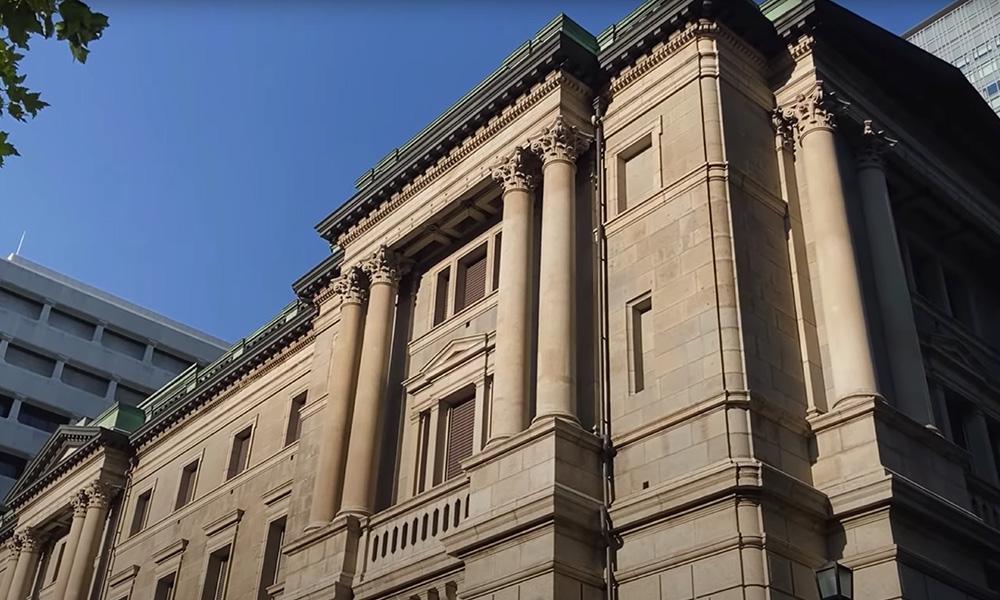
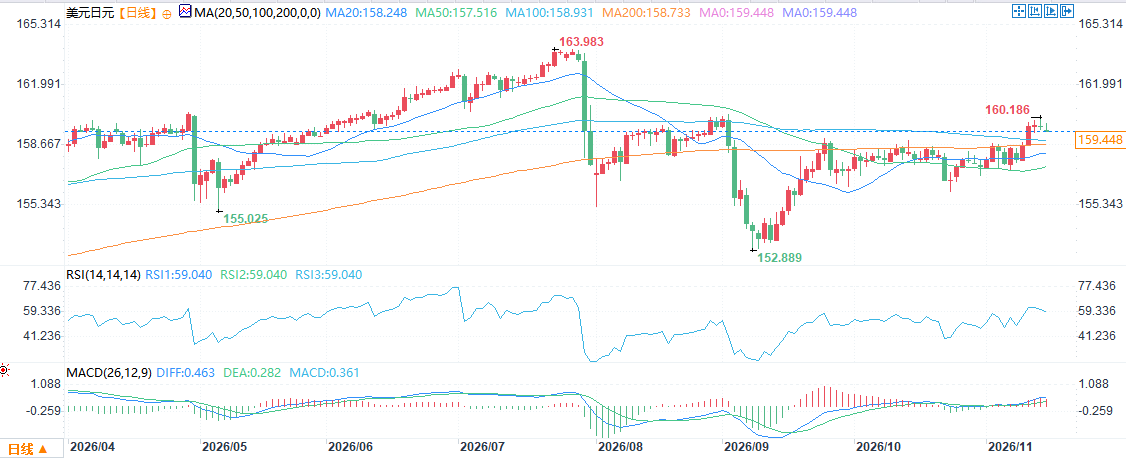 (USD/JPY daily chart, source: EasyForex) At 13:59 Beijing time, USD/JPY was trading at 159.46/47.
Core proposition: Break free from a fixed rhythm and move closer to the median of the neutral range as early as possible.
Takada was the only dissenter at the October meeting, where he proposed raising the policy rate from 1.25% to 1.5%. In his speech, he elaborated on his reasons, emphasizing that these views represented only his personal opinion. He stated that the Bank of Japan should not be bound by specific intervals or ranges expected by the market, but should respond to domestic price and economic conditions as well as overseas developments. Takada's criticism was not about "whether to raise interest rates," but rather "raising rates according to the market's expected timetable"—he argued that if inflation and exchange rate data already pointed to a tighter policy, then "waiting for the next quarterly window" was itself a policy mistake.Inflation assessment: Potential inflation has reached 2%, expectations have risen above 2%, and PPI rose by 7.1%.
The core of his argument is the shift in the inflation landscape. Takada stated that potential inflation has reached the 2% target, and medium- to long-term inflation expectations have risen above 2%, increasing the risk of a second-round effect. He pointed out that producer price inflation in October was 7.1%, cost transmission to consumers has accelerated, and that energy costs driven by the Middle East conflict could push prices above the target. Therefore, he advocated that the Bank of Japan should shift from "encouraging inflation" to "demonstrating its determination to prevent price overshooting to the market," while also considering the impact of exchange rates. The Bank of Japan's policy objective has shifted from "creating inflation" to "managing inflation," and this shift requires a change in the policy response function from "gradual" to "flexible."Exchange Rates and Neutral Interest Rates: Real Interest Rates are among the Lowest Globally, Neutral Interest Rates May Be Higher Than Expected
He also pointed to the yen. Japan's real policy rate remains the lowest in the world. Given that some currency market participants are focused on real interest rate differentials, he stated that price pressures transmitted through the exchange rate are one reason why interest rate hikes are now necessary. Regarding the neutral interest rate, Takada said Japan's policy rate has just entered the neutral range—estimated by the central bank at around 1.1% to 2.5%. With overseas central banks raising rates, he warned that Japan's neutral interest rate may eventually be higher than market assumptions. He stated that the central bank should act as soon as possible to reach near the midpoint of this range, which will leave room for future rate hikes or cuts. Takada links the "lowest real interest rate globally" with "exchange rate transmission," making interest rate hikes not only an inflation management tool but also a currency policy tool—forming a logical loop with what he calls "moving closer to the midpoint as soon as possible."Economic Assessment and Context of the Same Day: Cumulative Effects Still Far Off, AI Investment Remains Stable, and GDP Contraction Occurs on the Same Day
Takada stated that the cumulative effect of past rate hikes is still some time away. He cited strong corporate balance sheets, loose financial conditions, a recovering global economy, and AI-related demand—demands he expects to remain robust despite stock market volatility in early November. His remarks coincided with data showing a slight contraction in Japan's third-quarter economy, and the market is watching to see if the Bank of Japan will act in December. The weak GDP figures, contrasting with Takada's hawkish comments, indicate that the debate within the committee has clearly shifted towards "speed" rather than "direction"—the weak GDP figures did not shake Takada's stance on rate hikes, and his remarks did not soften due to the data.in conclusion
Takada called for flexible, data-driven interest rate hikes, rather than a fixed pace constrained by market expectations. He reiterated his advocacy for raising interest rates to 1.5%, calling 2026 a year of "systemic change." His arguments are based on: potential inflation already at 2%, medium- to long-term expectations rising above 2%, October PPI rising 7.1%, and energy costs potentially pushing up prices; Japan's real policy interest rate being the lowest globally, and exchange rate transmission providing a reason for raising rates; the neutral interest rate potentially higher than market expectations, and should move towards the midpoint of the 1.1% to 2.5% range as soon as possible. He stated that the cumulative effects of past rate hikes are still far off, and AI investments should remain prudent. This speech is the clearest public argument to date for a "faster pace of rate hikes than market assumptions"—he rejects a fixed quarterly pace, advocating for reaching the midpoint of the neutral range as soon as possible, bringing "above 1.5%" into view. Since his views were solely his own and had previously been rejected, the speech itself did not change the December pricing; however, it supported the yen and put upward pressure on short-term Japanese government bond yields, especially as the dollar/yen exchange rate approached 160. On the same day as the weak GDP figures, the debate within the committee clearly shifted towards "speed" rather than "direction." (USD/JPY daily chart, source: EasyForex) At 13:59 Beijing time, USD/JPY was trading at 159.46/47.
- Risk Warning and Disclaimer
- The market involves risk, and trading may not be suitable for all investors. This article is for reference only and does not constitute personal investment advice, nor does it take into account certain users’ specific investment objectives, financial situation, or other needs. Any investment decisions made based on this information are at your own risk.