Oil price forecast: WTI encounters resistance at the $90 mark, Brent lacks upward momentum.
2026-11-17 01:20:30
On Monday (November 16), the international crude oil market failed to maintain its previous upward trend after the start of the new week. WTI crude oil futures fell back to around $86.35, while Brent crude oil futures were around $93.39. Although Brent crude oil is still trading above the 200-day moving average, its short-term momentum is clearly insufficient.  With weakening export channels, the capacity of US refineries to absorb the increased supply is a key variable . The core question at the opening of WTI this week is whether US refineries can continue to absorb domestic crude oil supply if export channels weaken. EIA data shows that for the week ending November 6, US crude oil exports fell to 3.455 million barrels per day, down from 4.85 million barrels per day two weeks earlier and 3.675 million barrels per day the previous week. Weekly fluctuations should not be directly interpreted as a trend reversal—export shipments fall under different reporting periods, which can cause statistical jumps—but if exports continue to slow, domestic refineries and storage facilities will be forced to absorb more supply, with far more substantial consequences. The EIA weekly report released on November 18 will be the next window to observe this scenario. On the supply side, the EIA's Short-Term Energy Outlook released in October projected that refinery feedstock inputs in the fourth quarter will remain above seasonal averages: approximately 16.6 million barrels per day in October, roughly flat in November, and further increasing in December as maintenance shutdowns end. Product-side signals: Diesel production prices have fallen significantly . Product-side data also warrants attention. Data from the U.S. Bureau of Labor Statistics shows that the diesel producer price index fell 7.9% in October. It's important to emphasize that this indicator measures producer prices, not gas station retail prices or refinery cracking margins. Therefore, it cannot be simply equated with immediate changes in downstream demand. It reflects pricing pressure in the refined oil sector and indirectly impacts refinery operating rates. Brent: A race between refinery restart pace and seaborne supply . Regarding Brent crude, market focus is on the IEA's monthly report released on November 13th. The report shows that global refinery processing fell to 81.3 million barrels per day in October and predicts a rebound to 84.7 million barrels per day in December, representing a recovery of approximately 3.4 million barrels per day from the seasonal low. October's figure is an estimate, while December's remains a forecast. Refinery processing is a direct source of crude oil demand; therefore, the pace of restarts is as significant to Brent crude as the recovery speed of seaborne supply. However, the absorption of crude oil returning to the market by refineries does not equate to a corresponding increase in fuel consumption. Refineries can absorb raw materials by building up refined product inventories, adjusting export destinations, or changing product mixes. This is precisely why there is a time lag between the return of supply and the recovery of demand. The geographical location of crude oil is also a problem. Shipped barrels cannot meet refineries' immediate needs until they arrive and are unloaded, and shipping delays may therefore keep near-month supply at a premium, even if annual or quarterly balance sheets indicate a more relaxed supply. This means that the landed cost of alternative sources—the sum of freight, delivery time, and benchmark price—is the true basis for refinery decisions; cheaper overseas barrels will not automatically replace readily available local crude oil. Reports indicate that new tanker accident claims continue to emerge alongside the recovery of oil flows, but related analyses have not quantified independent supply losses. Regarding global supply, the IEA estimates global oil supply at 105.4 million barrels per day in October. It is important to note that supply data and refinery processing data have different coverage, and oil demand also includes non-traditional refinery processing uses; the two cannot be directly subtracted to estimate surplus. Market Outlook
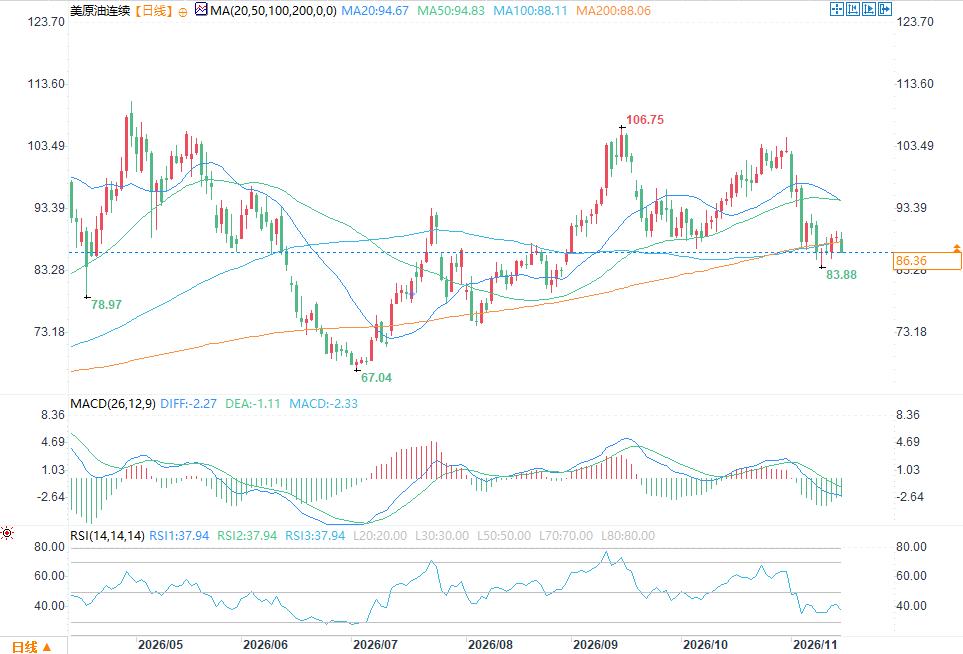
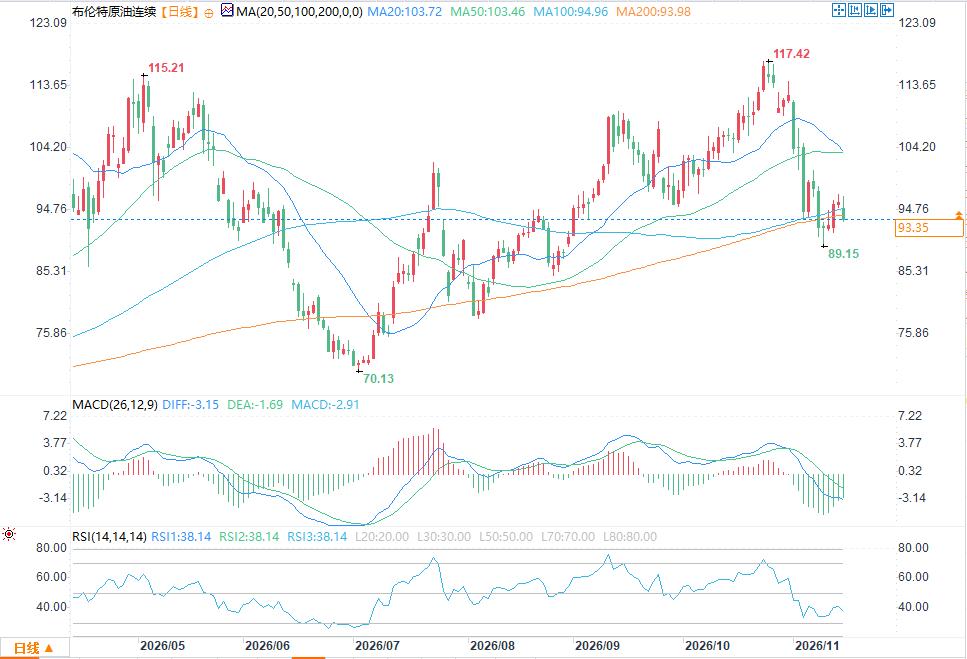 In summary, both WTI and Brent crude are consolidating sideways around their 200-day moving averages, lacking directional momentum in the short term. Until clear signals emerge from export data, refinery maintenance schedules, and maritime logistics, the market is likely to remain in a wait-and-see mode, with $90 and $95 representing the first resistance levels to be broken above these benchmarks.
With weakening export channels, the capacity of US refineries to absorb the increased supply is a key variable . The core question at the opening of WTI this week is whether US refineries can continue to absorb domestic crude oil supply if export channels weaken. EIA data shows that for the week ending November 6, US crude oil exports fell to 3.455 million barrels per day, down from 4.85 million barrels per day two weeks earlier and 3.675 million barrels per day the previous week. Weekly fluctuations should not be directly interpreted as a trend reversal—export shipments fall under different reporting periods, which can cause statistical jumps—but if exports continue to slow, domestic refineries and storage facilities will be forced to absorb more supply, with far more substantial consequences. The EIA weekly report released on November 18 will be the next window to observe this scenario. On the supply side, the EIA's Short-Term Energy Outlook released in October projected that refinery feedstock inputs in the fourth quarter will remain above seasonal averages: approximately 16.6 million barrels per day in October, roughly flat in November, and further increasing in December as maintenance shutdowns end. Product-side signals: Diesel production prices have fallen significantly . Product-side data also warrants attention. Data from the U.S. Bureau of Labor Statistics shows that the diesel producer price index fell 7.9% in October. It's important to emphasize that this indicator measures producer prices, not gas station retail prices or refinery cracking margins. Therefore, it cannot be simply equated with immediate changes in downstream demand. It reflects pricing pressure in the refined oil sector and indirectly impacts refinery operating rates. Brent: A race between refinery restart pace and seaborne supply . Regarding Brent crude, market focus is on the IEA's monthly report released on November 13th. The report shows that global refinery processing fell to 81.3 million barrels per day in October and predicts a rebound to 84.7 million barrels per day in December, representing a recovery of approximately 3.4 million barrels per day from the seasonal low. October's figure is an estimate, while December's remains a forecast. Refinery processing is a direct source of crude oil demand; therefore, the pace of restarts is as significant to Brent crude as the recovery speed of seaborne supply. However, the absorption of crude oil returning to the market by refineries does not equate to a corresponding increase in fuel consumption. Refineries can absorb raw materials by building up refined product inventories, adjusting export destinations, or changing product mixes. This is precisely why there is a time lag between the return of supply and the recovery of demand. The geographical location of crude oil is also a problem. Shipped barrels cannot meet refineries' immediate needs until they arrive and are unloaded, and shipping delays may therefore keep near-month supply at a premium, even if annual or quarterly balance sheets indicate a more relaxed supply. This means that the landed cost of alternative sources—the sum of freight, delivery time, and benchmark price—is the true basis for refinery decisions; cheaper overseas barrels will not automatically replace readily available local crude oil. Reports indicate that new tanker accident claims continue to emerge alongside the recovery of oil flows, but related analyses have not quantified independent supply losses. Regarding global supply, the IEA estimates global oil supply at 105.4 million barrels per day in October. It is important to note that supply data and refinery processing data have different coverage, and oil demand also includes non-traditional refinery processing uses; the two cannot be directly subtracted to estimate surplus. Market Outlook In summary, both WTI and Brent crude are consolidating sideways around their 200-day moving averages, lacking directional momentum in the short term. Until clear signals emerge from export data, refinery maintenance schedules, and maritime logistics, the market is likely to remain in a wait-and-see mode, with $90 and $95 representing the first resistance levels to be broken above these benchmarks.- Risk Warning and Disclaimer
- The market involves risk, and trading may not be suitable for all investors. This article is for reference only and does not constitute personal investment advice, nor does it take into account certain users’ specific investment objectives, financial situation, or other needs. Any investment decisions made based on this information are at your own risk.