Gold prices fell to a more than one-year low, pressured by a weak dollar and expectations of a Fed rate hike, and are expected to remain volatile and downward in the short term.
2026-11-17 10:52:32
Gold prices fell to a more than one-year low in early Asian trading on Tuesday, trading around $3,855, pressured by a stronger dollar. Last week's better-than-expected US inflation data reignited market sentiment that the Federal Reserve might resume interest rate hikes in December. Kansas City Fed President Schmid stated clearly on Sunday that current inflation levels remain too high and the Fed still has a lot of work to do in curbing price pressures.  Peter Grant, Senior Head of Metals Strategy at Zaner Metals, analyzed that persistently high inflation readings last week increased expectations of a December rate hike, driving up both the US dollar and US Treasury yields. These multiple factors combined to exert significant downward pressure on precious metals. The CME FedWatch Tool showed that the market was pricing in a 95.7% probability of a 25 basis point rate hike at the December FOMC meeting, and a 4.3% probability of a 50 basis point hike. Deutsche Bank statistics show that gold recorded its largest weekly drop since June last week, falling 4.58% to close at $3884. Rising US Treasury real yields and the market's repricing of the Fed's tightening path were the core drivers of this sharp decline in gold prices. Cleveland Fed President Hammark delivered a speech with a generally mildly hawkish tone, receiving a 7.1 rating on the FXS speech tracking platform, slightly below the historical average of 7.6. She expressed openness to the FOMC meeting but expressed concern that inflation is heading in the wrong direction, favoring multiple small rate hikes to allow the economy to gradually adapt to policy tightening. She also believes that current financial conditions are not yet sufficient to constrain the economy, and the economy can withstand further tightening. The labor market is generally balanced but lacks dynamism. The FXS Fed Sentiment Index remained high at 147.36, still in a clearly hawkish range. Her remarks largely confirmed market expectations and did not provide additional strong impetus for the dollar. The market is focused on the US October retail sales data to be released Tuesday evening. The market expects a 0.2% month-on-month increase in retail sales, and a 0.4% increase excluding automobiles. Weak consumer data could cool expectations of aggressive Fed rate hikes, putting pressure on the dollar and providing a breather for gold. If consumer data remains resilient, it will further reinforce tightening pricing, and gold prices may continue to decline. It is worth noting that while Middle East geopolitical conflicts continue to escalate, safe-haven funds currently prefer dollar assets, limiting the boost to gold and making it difficult to reverse the medium-term downward trend in gold prices. On the daily chart, spot gold maintains a clear bearish tone in the short term, with prices trading below the 20-day Bollinger Band and the 100-day moving average. Gold is trading between the lower Bollinger Band support and the upper Bollinger Band's midline. The 14-period RSI reading is 36.56, below the 50 neutral line, indicating slight oversold conditions, but bears still control the market. The first resistance level is at the 20-day Bollinger Band at $4010, followed by the upper Bollinger Band at $4185 and the 100-day moving average at $4195, forming a strong resistance cluster. A rebound to this range is likely to encounter selling pressure; only a firm hold above this level can improve the overall bearish structure. Immediate support is at the lower Bollinger Band at $3830. A break below this level would likely extend the downtrend; holding above $3830 would allow gold to consolidate within the bearish channel at lower levels.
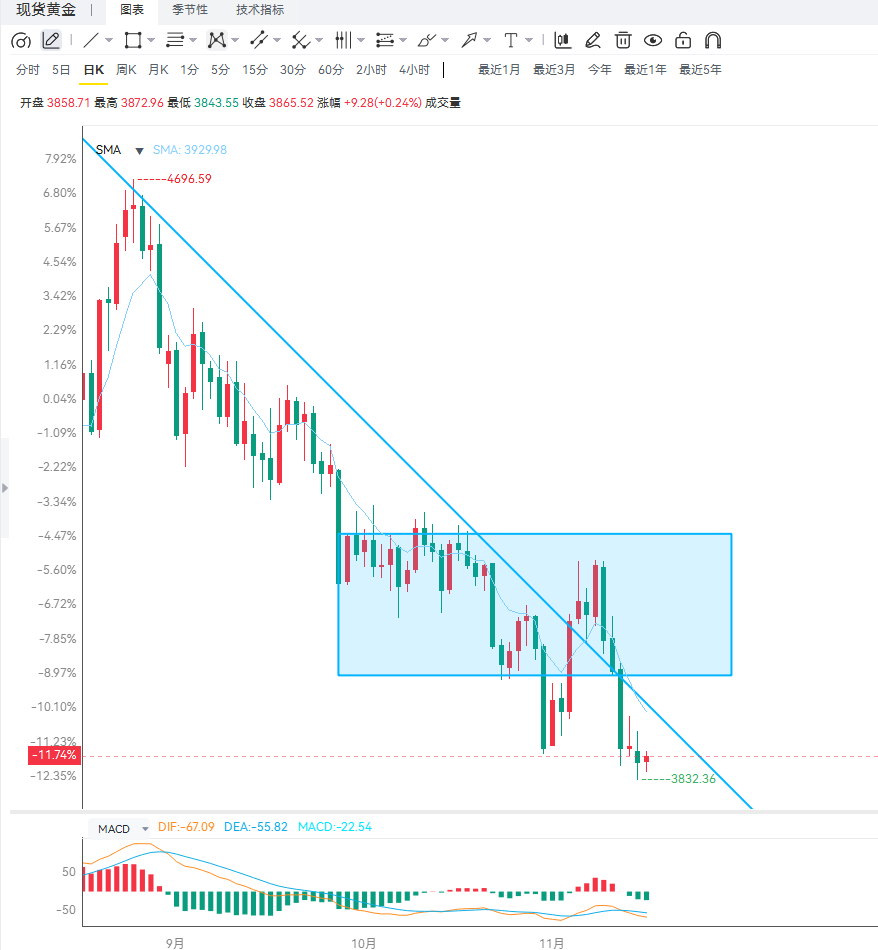 Editor's Summary: The core bearish factors for gold currently stem from sticky US inflation and the pricing of the Fed's tightening policy. Rising real yields on US Treasury bonds are the dominant logic suppressing gold prices. Geopolitical risk aversion can only provide a short-term boost and cannot reverse the large-scale downtrend. Technical indicators are near oversold levels, suggesting a possibility of low-level consolidation and correction. However, without a clear reversal signal, any rebound is more likely to be seen as a continuation of the downtrend. Tonight's retail sales data is a key short-term variable; strong consumer data will further open up downside potential, while weaker consumer data could lead to a corrective rebound in gold prices.
Peter Grant, Senior Head of Metals Strategy at Zaner Metals, analyzed that persistently high inflation readings last week increased expectations of a December rate hike, driving up both the US dollar and US Treasury yields. These multiple factors combined to exert significant downward pressure on precious metals. The CME FedWatch Tool showed that the market was pricing in a 95.7% probability of a 25 basis point rate hike at the December FOMC meeting, and a 4.3% probability of a 50 basis point hike. Deutsche Bank statistics show that gold recorded its largest weekly drop since June last week, falling 4.58% to close at $3884. Rising US Treasury real yields and the market's repricing of the Fed's tightening path were the core drivers of this sharp decline in gold prices. Cleveland Fed President Hammark delivered a speech with a generally mildly hawkish tone, receiving a 7.1 rating on the FXS speech tracking platform, slightly below the historical average of 7.6. She expressed openness to the FOMC meeting but expressed concern that inflation is heading in the wrong direction, favoring multiple small rate hikes to allow the economy to gradually adapt to policy tightening. She also believes that current financial conditions are not yet sufficient to constrain the economy, and the economy can withstand further tightening. The labor market is generally balanced but lacks dynamism. The FXS Fed Sentiment Index remained high at 147.36, still in a clearly hawkish range. Her remarks largely confirmed market expectations and did not provide additional strong impetus for the dollar. The market is focused on the US October retail sales data to be released Tuesday evening. The market expects a 0.2% month-on-month increase in retail sales, and a 0.4% increase excluding automobiles. Weak consumer data could cool expectations of aggressive Fed rate hikes, putting pressure on the dollar and providing a breather for gold. If consumer data remains resilient, it will further reinforce tightening pricing, and gold prices may continue to decline. It is worth noting that while Middle East geopolitical conflicts continue to escalate, safe-haven funds currently prefer dollar assets, limiting the boost to gold and making it difficult to reverse the medium-term downward trend in gold prices. On the daily chart, spot gold maintains a clear bearish tone in the short term, with prices trading below the 20-day Bollinger Band and the 100-day moving average. Gold is trading between the lower Bollinger Band support and the upper Bollinger Band's midline. The 14-period RSI reading is 36.56, below the 50 neutral line, indicating slight oversold conditions, but bears still control the market. The first resistance level is at the 20-day Bollinger Band at $4010, followed by the upper Bollinger Band at $4185 and the 100-day moving average at $4195, forming a strong resistance cluster. A rebound to this range is likely to encounter selling pressure; only a firm hold above this level can improve the overall bearish structure. Immediate support is at the lower Bollinger Band at $3830. A break below this level would likely extend the downtrend; holding above $3830 would allow gold to consolidate within the bearish channel at lower levels. Editor's Summary: The core bearish factors for gold currently stem from sticky US inflation and the pricing of the Fed's tightening policy. Rising real yields on US Treasury bonds are the dominant logic suppressing gold prices. Geopolitical risk aversion can only provide a short-term boost and cannot reverse the large-scale downtrend. Technical indicators are near oversold levels, suggesting a possibility of low-level consolidation and correction. However, without a clear reversal signal, any rebound is more likely to be seen as a continuation of the downtrend. Tonight's retail sales data is a key short-term variable; strong consumer data will further open up downside potential, while weaker consumer data could lead to a corrective rebound in gold prices.
- Risk Warning and Disclaimer
- The market involves risk, and trading may not be suitable for all investors. This article is for reference only and does not constitute personal investment advice, nor does it take into account certain users’ specific investment objectives, financial situation, or other needs. Any investment decisions made based on this information are at your own risk.