The 2-year JGB floating rate bond was stillborn: the Bank of Japan's interest rate hike expectations have been fully priced in, so what can the yen rely on to turn things around?
2026-11-17 10:46:32
Japan's Ministry of Finance has postponed the issuance of its first 2-year floating-rate government bond, citing market reliance on the Bank of Japan's (BOJ) interest rate hike path, which has diminished the hedging value of the instrument. Currently, the USD/JPY exchange rate is trading around 159, with the USD/JPY interest rate differential remaining the dominant force. Intervention risk and policy expectations are jointly shaping short-term volatility. For forex traders, this further confirms the high level of interest rate expectations, and close monitoring of the BOJ meeting and the Federal Reserve's actions is crucial. 
 Meanwhile, Japan's recent economic data has been weak, with the third-quarter GDP figures being particularly poor. This has limited the Bank of Japan's room for aggressive interest rate hikes and put short-term pressure on the yen.
Why are floating-rate government bonds "stalled"?
Japan's Ministry of Finance originally planned to launch its first 2-year floating-rate government bond (JGB) as early as January 2027. The coupon rate of these bonds is periodically reset with market interest rates, essentially providing investors with insurance against rising yields. Previously, as the Bank of Japan gradually exited its ultra-loose monetary policy and began a rate hike cycle, fixed-rate bonds faced the risk of price declines, and the Ministry of Finance hoped to maintain investor interest in Japanese government bonds through floating-rate bonds. However, the latest news indicates that the Ministry of Finance has decided to postpone and reassess demand, and will not set an issuance date for the time being. This decision will be included in the 2027 fiscal year government bond issuance plan, and related discussions will continue at a meeting with primary dealers on November 26. The core reason is straightforward: the market has already priced in a significant portion of future Bank of Japan rate hikes. The yield on 2-year Japanese government bonds once approached 1.88%. At this level, fixed-rate bonds have already compensated investors for a considerable portion of the anticipated policy tightening, naturally reducing the relative attractiveness of floating-rate bonds. Only when the actual rate hike exceeds market expectations will floating-rate bonds significantly outperform. The Ministry of Finance itself believes that demand may not be stable enough, and therefore chooses to wait and see. This move itself is a signal that the issuer acknowledges that the market has already largely priced in the Bank of Japan's tightening path.With interest rate expectations already high, what does this mean for the Japanese yen?
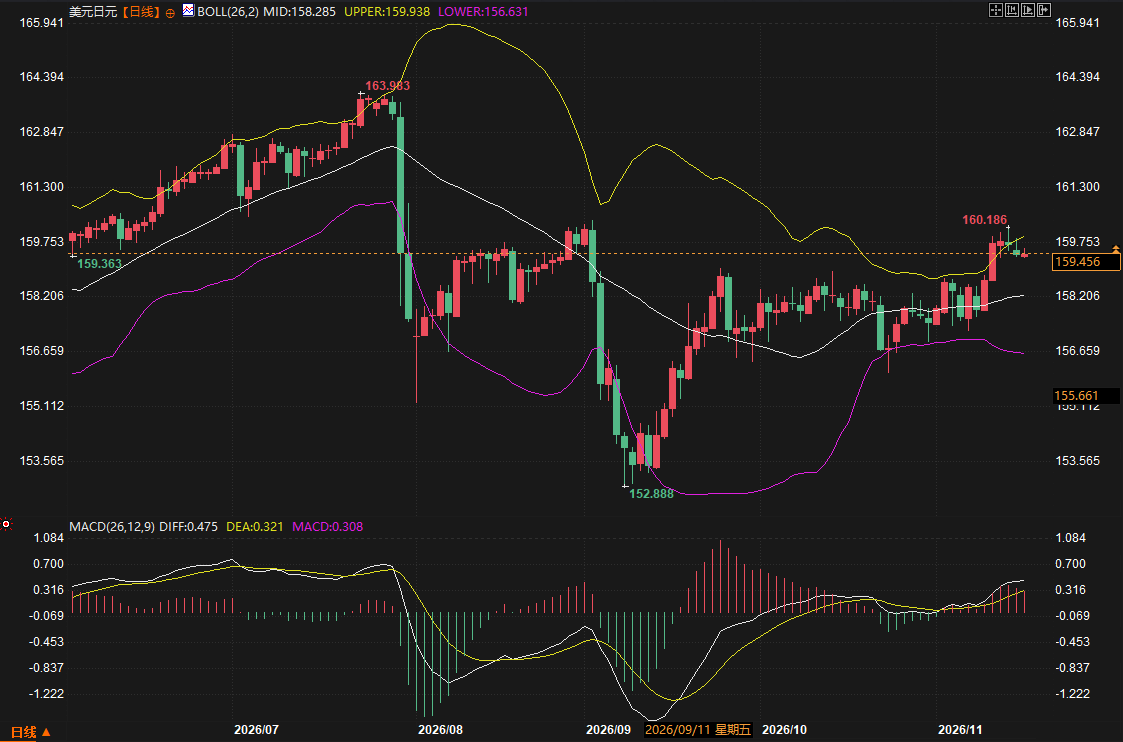
For the Japanese yen and USD/JPY, this news is neutral to slightly supportive. It confirms that front-end interest rate expectations are already high, limiting the room for an unexpectedly "more hawkish" stance in the short term. However, it also means that if the Bank of Japan does accelerate its pace, the market may still reassess. The current policy rate differential between the US and Japan remains significant. The Bank of Japan's policy rate is around 1.25%, and the market generally expects a further adjustment in December, followed by a moderate increase in 2027. The Federal Reserve, on the other hand, maintains a relatively high interest rate level, and the market is also paying close attention to its December moves. The interest rate differential remains an important fundamental factor supporting USD/JPY. Looking at price performance, USD/JPY has experienced significant volatility this year: after reaching a high of around 163.9 in early August, it fell sharply, briefly dipping to around 152 in mid-September, before rebounding and currently trading in the 159.4-159.7 range, repeatedly testing the psychological level of 160. Official warnings from Japan regarding "one-sided and excessively rapid" exchange rate fluctuations have made the market cautious near key psychological levels. Meanwhile, Japan's recent economic data has been weak, with the third-quarter GDP figures being particularly poor. This has limited the Bank of Japan's room for aggressive interest rate hikes and put short-term pressure on the yen.What do forex traders care about most?
For forex traders, the real driver of the USD/JPY exchange rate remains the interplay between the expectation gap in US-Japan monetary policy, risk appetite, and the Japanese government's willingness to intervene. The postponement of floating-rate government bonds is more of a reconfirmation of the interest rate path within the bond market, with limited direct impact on the yen, but it reinforces a consensus: expectations of a Bank of Japan rate hike are already quite high. This means that the yen's subsequent performance will likely depend more on whether the actual policy path aligns with or deviates from current pricing, and whether the Federal Reserve continues to maintain a high-interest-rate environment. Furthermore, the meeting between the Ministry of Finance and primary dealers on November 26, the issuance plan for fiscal year 2027 to be announced before the end of the year, and the Bank of Japan's next policy meeting could all become new information windows. Changes in the issuance structure or policy communication could affect front-end yields and exchange rate sensitivity. Against the backdrop of global funds still highly focused on the policy divergence among major central banks, the yen, as a typical low-interest currency, is often highly correlated with interest rate differentials and risk sentiment. The market has already "front-loaded" a significant portion of tightening expectations; what will truly trigger substantial volatility later is often unexpected policy signals or external shocks. Japan's postponement of its two-year floating-rate bond issuance directly reflects the bond market's full pricing of the Bank of Japan's interest rate hike expectations. Its short-term impact on the yen is limited, but traders should be aware that interest rate expectations are already high, and the USD/JPY interest rate differential and intervention risk remain key indicators for observing the USD/JPY exchange rate.- Risk Warning and Disclaimer
- The market involves risk, and trading may not be suitable for all investors. This article is for reference only and does not constitute personal investment advice, nor does it take into account certain users’ specific investment objectives, financial situation, or other needs. Any investment decisions made based on this information are at your own risk.