Intervention risks suppressed upward movement, causing the USD/JPY pair to retreat slightly.
2026-11-17 15:18:30
Japanese Finance Minister Satsuki Katayama previously stated that the authorities are closely monitoring unilateral and rapid exchange rate fluctuations, and the government will take appropriate measures to address exchange rate anomalies and will communicate with the US Treasury Department. The market generally regards the 160.00 level as an important observation threshold; if the exchange rate continues to hold above this level, the probability of Japanese intervention will significantly increase. Masahiko Loo, chief fixed-income strategist at State Street in Tokyo, pointed out that the yen may remain under pressure in the short term, but resistance above 160 is significant, increasing the risk of intervention. The risk-reward ratio for opening new short yen positions at this price level has worsened, and funds are actively avoiding chasing higher levels.  In the US, inflation data and hawkish comments from officials continue to push up the pricing of a Fed rate hike. CME FedWatch data shows that the probability of a 25bp rate hike at the December meeting is 95.7%, while the probability of a 50bp rate hike has fallen to 4.3%. US Treasury yields remain high, and the yield spread between the US and Japan remains the core fundamental factor supporting the medium-term upward movement of USD/JPY, creating a continuous game with intervention risks. Brown Brothers Harriman (BBH) analysis mentions that the yen is the strongest currency among the G10 currencies in this round, with safe-haven sentiment combined with intervention concerns suppressing USD/JPY below 160. The waning trading in the AI sector will further stimulate safe-haven buying of the yen. Meanwhile, Japan's economy unexpectedly stalled in the third quarter, with quarter-on-quarter growth at 0.0%, lower than the expected 0.1%. Net exports dragged down the economy, and domestic demand weakened for two consecutive quarters. This also constrains the Bank of Japan's tightening pace, meaning that the normalization of Japanese policy will be slow and gradual, and the US-Japan interest rate spread is unlikely to narrow rapidly in the medium to long term. Bank of Japan official Takata released a hawkish signal, receiving an 8.2 rating from FXS, in line with the historical average. He focused on the risk of second-degree inflation transmission, suggesting that policy rates need to move closer to a neutral level. He emphasized the transmission effect of real interest rate differentials and exchange rates on domestic prices, stating that a weak yen would amplify imported inflation, supporting the central bank's continued interest rate hikes. He also stated that rate hikes are flexible and data-dependent, without pre-setting a pace. If the market trades a more aggressive tightening by the central bank, it will further support the yen and limit the exchange rate's upside. On the daily chart, USD/JPY maintains an overall bullish tone, with the price steadily trading above the 20-day and 100-day moving averages. The medium- and long-term moving averages are trending upwards, forming a trend support zone. Currently, the price is in the upper half of the Bollinger Bands, with the upper band providing direct supply resistance. The 14-period RSI reading is 59.03, indicating robust bullish momentum, but it is still some distance from the 70 overbought level and has not yet entered the overheated zone. The trend still retains the possibility of further upward movement, although investor caution is increasing before key levels are reached. The primary resistance level is the upper Bollinger Band at 160.20, closely following the psychologically important 160 level. A break above 160.20 with significant volume would technically open up new upside potential; however, caution is advised regarding the risk of a rapid reversal due to verbal or even market intervention from Japan. The first support level is the 100-day moving average at 158.90, a crucial trendline protection level for this upward move; the second support is the middle Bollinger Band at 158.35; deeper support lies at the lower Bollinger Band at 156.50. As long as the price holds above 158.90 during a pullback, the daily bullish structure will remain intact; a decisive break below this level would signal a weakening of the current upward trend and a deeper correction. The 4-hour chart shows a slightly bullish bias, but the price action near 160 has repeatedly encountered resistance, resulting in long upper shadows and indicating selling pressure and risk aversion. The indicators haven't shown a clear bearish divergence, so it's not appropriate to immediately conclude a top. The market is more likely to fluctuate within the 158.90-160 range, awaiting the direction provided by tonight's US retail sales data. If the US consumer data is stronger than expected, US Treasury yields will rise, and the exchange rate may test the 160 level; if the consumer data is weaker than expected, the US dollar index will pull back, and USD/JPY will likely retrace to its moving average support.
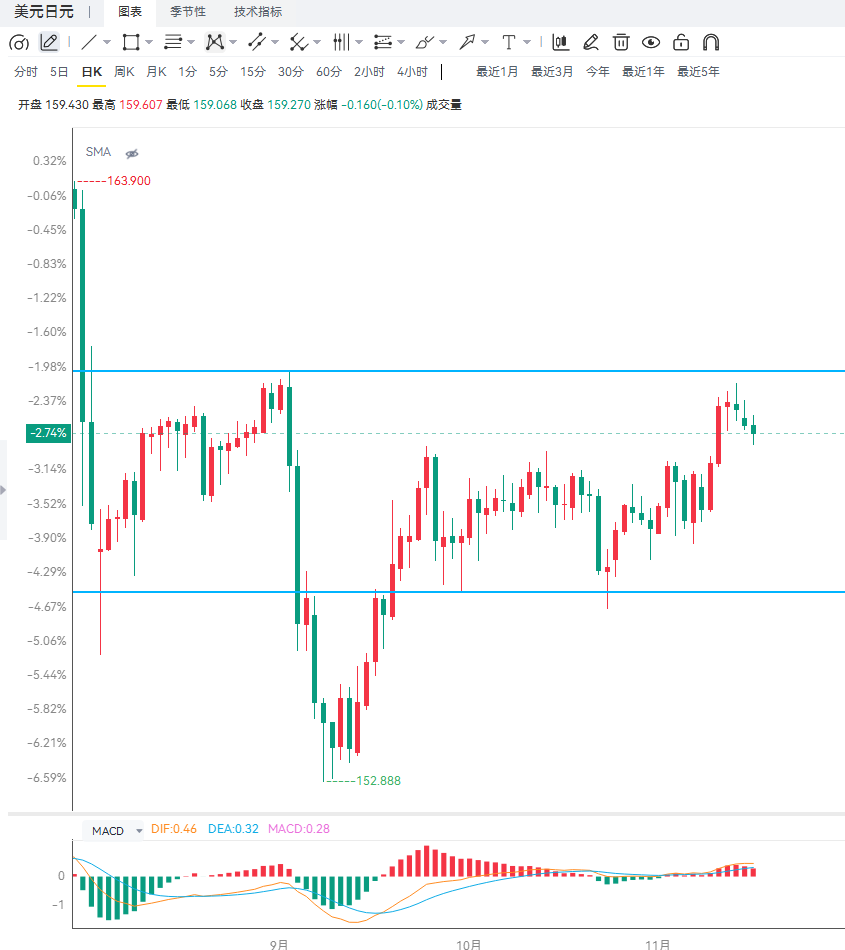 The current USD/JPY pair is in a stalemate between the bullish interest rate differential and the risk of Japanese currency intervention. High expectations of a Fed rate hike keep US Treasury yields high, supporting the exchange rate; however, the intervention threat at the 160 level, the hawkish stance of the Bank of Japan, and safe-haven demand are all boosting the yen, limiting its upside potential. The daily chart shows a healthy bullish structure, but significant risks at key levels suggest the pair is likely to enter a range-bound trading pattern awaiting guidance from retail sales data.
In the US, inflation data and hawkish comments from officials continue to push up the pricing of a Fed rate hike. CME FedWatch data shows that the probability of a 25bp rate hike at the December meeting is 95.7%, while the probability of a 50bp rate hike has fallen to 4.3%. US Treasury yields remain high, and the yield spread between the US and Japan remains the core fundamental factor supporting the medium-term upward movement of USD/JPY, creating a continuous game with intervention risks. Brown Brothers Harriman (BBH) analysis mentions that the yen is the strongest currency among the G10 currencies in this round, with safe-haven sentiment combined with intervention concerns suppressing USD/JPY below 160. The waning trading in the AI sector will further stimulate safe-haven buying of the yen. Meanwhile, Japan's economy unexpectedly stalled in the third quarter, with quarter-on-quarter growth at 0.0%, lower than the expected 0.1%. Net exports dragged down the economy, and domestic demand weakened for two consecutive quarters. This also constrains the Bank of Japan's tightening pace, meaning that the normalization of Japanese policy will be slow and gradual, and the US-Japan interest rate spread is unlikely to narrow rapidly in the medium to long term. Bank of Japan official Takata released a hawkish signal, receiving an 8.2 rating from FXS, in line with the historical average. He focused on the risk of second-degree inflation transmission, suggesting that policy rates need to move closer to a neutral level. He emphasized the transmission effect of real interest rate differentials and exchange rates on domestic prices, stating that a weak yen would amplify imported inflation, supporting the central bank's continued interest rate hikes. He also stated that rate hikes are flexible and data-dependent, without pre-setting a pace. If the market trades a more aggressive tightening by the central bank, it will further support the yen and limit the exchange rate's upside. On the daily chart, USD/JPY maintains an overall bullish tone, with the price steadily trading above the 20-day and 100-day moving averages. The medium- and long-term moving averages are trending upwards, forming a trend support zone. Currently, the price is in the upper half of the Bollinger Bands, with the upper band providing direct supply resistance. The 14-period RSI reading is 59.03, indicating robust bullish momentum, but it is still some distance from the 70 overbought level and has not yet entered the overheated zone. The trend still retains the possibility of further upward movement, although investor caution is increasing before key levels are reached. The primary resistance level is the upper Bollinger Band at 160.20, closely following the psychologically important 160 level. A break above 160.20 with significant volume would technically open up new upside potential; however, caution is advised regarding the risk of a rapid reversal due to verbal or even market intervention from Japan. The first support level is the 100-day moving average at 158.90, a crucial trendline protection level for this upward move; the second support is the middle Bollinger Band at 158.35; deeper support lies at the lower Bollinger Band at 156.50. As long as the price holds above 158.90 during a pullback, the daily bullish structure will remain intact; a decisive break below this level would signal a weakening of the current upward trend and a deeper correction. The 4-hour chart shows a slightly bullish bias, but the price action near 160 has repeatedly encountered resistance, resulting in long upper shadows and indicating selling pressure and risk aversion. The indicators haven't shown a clear bearish divergence, so it's not appropriate to immediately conclude a top. The market is more likely to fluctuate within the 158.90-160 range, awaiting the direction provided by tonight's US retail sales data. If the US consumer data is stronger than expected, US Treasury yields will rise, and the exchange rate may test the 160 level; if the consumer data is weaker than expected, the US dollar index will pull back, and USD/JPY will likely retrace to its moving average support. The current USD/JPY pair is in a stalemate between the bullish interest rate differential and the risk of Japanese currency intervention. High expectations of a Fed rate hike keep US Treasury yields high, supporting the exchange rate; however, the intervention threat at the 160 level, the hawkish stance of the Bank of Japan, and safe-haven demand are all boosting the yen, limiting its upside potential. The daily chart shows a healthy bullish structure, but significant risks at key levels suggest the pair is likely to enter a range-bound trading pattern awaiting guidance from retail sales data.
- Risk Warning and Disclaimer
- The market involves risk, and trading may not be suitable for all investors. This article is for reference only and does not constitute personal investment advice, nor does it take into account certain users’ specific investment objectives, financial situation, or other needs. Any investment decisions made based on this information are at your own risk.