The US dollar index rose and then fell back, maintaining a bullish structure in the short term, awaiting confirmation of support.
2026-11-17 15:20:30
The US dollar index had been strengthening for some time, primarily driven by inflation data and hawkish statements from Federal Reserve officials. Following higher-than-expected inflation last week, the market is repricing the Fed's rate hike path. MUFG analysts point out that the market is now pricing in three consecutive rate hikes in December, January, and March, with the federal funds rate potentially rising to around 4.6%. This expectation continues to provide underlying support for the dollar.  Federal Reserve Chairman Hammark delivered a moderately hawkish speech, receiving a 7.1 rating from FXS, slightly below the historical average of 7.6. She argued that inflation was deviating from its target, price diffusion pressures were rising, businesses were more likely to pass on costs to downstream customers, and current financial conditions were not yet constraining the economy, which could withstand further tightening. She favored a small, gradual interest rate hike, maintaining the 2% inflation target. This speech did not significantly change market expectations, and the FXS Fed Sentiment Index remained high at 147.36, continuing the hawkish tone. Kansas City Fed President Schmid took a more hawkish stance, receiving a 7.0 rating from FXS, above the historical average of 6.9. He stated that inflation was too high, controlling it was becoming increasingly difficult, and that excluding energy, inflation was still close to 3%, far from the target, indicating the Fed still had much work to do. He emphasized that policy would focus on managing aggregate demand and would not intervene in the prices of any single commodity. His speech caused the FXS Fed Sentiment Index to rise 1 point to 148.44, further solidifying market trading in a tightening cycle. The current pullback in the US dollar index is a normal consolidation after a significant rally. The hawkish pricing in fundamentals remains intact, and geopolitical risk aversion in the Middle East continues to provide support for the dollar, limiting its downside potential in the short term. The market awaits tonight's US retail sales data to verify the resilience of US consumption and re-guide the dollar's direction. On the weekly chart, the dollar index shows a clear bullish structure, with the price consistently holding above the 10-week moving average of 102.08. The moving average forms solid upward trend support, and the price is trending higher away from this support, maintaining a healthy medium-term upward channel. The weekly RSI reading is 68.46, approaching the 70 overbought level, indicating strong upward momentum. However, the bullish momentum has entered a state of expansion, making high-level consolidation and repeated back-and-forth movements likely, but this does not necessarily mean the trend will immediately turn downwards. In the short term, the pullback from the 103.70 high is likely a profit-taking correction after the surge. The key resistance level is the psychological and technical barrier of 104.00, a crucial level for this upward trend. A break above this level, if supported by fundamentals and renewed buying interest, would open up new upside potential. Conversely, repeated failures could trigger a deeper weekly pullback. The first short-term support is at 103.20, serving as the initial support level for any intraday pullback. Stronger support lies around 102.70. The core trend support is the 10-week EMA at 102.08, a key level to determine the continuation of the current bullish trend. As long as the weekly close holds above 102.08, the overall bullish pattern remains intact; a decisive break below this level would signal a weakening trend and a deeper correction. While the daily chart shows a bullish alignment of short-term moving averages, the presence of upper shadows on short-term candlesticks, coupled with high-level indicators, suggests increased volatility. In terms of trading strategy, prioritize defining the current market as a pullback and correction within an uptrend, and do not hastily conclude that it has topped out; do not chase the market at high levels, wait for a pullback to the support area before assessing buying opportunities at lower prices, and be wary of sharp fluctuations caused by data releases.
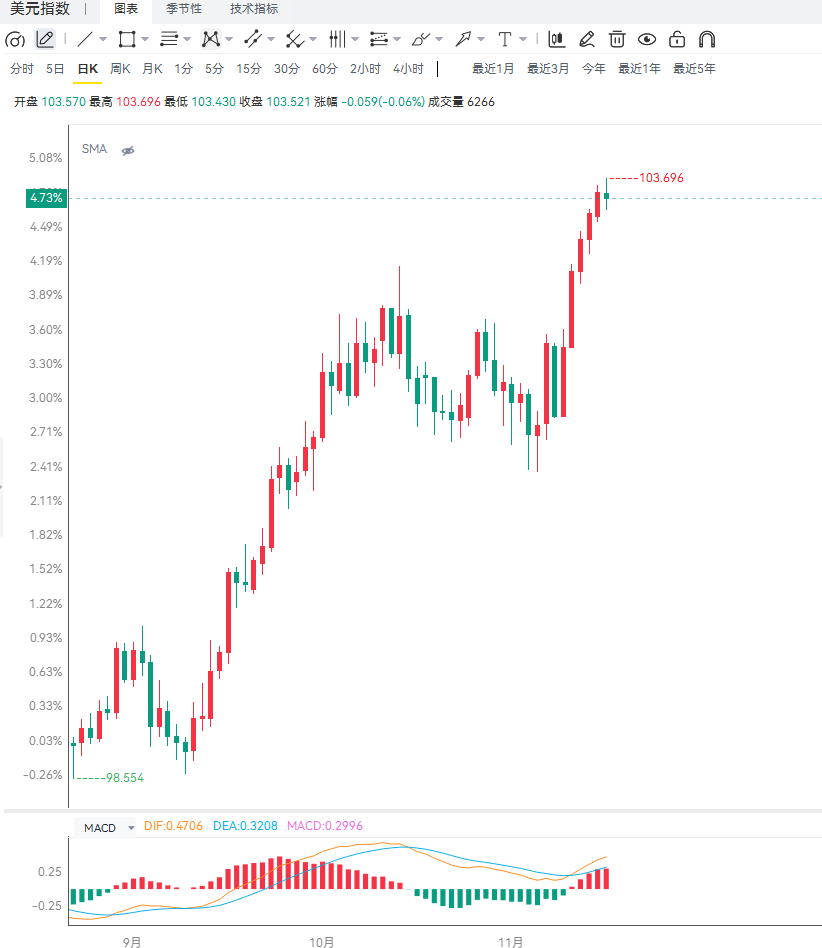 Editor's Summary: The US dollar index is currently in a consolidation phase after a strong upward trend. The core bullish factors are the collective hawkish stance of Federal Reserve officials and expectations of continued rate hikes. This pullback is mainly due to profit-taking, and the fundamental logic has not reversed. The weekly chart shows a solid bullish structure, but indicators are approaching overbought levels, suggesting potentially increased volatility. Tonight's US retail sales figures are crucial; stronger-than-expected consumer resilience will help the index challenge the 104 level; weaker consumer spending may lead to a further pullback to test support.
Federal Reserve Chairman Hammark delivered a moderately hawkish speech, receiving a 7.1 rating from FXS, slightly below the historical average of 7.6. She argued that inflation was deviating from its target, price diffusion pressures were rising, businesses were more likely to pass on costs to downstream customers, and current financial conditions were not yet constraining the economy, which could withstand further tightening. She favored a small, gradual interest rate hike, maintaining the 2% inflation target. This speech did not significantly change market expectations, and the FXS Fed Sentiment Index remained high at 147.36, continuing the hawkish tone. Kansas City Fed President Schmid took a more hawkish stance, receiving a 7.0 rating from FXS, above the historical average of 6.9. He stated that inflation was too high, controlling it was becoming increasingly difficult, and that excluding energy, inflation was still close to 3%, far from the target, indicating the Fed still had much work to do. He emphasized that policy would focus on managing aggregate demand and would not intervene in the prices of any single commodity. His speech caused the FXS Fed Sentiment Index to rise 1 point to 148.44, further solidifying market trading in a tightening cycle. The current pullback in the US dollar index is a normal consolidation after a significant rally. The hawkish pricing in fundamentals remains intact, and geopolitical risk aversion in the Middle East continues to provide support for the dollar, limiting its downside potential in the short term. The market awaits tonight's US retail sales data to verify the resilience of US consumption and re-guide the dollar's direction. On the weekly chart, the dollar index shows a clear bullish structure, with the price consistently holding above the 10-week moving average of 102.08. The moving average forms solid upward trend support, and the price is trending higher away from this support, maintaining a healthy medium-term upward channel. The weekly RSI reading is 68.46, approaching the 70 overbought level, indicating strong upward momentum. However, the bullish momentum has entered a state of expansion, making high-level consolidation and repeated back-and-forth movements likely, but this does not necessarily mean the trend will immediately turn downwards. In the short term, the pullback from the 103.70 high is likely a profit-taking correction after the surge. The key resistance level is the psychological and technical barrier of 104.00, a crucial level for this upward trend. A break above this level, if supported by fundamentals and renewed buying interest, would open up new upside potential. Conversely, repeated failures could trigger a deeper weekly pullback. The first short-term support is at 103.20, serving as the initial support level for any intraday pullback. Stronger support lies around 102.70. The core trend support is the 10-week EMA at 102.08, a key level to determine the continuation of the current bullish trend. As long as the weekly close holds above 102.08, the overall bullish pattern remains intact; a decisive break below this level would signal a weakening trend and a deeper correction. While the daily chart shows a bullish alignment of short-term moving averages, the presence of upper shadows on short-term candlesticks, coupled with high-level indicators, suggests increased volatility. In terms of trading strategy, prioritize defining the current market as a pullback and correction within an uptrend, and do not hastily conclude that it has topped out; do not chase the market at high levels, wait for a pullback to the support area before assessing buying opportunities at lower prices, and be wary of sharp fluctuations caused by data releases. Editor's Summary: The US dollar index is currently in a consolidation phase after a strong upward trend. The core bullish factors are the collective hawkish stance of Federal Reserve officials and expectations of continued rate hikes. This pullback is mainly due to profit-taking, and the fundamental logic has not reversed. The weekly chart shows a solid bullish structure, but indicators are approaching overbought levels, suggesting potentially increased volatility. Tonight's US retail sales figures are crucial; stronger-than-expected consumer resilience will help the index challenge the 104 level; weaker consumer spending may lead to a further pullback to test support.
- Risk Warning and Disclaimer
- The market involves risk, and trading may not be suitable for all investors. This article is for reference only and does not constitute personal investment advice, nor does it take into account certain users’ specific investment objectives, financial situation, or other needs. Any investment decisions made based on this information are at your own risk.