Weakening Canadian inflation coupled with declining oil prices fueled a bullish trend in the USD/CAD exchange rate.
2026-11-17 15:28:32
Statistics Canada released inflation data on Monday, showing that the October CPI rose 3.1% year-on-year, unchanged from September and below market expectations of 3.2%; the monthly CPI was 0.2%, also below the expected 0.3%. The weak inflation figures led the market to lower its forecast for further monetary tightening by the Bank of Canada, directly weakening interest rate support for the Canadian dollar. ING had previously predicted a slight rebound in Canadian CPI, but also cautioned that even a slight increase in inflation would be unlikely to push the Bank of Canada to a hawkish stance, with only a potential risk of a small rate hike in December, and a rate hike more likely to be postponed until January.  As a typical commodity currency, the Canadian dollar's performance is highly correlated with oil prices. The IEA updated its oil market balance forecast last Friday, predicting a global oil supply surplus of 1.7 million barrels per day in the fourth quarter of 2026, shifting from a previous shortage expectation to a supply easing one. This pressured oil prices downwards, further dragging down the Canadian dollar. Although ongoing tanker attacks in the Strait of Hormuz have caused geopolitical disturbances, the expectation of oversupply dominates oil price pricing, offering limited support for the Canadian dollar. On the US dollar side, Federal Reserve official Hammark released a mildly hawkish signal, receiving a 7.1 rating from FXS, slightly below the historical average of 7.6, but the overall stance remains biased towards continued tightening. She favors small, gradual rate hikes, believing that inflation is deviating from the target and that price transmission is spreading. She argues that current financial conditions are not effectively constraining the economy, and that the economy can withstand further tightening, maintaining the 2% inflation target. The FXS Fed sentiment index remains high at 147.36, with no significant shift in the hawkish tone, continuing to support the US dollar. The widening interest rate differential between the US dollar and the Canadian dollar is pushing the USD/CAD exchange rate higher. ING points out that the widening interest rate differential has pushed USD/CAD close to the October high of 1.430. A decisive break above this level would open up further technical upside potential, with the next key target at 1.450. Tuesday evening's US October retail sales data is the focus of the entire market, with expectations of a 0.2% monthly increase. Stronger-than-expected consumer data would solidify expectations of a Fed rate hike, continuing to benefit USD/CAD; weaker consumer data would pressure the dollar, leading to a pullback in the exchange rate. On the daily chart, the USD/CAD bullish structure is clear, with the price holding above the 20-day Bollinger Band and the 100-day moving average, both of which are trending upwards, forming a support zone and solidifying the bullish trend. Currently, the price is trading close to the upper Bollinger Band, indicating that this upward move has entered the upper Bollinger Band range, representing a strong acceleration phase. The 14-period RSI reading is 69.3, approaching the 70 overbought threshold, indicating strong upward momentum, but the bullish force has already reached its limit. There are two possible development paths in this situation: one is a strong breakout above the upper Bollinger Band with high volume, opening up new upward space; the other is exhaustion of momentum, triggering short-term profit-taking and a pullback. The MACD remains above the zero line, with the red bars continuing, but the expansion of the bars has slowed, indicating a weakening of the marginal upward momentum. The first immediate resistance is the upper Bollinger Band at 1.4330, which is the current core resistance level, corresponding to the previous high in October, and is a watershed between bulls and bears. If it holds above this level, it will open up upward space to 1.4500; if it encounters resistance at this level, it will trigger a profit-taking retracement. The first support is the opening pivot of today at 1.4300, which is a short-term watershed between bulls and bears; the second support is the middle Bollinger Band at 1.4095, and the third support is the 100-day moving average at 1.4045. This range is the core trend protection zone of this round of upward movement; the further structural support is at the lower Bollinger Band at 1.3855.
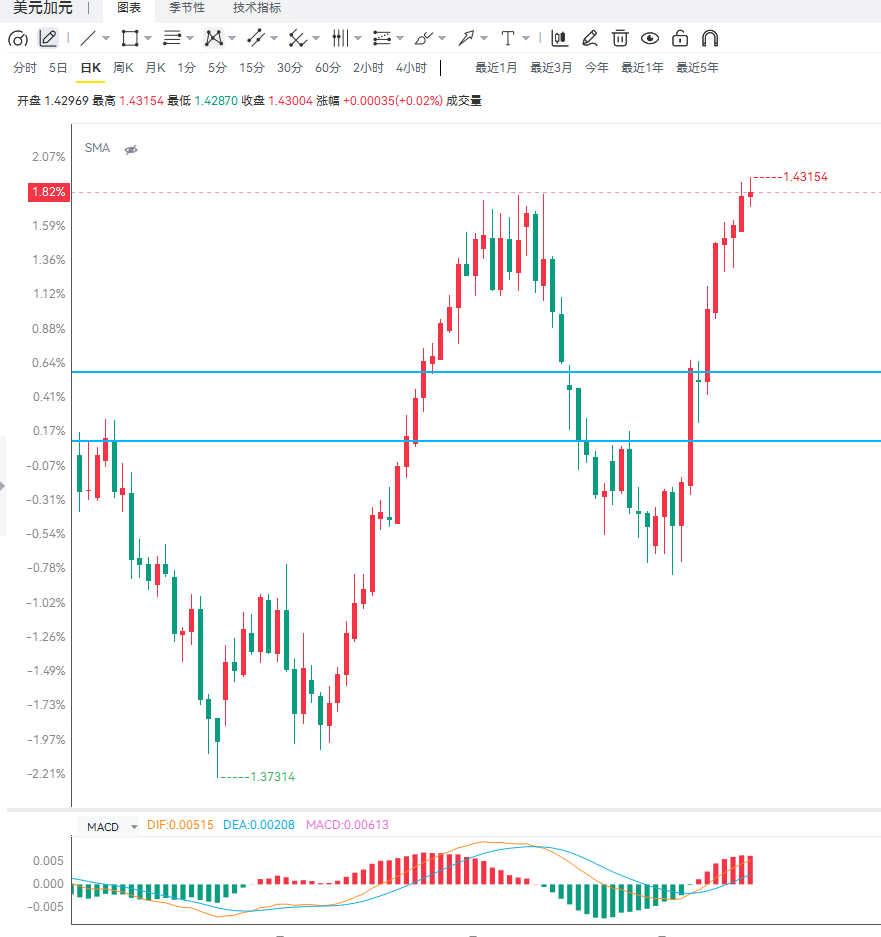 The current upward momentum in USD/CAD stems from two main factors: weakening Canadian inflation reduces expectations of a rate hike by the Canadian central bank, while weaker oil prices are weighing on the commodity currency, the Canadian dollar; simultaneously, the Federal Reserve maintains a hawkish stance, widening the USD/CAD interest rate differential and supporting the exchange rate. Technically, the bullish trend remains intact, but indicators are approaching overbought levels, increasing the risk of volatility at higher levels. Tonight's US retail sales data is a key variable; strong data could help break through the 1.4330 level, while weaker-than-expected data could trigger profit-taking at higher levels, causing the exchange rate to retrace to support levels near the moving average.
As a typical commodity currency, the Canadian dollar's performance is highly correlated with oil prices. The IEA updated its oil market balance forecast last Friday, predicting a global oil supply surplus of 1.7 million barrels per day in the fourth quarter of 2026, shifting from a previous shortage expectation to a supply easing one. This pressured oil prices downwards, further dragging down the Canadian dollar. Although ongoing tanker attacks in the Strait of Hormuz have caused geopolitical disturbances, the expectation of oversupply dominates oil price pricing, offering limited support for the Canadian dollar. On the US dollar side, Federal Reserve official Hammark released a mildly hawkish signal, receiving a 7.1 rating from FXS, slightly below the historical average of 7.6, but the overall stance remains biased towards continued tightening. She favors small, gradual rate hikes, believing that inflation is deviating from the target and that price transmission is spreading. She argues that current financial conditions are not effectively constraining the economy, and that the economy can withstand further tightening, maintaining the 2% inflation target. The FXS Fed sentiment index remains high at 147.36, with no significant shift in the hawkish tone, continuing to support the US dollar. The widening interest rate differential between the US dollar and the Canadian dollar is pushing the USD/CAD exchange rate higher. ING points out that the widening interest rate differential has pushed USD/CAD close to the October high of 1.430. A decisive break above this level would open up further technical upside potential, with the next key target at 1.450. Tuesday evening's US October retail sales data is the focus of the entire market, with expectations of a 0.2% monthly increase. Stronger-than-expected consumer data would solidify expectations of a Fed rate hike, continuing to benefit USD/CAD; weaker consumer data would pressure the dollar, leading to a pullback in the exchange rate. On the daily chart, the USD/CAD bullish structure is clear, with the price holding above the 20-day Bollinger Band and the 100-day moving average, both of which are trending upwards, forming a support zone and solidifying the bullish trend. Currently, the price is trading close to the upper Bollinger Band, indicating that this upward move has entered the upper Bollinger Band range, representing a strong acceleration phase. The 14-period RSI reading is 69.3, approaching the 70 overbought threshold, indicating strong upward momentum, but the bullish force has already reached its limit. There are two possible development paths in this situation: one is a strong breakout above the upper Bollinger Band with high volume, opening up new upward space; the other is exhaustion of momentum, triggering short-term profit-taking and a pullback. The MACD remains above the zero line, with the red bars continuing, but the expansion of the bars has slowed, indicating a weakening of the marginal upward momentum. The first immediate resistance is the upper Bollinger Band at 1.4330, which is the current core resistance level, corresponding to the previous high in October, and is a watershed between bulls and bears. If it holds above this level, it will open up upward space to 1.4500; if it encounters resistance at this level, it will trigger a profit-taking retracement. The first support is the opening pivot of today at 1.4300, which is a short-term watershed between bulls and bears; the second support is the middle Bollinger Band at 1.4095, and the third support is the 100-day moving average at 1.4045. This range is the core trend protection zone of this round of upward movement; the further structural support is at the lower Bollinger Band at 1.3855. The current upward momentum in USD/CAD stems from two main factors: weakening Canadian inflation reduces expectations of a rate hike by the Canadian central bank, while weaker oil prices are weighing on the commodity currency, the Canadian dollar; simultaneously, the Federal Reserve maintains a hawkish stance, widening the USD/CAD interest rate differential and supporting the exchange rate. Technically, the bullish trend remains intact, but indicators are approaching overbought levels, increasing the risk of volatility at higher levels. Tonight's US retail sales data is a key variable; strong data could help break through the 1.4330 level, while weaker-than-expected data could trigger profit-taking at higher levels, causing the exchange rate to retrace to support levels near the moving average.
- Risk Warning and Disclaimer
- The market involves risk, and trading may not be suitable for all investors. This article is for reference only and does not constitute personal investment advice, nor does it take into account certain users’ specific investment objectives, financial situation, or other needs. Any investment decisions made based on this information are at your own risk.