Oil prices plummet while gold prices rebound! With interest rate hike expectations weighing on prices, will gold continue to decline?
2026-11-17 17:38:32
On Tuesday (November 17th) during the Asian and European sessions, international gold prices rebounded slightly, but remained hovering near their lowest levels in over a year. Spot gold rose 0.3% to around $3847, with December US gold futures also rising. Silver, platinum, and palladium followed suit with slight gains; however, silver's fundamentals are weak, and as a high-beta variety of gold, a sustained rebound requires stabilization in gold prices. Notably, on Monday during the New York session, international oil prices fell nearly 4% due to Iran reiterating its two-day plan, but gold prices did not rebound significantly. 
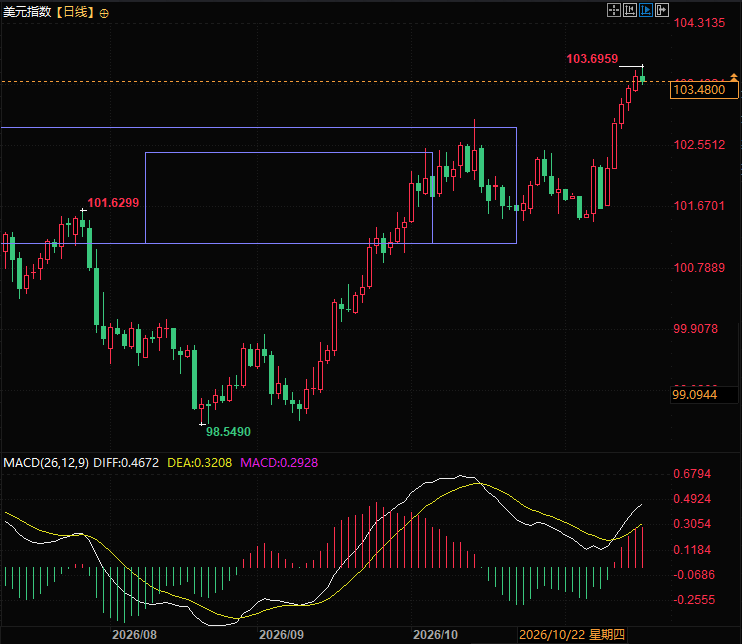 (US Dollar Index Daily Chart, Source: FX678)
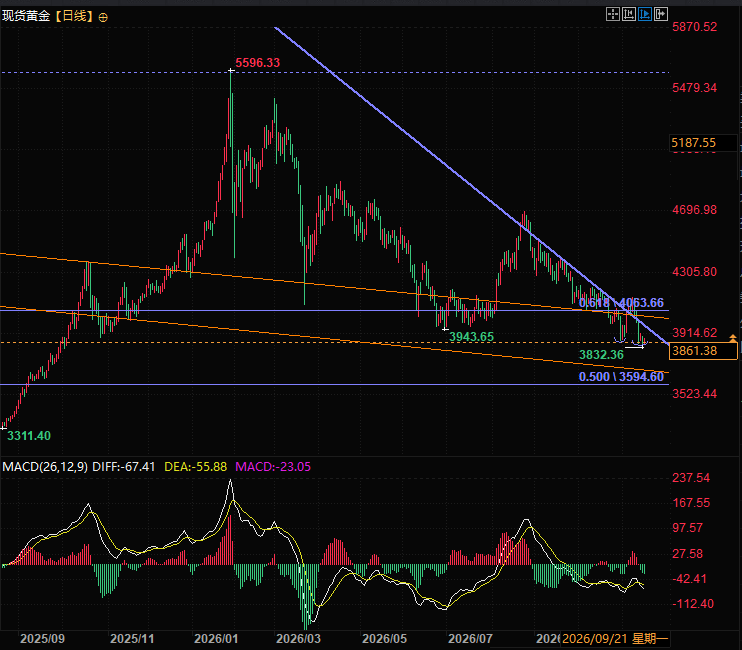 (Spot gold daily chart, source: EasyTrade) At 17:35 Beijing time, spot gold is currently trading at $3,862 per ounce.
Gold and oil price divergence signal: The sharp drop in oil prices is unlikely to drive a rebound in gold prices; inflation concerns remain.
One noteworthy market signal: oil prices plunged over 4% in the previous trading day, but gold prices did not rebound significantly. This divergence reflects that, in terms of pricing in long-term inflation, gold traders do not believe that short-term oil price fluctuations can outweigh the long-term uncertainty brought about by the geopolitical stalemate. The market consensus is that the risks in the Red Sea and the Strait of Hormuz have only eased temporarily, and the tail risks of shipping lane blockades and attacks on energy facilities have not disappeared. This persistent inflationary concern is also an important reason why central banks around the world have maintained a hawkish stance recently.Key resistance: A stronger US dollar + highly consistent expectations of a December rate hike.
The core driver of this round of gold price weakness is the strong US dollar and the rising expectations of a Federal Reserve interest rate hike. The US dollar hit a 19-month high, increasing the cost of gold for buyers outside the US dollar region. CME FedWatch data shows that the market is pricing in a 95.4% probability of a 25bp rate hike in December and a 4.6% probability of a 50bp hike. Gold does not generate interest income, so rising interest rates directly increase its opportunity cost of holding, leading to continuous capital outflows and suppressing the market. Analyst Kyle Rodda commented that the current gold market is completely anchored to the Fed's policy expectations for next year. The market is betting on the final peak of interest rates, and the sharp sell-off last night was a concentrated realization of this expectation. Today's rebound is merely a minor correction after the decline. (US Dollar Index Daily Chart, Source: FX678)Fed Signals: AI Reshaping Economic Outlook, Expectations of a Longer Interest Rate Hike Cycle
Recent statements by Federal Reserve Chairman Warsh have further amplified macroeconomic uncertainty. At a seminar, Warsh revealed that the Fed has built models to simulate multiple scenarios of AI's impact on the economy, including optimistic paths such as AI boosting productivity and achieving inflation-free growth, as well as risk scenarios such as job displacement and weaker-than-expected stock market returns dragging down the economy. He did not provide short-term interest rate guidance, but the market is already linking the narrative of AI stimulating demand, coupled with rising costs due to Middle East geopolitical tensions, to a longer rate hike cycle. Following the Fed's first rate hike in three years in September, bringing the benchmark interest rate to the 3.75%-4.00% range, and after strong inflation data, traders have begun betting on a rate hike cycle extending to 2027. The market is now focused on Wednesday's FOMC meeting minutes and tonight's US retail sales data, seeking clues about the policy path.Institutional opinions are divided: short-term pressure, central bank gold purchases provide support in the medium to long term.
Goldman Sachs' latest report lowered its gold price forecast, believing that in an environment of continued interest rate hikes by the Federal Reserve, gold will face downward pressure and increased volatility in the short term. The bank lowered its year-end 2027 gold price target from $4,800 to $4,650. The bank predicts the market will mirror the characteristics of 2022: interest rate hikes suppress private investment demand, but continued central bank gold purchases provide a floor. Goldman Sachs further points out that only when the Federal Reserve shifts to a rate-cutting cycle will gold ETF funds flow back, potentially pushing gold prices to $5,600 by the end of 2028, setting a new historical high. ANZ Bank also believes the current weakness is only temporary, and the uncertainty brought about by US fiscal and debt negotiations will continue to maintain gold's value as a risk diversification tool. However, ANZ Bank also warns of risks: although physical demand is currently resilient, the continued weakening macroeconomic environment may gradually erode investment buying, causing gold to lose key support.Sector and Annual Performance: Precious metals show divergence, with gold underperforming this year.
Gold surged over 30% in a single month at the beginning of the year, reaching a high of nearly $5,600, but has since retreated by almost 11%, potentially marking its worst annual performance in over a decade. Silver is more volatile, but its weak industrial demand makes it difficult to break out of its own price range. Platinum and palladium are affected by factors such as the transition to electric vehicles and tariff disruptions, respectively, while rising interest rates will also suppress investment demand in the precious metals sector.Summary and Technical Analysis:
Interest rate expectations are the main pricing driver for gold in the short term; any hawkish signals from the Federal Reserve are likely to trigger a new round of selling pressure. Central bank gold purchases provide medium- to long-term support, and the interplay between these two factors determines the range-bound trading pattern of gold. Before a clear signal of an interest rate cut is established, it will be difficult for the bulls to initiate a trend. In trading, priority should be given to tracking interest rate hike expectations, the US dollar, and US Treasury yields as core indicators, while also paying attention to short-term safe-haven impulses brought about by geopolitical events. Technically, the weak rebound in spot gold suggests a higher probability of further declines. Currently, the distant support level is around 3600 at the 0.500 Fibonacci retracement level. Unless this downward move stops here, and the MACD shows a short-term divergence on the daily chart, it is highly likely to continue its downward exploration. The MACD indicator also suggests a chance of further new lows. (Spot gold daily chart, source: EasyTrade) At 17:35 Beijing time, spot gold is currently trading at $3,862 per ounce.
- Risk Warning and Disclaimer
- The market involves risk, and trading may not be suitable for all investors. This article is for reference only and does not constitute personal investment advice, nor does it take into account certain users’ specific investment objectives, financial situation, or other needs. Any investment decisions made based on this information are at your own risk.